Tuesday, September 15, 2026
Hexagram 3: Difficulty at the Beginning
The Judgment
元亨利貞。勿用有攸往。利建侯。
Character Analysis
Commentary
You're at the start of something—chaos precedes order. Everything is trying to take form at once. Don't force it. Premature action wastes what's emerging. Find helpers; you can't organize this alone.
Today’s Artwork
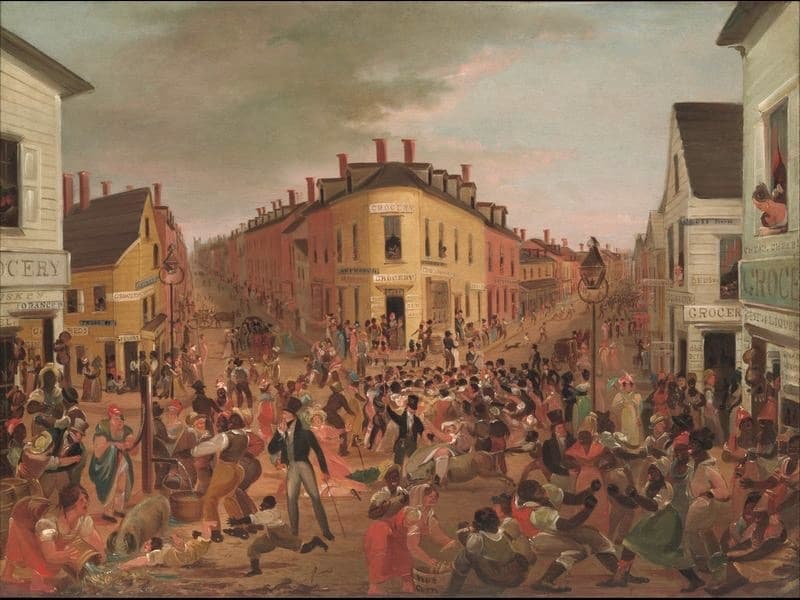
The Five Points, Unknown Artist (ca. 1827)
This watercolor depicts the Five Points, a notorious New York slum district in the 1820s. The chaotic street scene shows the difficult conditions and social disorder that characterize the early stages of breakthrough.
Difficulty at the Beginning
An unknown artist painted The Five Points around 1827, documenting a notorious New York intersection where Anthony, Orange, Cross, and Little Water Streets converged. The watercolor shows a chaotic street scene: ramshackle buildings lean against each other, laundry hangs across alleys, pigs root in muddy streets, crowds gather in doorways. This was the heart of a slum district where freed slaves, Irish immigrants, and working poor lived in dense confusion. The painting captures urban life in the moment of its messy emergence—not planned neighborhoods but shanties thrown up wherever space permitted, not orderly commerce but street vendors and grog shops and penny theaters jumbled together.
This is Zhūn (屯), which combines Water (☵) below and Thunder (☳) above. The character 屯 originally depicted a sprout struggling through hard ground, the difficulty inherent in any beginning. Thunder over Water: energy attempting movement but meeting resistance. The Five Points emerged this way—opportunity and desperation colliding, creating something new but turbulent. Zhou Dynasty diviners saw this hexagram when ventures first took form, when the meeting of opposing forces produced breakthrough but not yet clarity.
This watercolor depicts the Five Points, a notorious New York slum district in the 1820s. The chaotic street scene shows the difficult conditions and social disorder that characterize the early stages of breakthrough.
The Judgment counsels: \"Difficulty at the beginning works supreme success, furthering through perseverance. Nothing should be undertaken.\" The advice seems paradoxical—success through not undertaking—until you stand in that crowded street and recognize that forcing order onto chaos breeds more chaos. The Image Text offers different counsel: \"Clouds and thunder: the image of difficulty at the beginning. Thus the superior man brings order out of confusion.\" Not through aggressive action but through patient organization, appointing helpers, allowing structure to emerge from the situation itself. The artist documented this moment when Five Points existed but had not yet calcified into its later infamy. In the I-Ching's sequence, Zhūn comes third, after the pure yang of Qián and pure yin of Kūn—their first mixture produces this generative turbulence, the necessary difficulty when any new thing pushes into existence.
From the Forest of Changes
Yilin (焦氏易林) · 1st century BCE
兵征大宛,北出玉關。與胡寇戰,平城道西,七日絕糧,身幾不全。
The army campaigns against Dayuan, going north out through Jade Gate. Battling the Xiongnu raiders west of Pingcheng; seven days without grain, the body nearly lost.
Difficulty doubles upon itself when the hexagram transforms into its own image. Troops march against Dayuan and venture north through the Jade Gate, only to clash with nomad raiders west of Pingcheng, cut off from supplies for seven days, their lives hanging by a thread. This references the Siege of Baideng in 200 BC, when Emperor Gaozu of Han rashly pursued the Xiongnu and was encircled by Modu Chanyu's forty thousand cavalry on Baideng Mountain for seven full days without provisions. Only Chen Ping's secret stratagem, bribing the Chanyu's consort, secured the emperor's escape. Zhun unchanging intensifies its own nature: the initial difficulty is not merely encountered but compounded, and reckless advance into hostile terrain magnifies every vulnerability.