同人
Tóng Rén — Fellowship
upper trigram
乾Heaven (Strong)lower trigram
離Fire (Clinging)The Judgment
于野。亨。利涉大川。利君子貞。
Character-by-character gloss
Modern Interpretation
Fellowship in the open—success. It furthers one to cross the great water. The perseverance of the person of moral stature furthers. True fellowship must be based on universal concern, not private interest. Cliques don't count.
The Image
天與火,同人。君子以類族辨物。
Character-by-character gloss
Modern Interpretation
Heaven with fire—same direction, different natures. The person of character organizes by kind and distinguishes between things. Fellowship requires acknowledging both what unites and what differs.
天與火——同一個方向,不同的性質。有德行的人會按類別組織,同時區分事物。共同體需要認識到什麼讓我們相連,也需要認識到什麼讓我們不同。
The Six Lines
First (Bottom) Line
初九 同人于門。无咎。
Modern Interpretation
Fellowship at the gate. No blame. People meet at the entrance—the connection is beginning. No exclusive ties yet, so no blame.
Second Line
六二 同人于宗。吝。
Modern Interpretation
Fellowship within the clan. Humiliation. When fellowship narrows to only your own kind, you've already failed the universal principle. This brings regret.
Third Line
九三 伏戎于莽。升其高陵。三歲不興。
Modern Interpretation
Troops hidden in the thicket, climbing the high hill. Three years without rising. The attempt at connection through force or stealth fails completely. Years of waiting with no result.
Fourth Line
九四 乘其墉。弗克攻。吉。
Modern Interpretation
Climbing the wall, but cannot attack. Good fortune. Approaching conflict, but recognizing you can't win—and stopping. Wisdom in not attacking.
Fifth Line
九五 同人先號咷而後笑。大師克相遇。
Modern Interpretation
First weeping and lamenting, then laughing. The great army manages to meet after all. Fellowship tested by difficulty, nearly lost, finally achieved. The joy of reunion after near-separation.
Sixth (Top) Line
上九 同人于郊。无悔。
Modern Interpretation
Fellowship in the countryside. No regret. The bond forms outside the city, in the open—not as deep as it might be, but without the entanglements of closer alliance. No regret in this limited connection.
Yilin Verse
From the Forest of Changes (焦氏易林) — 同人 Tóng Rén (Fellowship)
密橐山巔,銷鋒鑄刃;示不復用,天下大勸。
Weapons sealed on the mountaintop; blades melted, edges reforged. Shown never to be used again; all under heaven is greatly inspired.
Full explanation
Heaven and fire form Fellowship, and here Fellowship returns to itself — source and target are the same hexagram. Weapons are sealed in leather bags and hidden on mountaintops; blades are melted down and recast as tools. This gesture declares to the world: arms shall not be used again, and all under heaven are greatly encouraged. The image echoes the ancient ideal of ceasing warfare to cultivate civil virtue. When Fellowship meets Fellowship, the redundancy becomes reinforcement: shared purpose so complete that even the instruments of conflict are permanently retired. Fire rises to heaven and heaven blazes with fire — pure communal illumination, with nothing left to fight over.
Masterpiece
A work of art reflecting this hexagram's essence
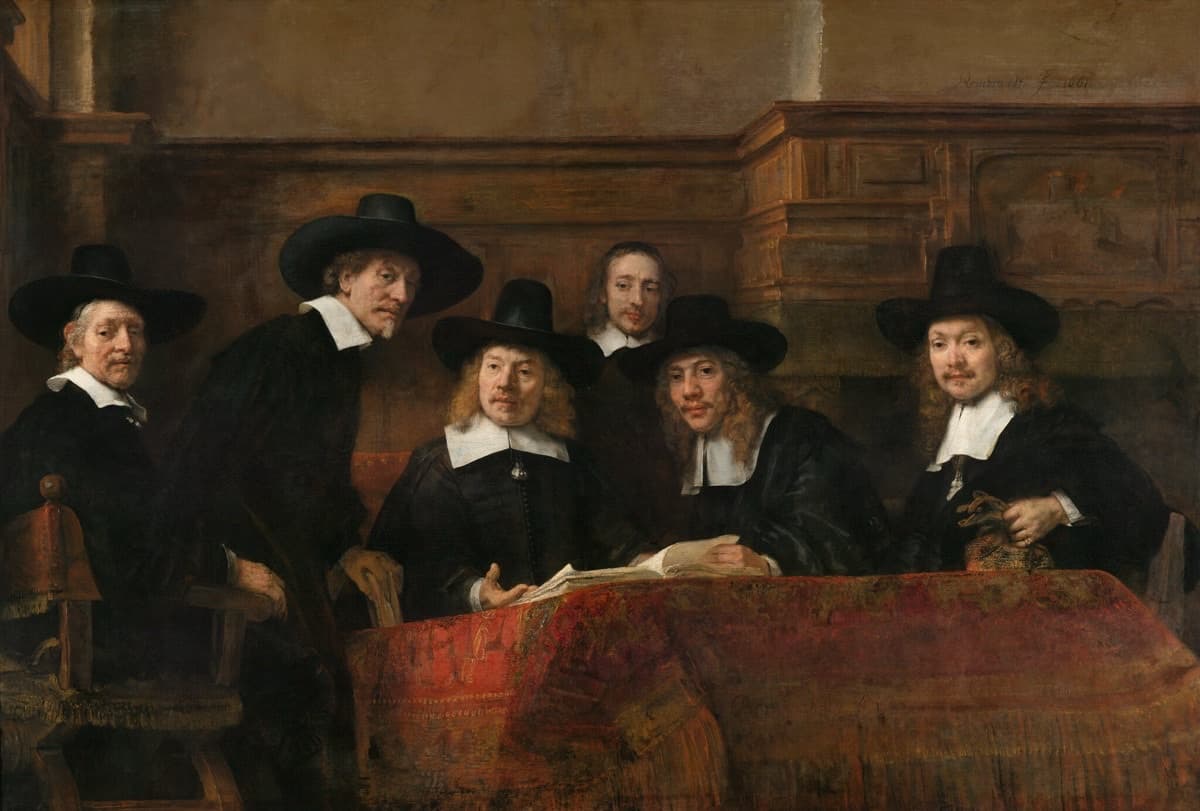
The Syndics
Rembrandt, Unknown
Rembrandt's 1662 group portrait shows five guild officials and their servant meeting around a table. The unified gathering of people working together for common purpose connects to hexagram 13's theme of fellowship with others in open space.
Wilhelm Commentary
Richard Wilhelm's classic translation and interpretation
The Judgment
True fellowship among men must be based upon a concern that is universal. It is not the private interests of the individual that create lasting fellowship among men, but rather the goals of humanity. That is why it is said that fellowship with men in the open succeeds. If unity of this kind prevails, even difficult and dangerous tasks, such as crossing the great water, can be accomplished. But in order to bring about this sort of fellowship, a persevering and enlightened leader is needed–a man with clear, convincing, and inspiring aims and the strength to carry them out. (The inner trigram means clarity; the outer, strength. )
The Image
Heaven has the same direction of movement as fire, yet it is different from fire. Just as the luminaries in the sky serve for the systematic division and arrangement of time, so human society and all things that really belong together must be organically arranged. Fellowship should not be a mere mingling of individuals or of things–that would be chaos, not fellowship. If fellowship is to lead to order, there must be organization within diversity.
First (Bottom) Line
The beginning of union among people should take place before the door. All are equally close to one another. No divergent aims have yet arisen, and one makes no mistakes. The basic principles of any kind of union must be equally accessible to all concerned. Secret agreements bring misfortune.
Second Line
There is danger here of formation of a separate faction on the basis of personal and egotistic interests. Such factions, which are exclusive and, instead of welcoming all men, must condemn one group in order to unite the others, originate from low motives and therefore lead in the course of time to humiliation.
Third Line
Here fellowship has changed about to mistrust. Each man distrusts the other, plans a secret ambush, and seeks to spy on his fellow form afar. We are dealing with an obstinate opponent whom we cannot come at by this method. Obstacles standing in the way of fellowship with others are shown here. One has mental reservations for one's own part and seeks to take his opponent by surprise. This very fact makes one mistrustful, suspecting the same wiles in his opponent and trying to ferret them out. The result is that one departs further and further from true fellowship. The longer this goes on, the more alienated one becomes.
Fourth Line
Here the reconciliation that follows quarrel moves nearer. It is true that there are still dividing walls on which we stand confronting one another. But the difficulties are too great. We get into straits, and this brings us to our senses. We cannot fight, and therein lies our good fortune.
Fifth Line
Two people are outwardly separated, but in their hearts they are united. They are kept apart by their positions in life. Many difficulties and obstructions arise between them and cause them grief. But, remaining true to each other, they allow nothing to separate them, and although it costs them a severe struggle to overcome the obstacles, they will succeed. When they come together their sadness will change to joy. Confucius says of this: Life leads the thoughtful man on a path of many windings. Now the course is checked, now it runs straight again. Here winged thoughts may pour freely forth in words, There the heavy burden of knowledge must be shut away in silence. But when two people are at one in the inmost hearts, They shatter even the strength of iron or of bronze. And when two people understand each other in their inmost hearts, Their words are sweet and strong, like the fragrance of orchids.
Sixth (Top) Line
The warm attachment that springs from the heart is lacking here. We are by this time actually outside of fellowship with others. However, we ally ourselves with them. The fellowship does not include all, but only those who happen to dwell near one another. The meadow is the pasture at the entrance to the town. At this stage, the ultimate goal of the union of mankind has not yet been attained, but we need not reproach ourselves. We join the community without separate aims of our own.