否
Pǐ — Standstill
upper trigram
乾Heaven (Strong)lower trigram
坤Earth (Yielding)The Judgment
之匪人。不利君子貞。大往小來。
Character-by-character gloss
Modern Interpretation
Evil people do not further the perseverance of the superior person. The great departs, the small approaches. Heaven and earth are out of communion—everything is numbed. What's above has no relation to what's below. Confusion and disorder prevail.
The Image
天地不交,否。君子以儉德辟難,不可榮以祿。
Character-by-character gloss
Modern Interpretation
Heaven and earth do not unite. The person of character withdraws into inner worth to escape difficulties, refusing to be honored with revenue. When inferior influence dominates, the superior retreats inward.
天地不交。有德行的人退回內在的價值,以避開困難,不讓自己被俸祿所榮耀。當低劣的影響當道,好的只能先退開。
The Six Lines
First (Bottom) Line
初六 拔茅茹。以其彙。貞吉。亨。
Modern Interpretation
Pull up the grass—it comes with roots intertwined. Perseverance brings good fortune and success. In stagnation, hold to your kind. Retreat together with the like-minded.
Second Line
六二 包承。小人吉。大人否。亨。
Modern Interpretation
Embrace and bear with things. Small people find good fortune here. The great person accepts standstill—and through acceptance, still succeeds. Endure what can't be changed.
Third Line
六三 包羞。
Modern Interpretation
Embracing shame. Inferiors attempt what they can't achieve. Their overreach contains its own humiliation. Watch them fail.
Fourth Line
九四 有命无咎。疇離祉。
Modern Interpretation
Following a higher command, no blame. Those of similar mind share in the blessing. Acting under proper authority during standstill brings no blame.
Fifth Line
九五 休否。大人吉。其亡其亡。繫于苞桑。
Modern Interpretation
Standstill ends. The great person brings good fortune. 'What if it fails? What if it fails?' Tie it to a clump of mulberry shoots. The root holds even when all seems to collapse.
Sixth (Top) Line
上九 傾否。先否後喜。
Modern Interpretation
Standstill overturns. First standstill, then joy. The obstruction finally breaks. What was blocked now flows again.
Yilin Verse
From the Forest of Changes (焦氏易林) — 否 Pǐ (Standstill)
秦為虎狼,與晉爭強;併吞其國,號曰始皇。
Qin was as wolf and tiger, contending with Jin for supremacy. Swallowing and annexing its states, it proclaimed itself First Emperor.
Full explanation
Heaven and earth stand apart, and Standstill meets its own image — Pi doubled. Qin acts as tiger and wolf, contending with the six states for supremacy, swallowing them all and proclaiming its lord the First Emperor. When Standstill encounters itself, the blockage intensifies rather than resolves. Qin's unification was achieved through total non-communication — the destruction of rival voices, the burning of books, the silencing of dissent. The First Emperor's empire is Pi's ultimate expression: heaven and earth sealed so tightly that nothing circulates. The verse captures the terrifying efficiency of doubled stagnation: order imposed by extinguishing all exchange, a peace that is merely the silence of the conquered.
Masterpiece
A work of art reflecting this hexagram's essence
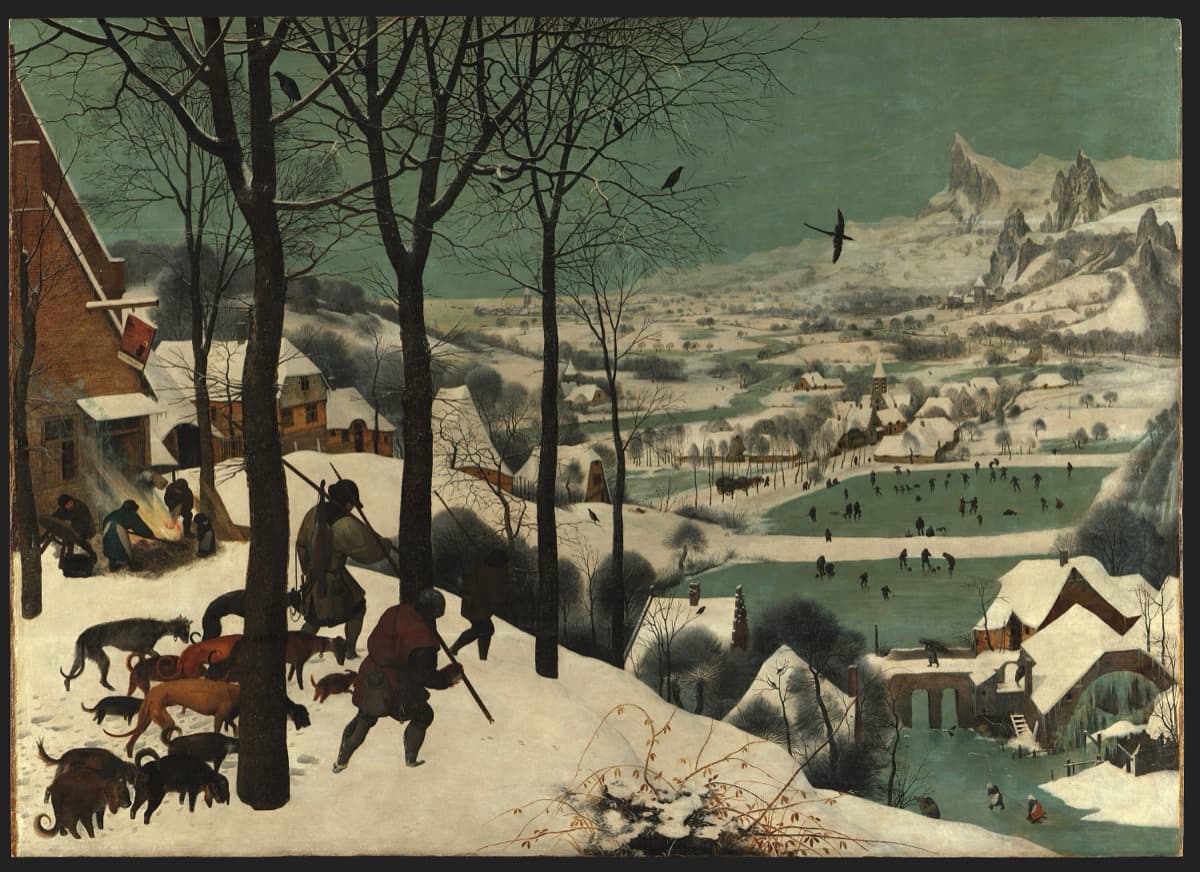
The Hunters in the Snow
Pieter Bruegel the Elder, 1565
Bruegel's winter landscape from his Months series shows hunters returning with meager catch through deep snow. The frozen landscape and stagnant village activity connect to hexagram 12's theme of standstill, where heaven and earth are disconnected and efforts yield little.
Wilhelm Commentary
Richard Wilhelm's classic translation and interpretation
The Judgment
Heaven and earth are out of communion and all things are benumbed. What is above has no relation to what is below, and on earth confusion and disorder prevail. The dark power is within, the light power is without. Weakness is within, harshness without. Within are the inferior, and without are the superior. The way of inferior people is in ascent; the way of superior people is one the decline. But the superior people do not allow themselves to be turned from their principles. If the possibility of exerting influence is closed to them, they nevertheless remain faithful to their principles and withdraw into seclusion.
The Image
When, owing to the influence of inferior men, mutual mistrust prevails in public life, fruitful activity is rendered impossible, because the fundaments are wrong. Therefore the superior man knows what he must do under such circumstances; he does not allow himself to be tempted by dazzling offers to take part in public activities. This would only expose him to danger, since he cannot assent to the meanness of the others. He therefore hides his worth and withdraws into seclusion.
First (Bottom) Line
The text is almost the same as that of the first line of the preceding hexagram, but with a contrary meaning. In the latter a man is drawing another along with him on the road to an official career; here a man is drawing another with him into retirement form public life. This is why the text says here, "Perseverance brings good fortune and success," and not "Undertakings bring good fortune. " If it becomes impossible to make our influence count, it is only by retirement that we spare ourselves humiliation. Success in a higher sense can be ours, because we know how to safeguard the value of our personalities.
Second Line
Inferior people are ready to flatter their superiors in a servile way. They would also endure the superior man if he would put an end to their confusion. This is fortunate for them. But the great man calmly bears the consequences of the standstill. He does not mingle with the crowd of the inferior; that is not his place. By his willingness to suffer personally he insures the success of his fundamental principles.
Third Line
Inferior people who have risen to power illegitimately do not feel equal to the responsibility they have taken upon themselves. In their hearts they begin to be ashamed, although at first they do not show it outwardly. This marks a turn for the better.
Fourth Line
The time of standstill is nearing the point of change into its opposite. Whoever wishes to restore order must feel himself called to the task and have the necessary authority. A man who sets himself up as capable of creating order according to his own judgment could make mistakes and end in failure. But the man who is truly called to the task is favored by the conditions of the time, and all those of like mind will share in his blessing.
Fifth Line
The time undergoes a change. The right man, able to restore order, has arrived. Hence "good fortune. " But such periods of transition are the very times in which we must fear and tremble. Success is assured only through greatest caution, which asks always, "What if it should fail?" When a mulberry bush is cut down, a number of unusually strong shoots sprout from the roots. Hence the image of tying something to a cluster of mulberry shoots is used to symbolize the way of making success certain. Confucius says about this line: Danger arises when a man feels secure in his position. Destruction threatens when a man seeks to preserve his worldly estate. Confusion develops when a man has put everything in order. Therefore the superior man does not forget danger in his security, not ruin when he is well established, nor confusion when his affairs are in order. In this way he gains personal safety and is able to protect the empire.
Sixth (Top) Line
The standstill does not last forever. However, it does not cease of its own accord; the right man is needed to end it. This is the difference between a state of peace and a state of stagnation. Continuous effort is necessary to maintain peace: left to itself it would change into stagnation and disintegration. The time of disintegration, however, does not change back automatically to a condition of peace and prosperity; effort must be put forth in order to end it. This shows the creative attitude that man must take if the world is to be put in order.