泰
Tài — Peace
upper trigram
坤Earth (Yielding)lower trigram
乾Heaven (Strong)The Judgment
小往大來。吉亨。
Character-by-character gloss
Modern Interpretation
The small departs, the great arrives. Good fortune and success. Heaven and earth unite—their powers combine in deep harmony. This is the season of flourishing. The ruler completes heaven and earth's work and aids the people.
The Image
天地交,泰。后以財成天地之道,輔相天地之宜,以左右民。
Character-by-character gloss
Modern Interpretation
Heaven and earth in communion. The ruler uses this alignment to complete what nature begins, to regulate heaven and earth's gifts for the people's benefit. Power flows to where it's needed.
天地交通。有位者裁成天地之道,輔助萬物各得其宜,讓力量流向需要的地方。這是一種疏導,不是佔有。
The Six Lines
First (Bottom) Line
初九 拔茅茹。以其彙。征吉。
Modern Interpretation
Pull up the grass—it comes with its roots intertwined. Move forward with your kind. In times of flourishing, pulling up one thing brings others along. Advance together.
Second Line
九二 包荒。用馮河。不遐遺。朋亡。得尚于中行。
Modern Interpretation
Embrace the uncultivated, cross the river boldly, don't neglect the distant, abandon partisan cliques. You gain honor by walking the middle path. Greatness requires breadth.
Third Line
九三 无平不陂。无往不復。艱貞无咎。勿恤其孚。于食有福。
Modern Interpretation
No level plain without slopes, no going without return. Hardship, but perseverance brings no blame. Don't worry about your sincerity—the blessing in food remains. Even in peace, prepare for change.
Fourth Line
六四 翩翩。不富以其鄰。不戒以孚。
Modern Interpretation
Light and quick, not wealthy but sharing with neighbors. Trust without warnings. The good descend to meet the lesser; connection happens naturally.
Fifth Line
六五 帝乙歸妹。以祉元吉。
Modern Interpretation
The emperor gives his daughter in marriage. Blessing follows. Supreme good fortune. Power marries down gracefully—this brings happiness to all.
Sixth (Top) Line
上六 城復于隍。勿用師。自邑告命。貞吝。
Modern Interpretation
The city wall falls into the moat. Don't use the army. Give orders from your own city. Perseverance brings humiliation. Peace ends. The structure collapses. Defense, not expansion.
Yilin Verse
From the Forest of Changes (焦氏易林) — 泰 Tài (Peace)
求玉陳國,留連東域;須我王孫,四月來復;主君有德,蒙恩受福。
Seeking jade in the state of Chen, lingering in the eastern lands. Awaiting our noble scion, who returns in the fourth month. The lord possesses virtue; we receive grace and blessing.
Full explanation
Peace returning to itself, earth above heaven in doubled communion. One journeys to the state of Chen seeking jade, lingering in the eastern lands. The verse then calls out: 'Wait for our prince to return — in the fourth month he shall come back.' The lord possesses virtue, and through his merit all receive blessing. Chen was famed for its jade and its ancient lineage descended from Emperor Shun. The fourth month marks the height of spring's generative power. From Peace to Peace, the pattern is self-renewing: virtue circulates without depletion, and the prince who departs on a worthy errand returns enriched, distributing fortune to all.
Masterpiece
A work of art reflecting this hexagram's essence
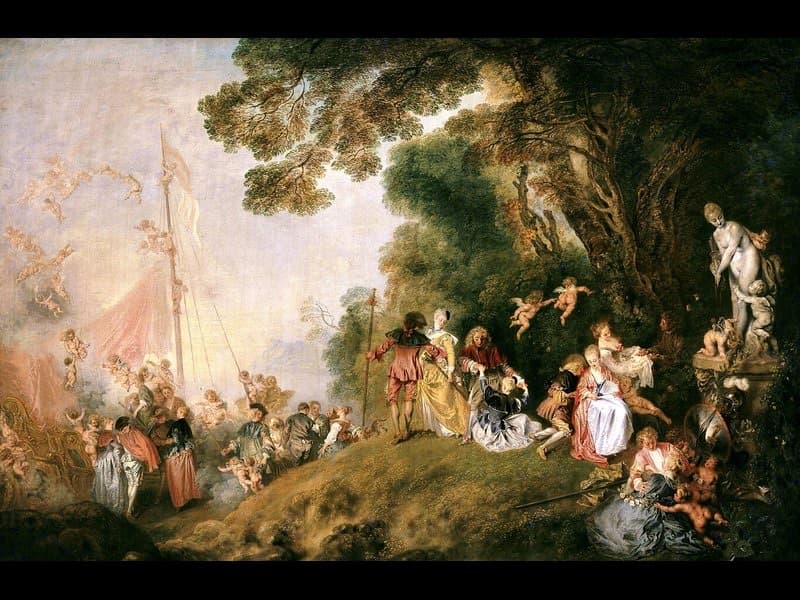
Pilgrimage to Cythera
Watteau, 1717
Watteau's painting depicts aristocratic couples departing for Cythera, the mythical island of Venus. The harmonious movement between earthly garden and divine destination reflects hexagram 11's theme of heaven and earth in communion, where all elements work together naturally.
Wilhelm Commentary
Richard Wilhelm's classic translation and interpretation
The Judgment
This hexagram denotes a time in nature when heaven seems to be on earth. Heaven has placed itself beneath the earth, and so their powers unite in deep harmony. Then peace and blessing descend upon all living things. In the world of man it is a time of social harmony; those in high places show favor to the lowly, and the lowly and inferior in their turn are well disposed toward the highly placed. There is an end to all feuds. Inside, at the center, in the key position, is the light principle; the dark principle is outside. Thus the light has a powerful influence, while the dark is submissive. In this way each receives its due. When the good elements of society occupy a central position and are in control, the evil elements come under their influence and change for the better. When the spirit of heaven rules in man, his animal nature also comes under its influence and takes its appropriate place. The individual lines enter the hexagram from below and leave it again at the top. Here the small, weak, and evil elements are about to take their departure, while the great, strong, and good elements are moving up. This brings good fortune and success.
The Image
Heaven and earth are in contact and combine their influences, producing a time of universal flowering and prosperity. This stream of energy must be regulated by the ruler of men. It is done by a process of division. Thus men divide the uniform flow of time into the seasons, according to the succession of natural phenomena, and mark off infinite space by the points of the compass. In this way nature in its overwhelming profusion of phenomena is bounded and controlled. On the other hand, nature must be furthered in her productiveness. This is done by adjusting the products to the right time and the right place, which increases the natural yield. This controlling and furthering activity of man in his relation to nature is the work on nature that rewards him.
First (Bottom) Line
In times of prosperity every able man called to fill an office draws like minded people along with him, just as in pulling up ribbon grass one always pulls up a bunch of it, because the stalks are connected by their roots. In such times, when it is possible to extend influence widely, the mind of an able man is set upon going out into life and accomplishing something.
Second Line
In times of prosperity it is important and above all to possess enough greatness of soul to bear with imperfect people. For in the hands of a great master no material is unproductive; he can find use for everything. But this generosity is by no means laxity or weakness. It is during times of prosperity especially that we must always be ready to risk even dangerous undertakings, such as the crossing of a river, if they are necessary. So too we must not neglect what is distant but must attend scrupulously to everything. Factionalism and the dominance of cliques are especially to be avoided. Even if people of like mind come forward together, they ought not to form a faction by holding together for mutual advantage; instead, each man should do is duty. These are four ways in which one can overcome the hidden danger of a gradual slackening that always lurks in any time of peace. And that is how one finds the middle way for action.
Third Line
Everything on earth is subject to change. Prosperity is followed by decline: this is the eternal law on earth. Evil can indeed be held in check but not permanently abolished. It always returns. This conviction might induct melancholy, but it should not; it ought only to keep us from falling into illusion when good fortune comes to us. If we continue mindful of the danger, we remain persevering and make no mistakes. As long as a man's inner nature remains stronger and richer than anything offered by external fortune, as long as he remains inwardly superior to fate, fortune will not desert him.
Fourth Line
In times of mutual confidence, people of high rank come in close contact with the lowly quite simply and without boasting of their wealth. This is not due to the force of circumstances but corresponds with their inmost sentiment. The approach is made quite spontaneously, because it is based on inner conviction.
Fifth Line
The sovereign I is T'ang the Completer. By his decree the imperial princesses, although higher in rank than their husbands, had to obey them like all other wives. Here too we are shown a truly modest union of high and low that brings happiness and blessings.
Sixth (Top) Line
The change alluded to in the middle of the hexagram has begun to take place. The wall of the town sinks back into the moat from which it was dug. The hour of doom is at hand. When matters have come to this pass, we should submit to fate and not try to stave it off by violent resistance. The one recourse left us is to hold our own within our intimate circle. Should we persevere in trying to resist the evil in the usual way, our collapse would only be more complete, and humiliation would be the result.