履
Lǚ — Treading
upper trigram
乾Heaven (Strong)lower trigram
兌Lake (Joyful)The Judgment
虎尾。不咥人。亨。
Character-by-character gloss
Modern Interpretation
You're stepping on the tiger's tail. It doesn't bite. Success—but only because your conduct is correct. The situation is genuinely dangerous. The weak follows the strong and worries it. Your manner, not your power, determines whether you survive.
The Image
上天下澤,履。君子以辯上下,定民志。
Character-by-character gloss
Modern Interpretation
Heaven above, lake below—natural hierarchy. The person of character discriminates between high and low, clarifying distinctions so people know where they stand. Order requires acknowledged differences.
天在上,澤在下——自然的分別。有德行的人會辨明上下的分際,讓人們知道自己的位置。秩序需要被認可的差異,但這差異要基於內在的價值,不是任意的安排。
The Six Lines
First (Bottom) Line
初九 素履往。无咎。
Modern Interpretation
Simple conduct, going forward plainly. No blame. When you act without pretension, staying within your natural sphere, you move safely.
Second Line
九二 履道坦坦。幽人貞吉。
Modern Interpretation
The path is level and smooth. The solitary person finds good fortune through perseverance. Steady and unassuming progress on a clear road.
Third Line
六三 眇能視。跛能履。履虎尾。咥人凶。武人為于大君。
Modern Interpretation
The one-eyed thinks he can see. The lame thinks he can walk. He treads on the tiger's tail and gets bitten. Misfortune. This is the warrior who oversteps toward the great ruler—overconfidence destroys him.
Fourth Line
九四 履虎尾。愬愬終吉。
Modern Interpretation
Treading on the tiger's tail with extreme caution—success in the end. Fear is appropriate here. Careful fear leads to good fortune.
Fifth Line
九五 夬履。貞厲。
Modern Interpretation
Resolute treading. Perseverance brings danger. You're determined, but determination alone isn't enough. The situation remains precarious despite your firmness.
Sixth (Top) Line
上九 視履考祥。其旋元吉。
Modern Interpretation
Look back at your conduct, examine the omens. If you can complete the circle with integrity, supreme good fortune.
Yilin Verse
From the Forest of Changes (焦氏易林) — 履 Lǚ (Treading)
十烏俱飛,羿得九雌;雖得淂全,且驚不危。
Ten crows fly together; Yi shoots down nine hens. Though what is gained is kept whole; there is a fright, but no real danger.
Full explanation
Treading upon itself — the hexagram doubled. Ten sun-crows fly together, and Archer Yi brings down nine, but takes only the females. Though the world survives intact, the fright was real. This directly invokes the myth of Hou Yi shooting down the nine surplus suns that were scorching the earth, leaving one to light the world. Yet the detail of 'nine females' is curious — perhaps distinguishing the docile from the dangerous, or counting only what was safely captured. From Treading to Treading, the pattern is self-referential: peril managed through precise conduct, danger averted but not forgotten. The tiger's tail was touched; the tiger did not bite.
Masterpiece
A work of art reflecting this hexagram's essence
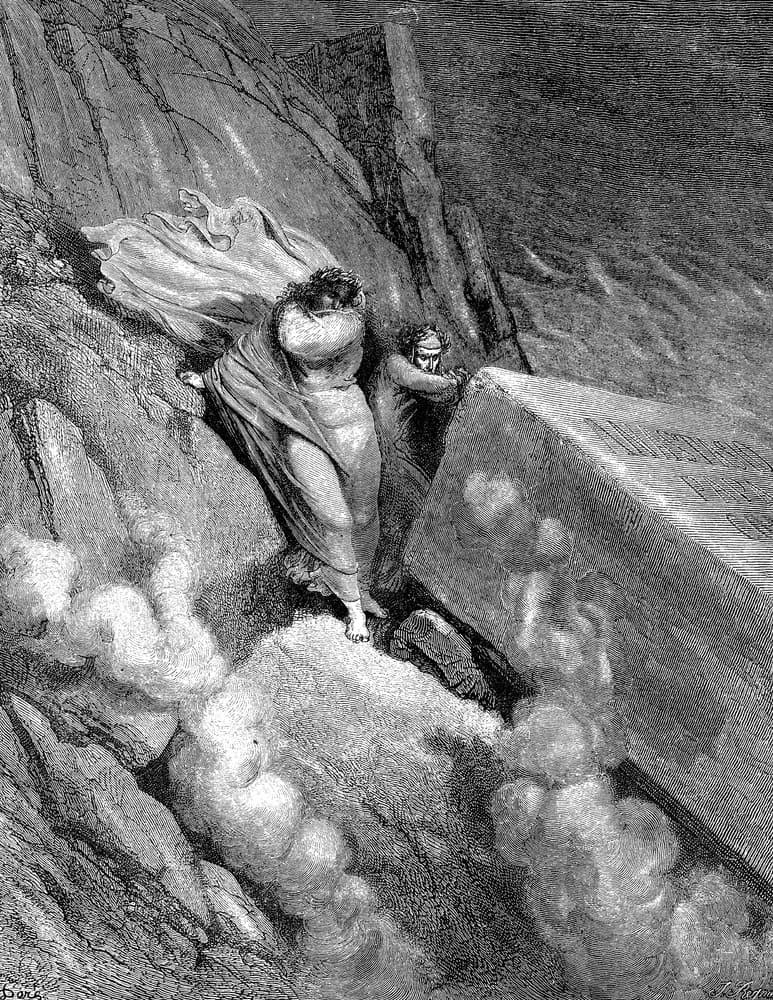
Dante and Virgil Edge of Abyss
Gustave Dore, Unknown
Doré's illustration from Dante's Inferno shows the poet and his guide navigating dangerous cliffs at the edge of an abyss. The careful, deliberate movement through perilous terrain reflects hexagram 10's theme of treading carefully in dangerous situations.
Wilhelm Commentary
Richard Wilhelm's classic translation and interpretation
The Judgment
The situation is really difficult. That which is strongest and that which is weakest are close together. The weak follows behind the strong and worries it. The strong, however, acquiesces and does not hurt the weak, because the contact is in good humor and harmless. In terms of a human situation, one is handling wild, intractable people. In such a case one's purpose will be achieved if one behaves with decorum. Pleasant manners succeed even with irritable people.
The Image
Heaven and the lake show a difference of elevation that inheres in the natures of the two, hence no envy arises. Among mankind also there are necessarily differences of elevation; it is impossible to bring about universal equality. But it is important that differences in social rank should not be arbitrary and unjust, for if this occurs, envy and class struggle are the inevitable consequences. If, on the other hand, external differences in rank correspond with differences in inner worth, and if inner worth forms the criterion of external rank, people acquiesce and order reigns in society.
First (Bottom) Line
The situation is one in which we are still not bound by any obligations of social intercourse. If our conduct is simple, we remain free of them We can quietly follow our predilections as long as we are content and make no demands on people. The meaning of the hexagram is not standstill but progress. A man finds himself in an altogether inferior position at the start. However, he has the inner strength that guarantees progress. If he can be content with simplicity, he can make progress without blame. When a man is dissatisfied with modest circumstances, he is restless and ambitious and tries to advance, not for the sake of accomplishing anything worth while, but merely in order to escape from lowliness and poverty by dint of his conduct. Once his purpose is achieved, he is certain to become arrogant and luxury-loving. Therefore blame attaches to his progress. On the other hand, a man who is good at his work is content to behave simply. He wishes to make progress in order to accomplish something. When he attains his goal, he does something worth while, and all is well.
Second Line
The situation of a lonely sage is indicated here. He remains withdrawn from the bustle of life, seeks nothing, asks nothing of anyone, and is not dazzled by enticing goals. He is true to himself and travels through life unassailed, on a level road. Since he is content and does not challenge fate, he remains free of entanglements.
Third Line
A one-eyed man can indeed see, but not enough for clear vision. A lame man can indeed tread, but not enough to make progress. If in spite of such defects a man considers himself strong and consequently exposes himself to danger, he is inviting disaster, for he is undertaking something beyond his strength. This reckless way of plunging ahead, regardless of the adequacy of one's powers, can be justified only in the case of a warrior battling for his prince.
Fourth Line
This text refers to a dangerous enterprise. The inner power to carry it through is there, but this inner power is combined with hesitating caution in one's external attitude. This line contrasts with the preceding line, which is weak within but outwardly presses forward. Here one is sure of ultimate success, which consists in achieving one's purpose, that is, in overcoming danger by going forward.
Fifth Line
This refers to the ruler of the hexagram as a whole. One sees that one has to be resolute in conduct. But at the same time one must remain conscious of the danger connected with such resoluteness, especially if it is to be persevered in. Only awareness of the danger makes success possible.
Sixth (Top) Line
The work is ended. If we want to know whether good fortune will follow, we must look back upon our conduct and its consequences. If the effects are good, then good fortune is certain. No one knows himself. It is only by the consequences of his actions, by the fruit of his labors, that a man can judge what he is to expect.