謙
Qiān — Modesty
upper trigram
坤Earth (Yielding)lower trigram
艮Mountain (Stillness)The Judgment
亨。君子有終。
Character-by-character gloss
Modern Interpretation
Modesty creates success. The person of character carries things through to completion. Heaven empties fullness and fills modesty. Earth transforms fullness and flows toward the modest. Spirits harm the full and bless the humble. Human hearts hate excess and love restraint.
The Image
地中有山,謙。君子以裒多益寡,稱物平施。
Character-by-character gloss
Modern Interpretation
A mountain hidden within earth—wealth concealed, not displayed. The person of character reduces what's too much and increases what's too little, weighing things to create balance. Modesty isn't weakness; it's accurate self-assessment.
地中有山——財富隱藏,不外露。有德行的人減少過多的,增加不足的,衡量事物以創造平衡。這種工作往往需要很長時間才能完成,但最後看起來像是自然而然的。
The Six Lines
First (Bottom) Line
初六 謙謙君子。用涉大川。吉。
Modern Interpretation
Modest and still more modest, the person of character. Use this to cross the great water. Good fortune. Humility doubled lets you attempt what arrogance cannot.
Second Line
六二 鳴謙。貞吉。
Modern Interpretation
Modesty that expresses itself. Perseverance brings good fortune. When inner modesty manifests outwardly through conduct, persistence is rewarded.
Third Line
九三 勞謙君子。有終吉。
Modern Interpretation
The person of character with merit yet modest. Carries things through to good fortune. Achievement without self-inflation—this is the complete pattern.
Fourth Line
六四 无不利撝謙。
Modern Interpretation
Nothing that does not further in demonstrating modesty. Showing humility in action—no possible disadvantage.
Fifth Line
六五 不富以其鄰。利用侵伐。无不利。
Modern Interpretation
Not wealthy, but using neighbors. Advantageous to invade and attack. Nothing that does not further. Modesty doesn't mean passivity. When action is required, the modest can still strike.
Sixth (Top) Line
上六 鳴謙。利用行師。征邑國。
Modern Interpretation
Modesty that expresses itself. Advantageous for action—marching armies, attacking cities and states. Modesty extended outward becomes effective force.
Yilin Verse
From the Forest of Changes (焦氏易林) — 謙 Qiān (Modesty)
王喬無病,苟頭不痛。亡破失履,乏我送從。
Master Wang Qiao has no ailment; Gou's head does not ache. One has lost and shattered one's shoes; I lack attendants and followers.
Full explanation
Modesty returns to itself. Wang Qiao — the immortal prince of Zhou who transcended mortality — knows no illness, and even trivial head-pains are absent. Yet the verse pivots: shoes are lost and broken, and there is no one to accompany or send off the traveler. The immortal has no bodily suffering but also no human companionship. From Modesty to Modesty, the hexagram does not transform; it echoes in place. The doubled stillness reveals both the blessing and the cost of perfect self-containment: the transcendent one is beyond pain but also beyond fellowship. When modesty meets modesty, nothing advances or connects. The mountain remains buried, complete and solitary.
Masterpiece
A work of art reflecting this hexagram's essence
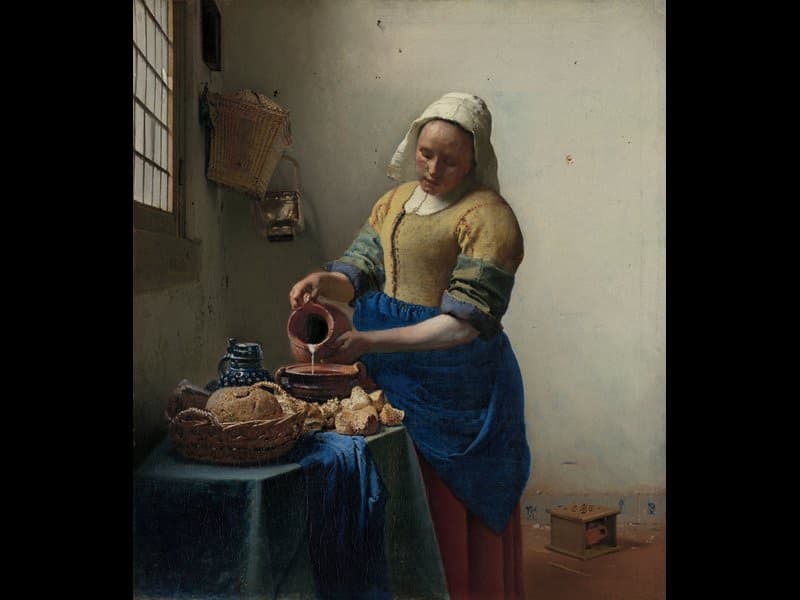
The Milkmaid
Johannes Vermeer, 1658
Vermeer's painting shows a kitchen maid pouring milk, focused on her humble task. The quiet dignity of simple domestic labor connects to hexagram 15's theme of modesty and unpretentious virtue.
Wilhelm Commentary
Richard Wilhelm's classic translation and interpretation
The Judgment
It is the law of heaven to make fullness empty and to make full what is modest; when the sun is at its zenith, it must, according to the law of heaven, turn toward its setting, and at its nadir it rises toward a new dawn. In obedience to the same law, the moon when it is full begins to wane, and when empty of light it waxes again. This heavenly law works itself out in the fates of men also. It is the law of earth to alter the full and to contribute to the modest. High mountains are worn down by the waters, and the valleys are filled up. It is the law of fate to undermine what is full and to prosper the modest. And men also hate fullness and love the modest. The destinies of men are subject to immutable laws that must fulfill themselves. But man has it in his power to shape his fate, according as his behavior exposes him to the influence of benevolent or of destructive forces. When a man holds a high position and is nevertheless modest, he shines with the light of wisdom; if he is in a lowly position and is modest, he cannot be passed by. Thus the superior man can carry out his work to the end without boasting of what he has achieved.
The Image
The wealth of the earth in which a mountain is hidden is not visible to the eye, because the depths are offset by the height of the mountain. Thus high and low competent each other and the result is the plain. Here an effect that it took a long time to achieve, but that in the end seems easy of accomplishment and self-evident, is used as the image of modesty. The superior man does the same thing when he establishes order in the world; he equalizes the extremes that are the source of social discontent and thereby creates just and equable conditions.
First (Bottom) Line
A dangerous enterprise, such as the crossing of a great stream, is made much more difficult if many claims and considerations have to be taken into account. On the other hand, the task is easy if it is attended to quickly and simply. Therefore the unassuming attitude of mind that goes with modesty fits a man to accomplish even difficult undertakings: he imposes no demands or stipulations but settles matters easily and quickly. Where no claims are put forward, no resistances arise.
Second Line
"Out of the fullness of the heart the mouth speaketh. " When a man's attitude of mind is so modest that this expresses itself in his outward behavior, it is a source of good fortune to him. For the possibility of exerting a lasting influence arises of itself and no one can interfere.
Third Line
This is the center of the hexagram, where its secret is disclosed. A distinguished name is readily earned by great achievements. If a man allows himself to be dazzled by fame, he will soon be criticized, and difficulties will arise. If, on the contrary, he remains modest despite his merit, he makes himself beloved and wins the support necessary for carrying his work through to the end.
Fourth Line
Everything has its proper measure. Even modesty in behavior can be carried too far. Here, however, it is appropriate, because the place between a worthy helper below and a kindly ruler above carries great responsibility. The confidence of the man in superior place must not be abused nor the merits of the man in inferior place concealed. There are officials who indeed do not strive for prominence; they hide behind the letter of ordinances, decline all responsibility, accept pay without giving its equivalent in work, and bear empty titles. This is the opposite of what is meant here by modesty. In such a position, modesty is shown by interest in one's work.
Fifth Line
Modesty is not to be confused with weak good nature that lets things take their own course. When a man holds a responsible position, he must at times resort to energetic measures. In doing so he must not try to make an impression by boasting of his superiority but must make certain of the people around him. The measures taken should be purely objective and in no way personally offensive. Thus modesty manifests itself even in severity.
Sixth (Top) Line
A person who is really sincere in his modesty must make it show in reality. He must proceed with great energy in this. When enmity arises nothing is easier than to lay the blame on another. A weak man takes offense perhaps, and draws back, feeling self-pity; he thinks that it is modesty that keeps him from defending himself. Genuine modesty sets one to creating order and inspires one to begin by disciplining one's own ego and one's immediate circle. Only through having the courage to marshal one's armies against oneself, will something forceful really be achieved.