豫
Yù — Enthusiasm
upper trigram
震Thunder (Movement)lower trigram
坤Earth (Yielding)The Judgment
利建侯行師。
Character-by-character gloss
Modern Interpretation
Enthusiasm. It furthers one to install helpers and set armies marching. The time is right because an eminent person acts in harmony with the spirit of the people. Energy rises and finds direction.
The Image
雷出地奮,豫。先王以作樂崇德,殷薦之上帝,以配祖考。
Character-by-character gloss
Modern Interpretation
Thunder comes bursting out of the earth. Ancient kings made music to honor merit, offering it to the Supreme Deity, inviting ancestors to be present. Enthusiasm channeled through ritual creates meaning.
雷出地奮。古代的君王作樂以崇尚德行,盛大地獻給上帝,並請祖先降臨。熱忱通過儀式被引導,創造出意義。音樂有力量化解心中的緊張,鬆開那些幽暗情緒的束縛。
The Six Lines
First (Bottom) Line
初六 鳴豫。凶。
Modern Interpretation
Enthusiasm that expresses itself. Misfortune. Enthusiasm that announces itself—showing off, calling attention—this brings bad results. Display undercuts the power.
Second Line
六二 介于石。不終日。貞吉。
Modern Interpretation
Firm as stone. Not waiting till the end of the day. Perseverance brings good fortune. Knowing when to stop before excess—recognizing limits early. This grounded awareness is correct.
Third Line
六三 盱豫悔。遲有悔。
Modern Interpretation
Looking upward for enthusiasm brings regret. Delay brings regret. Looking elsewhere for what must come from within—or hesitating when the moment requires action. Either way, regret.
Fourth Line
九四 由豫。大有得。勿疑。朋盍簪。
Modern Interpretation
The source of enthusiasm. Great achievement. No doubt—friends gather like hair clasped in a pin. You are the origin of the energy. Others collect around you naturally. Doubt has no place here.
Fifth Line
六五 貞疾。恆不死。
Modern Interpretation
Persistently ill, yet never dies. Pressure sustained indefinitely—somehow surviving without thriving. The enthusiasm meets constant resistance but endures.
Sixth (Top) Line
上六 冥豫。成有渝。无咎。
Modern Interpretation
Deluded enthusiasm. But if it changes after completion, no blame. Enthusiasm based on illusion—yet if realization comes after the action, no blame remains. You can learn from completed mistakes.
Yilin Verse
From the Forest of Changes (焦氏易林) — 豫 Yù (Enthusiasm)
冰將泮散,鳴雁噰噰;丁男長女,可以會同。生育聖人。
Ice is about to melt and scatter; geese honk in harmonious chorus. Grown men and elder daughters may now come together. They shall give birth to a sage.
Full explanation
Thunder surges from the earth as ice begins to thaw and migrating geese cry out in chorus. Young men and women may now gather together freely, and a sage shall be born. The verse celebrates the return of spring: frozen stillness gives way to movement, birdsong fills the air, and the social and biological cycles resume. The honking geese signal the season of courtship and assembly. From Enthusiasm to Enthusiasm — the hexagram returns to itself, and appropriately the verse captures the purest expression of its nature: communal joy, fertile union, cosmic renewal. When the pattern holds steady, its inherent energy simply manifests as what it always was — the earth trembling with new life.
Masterpiece
A work of art reflecting this hexagram's essence
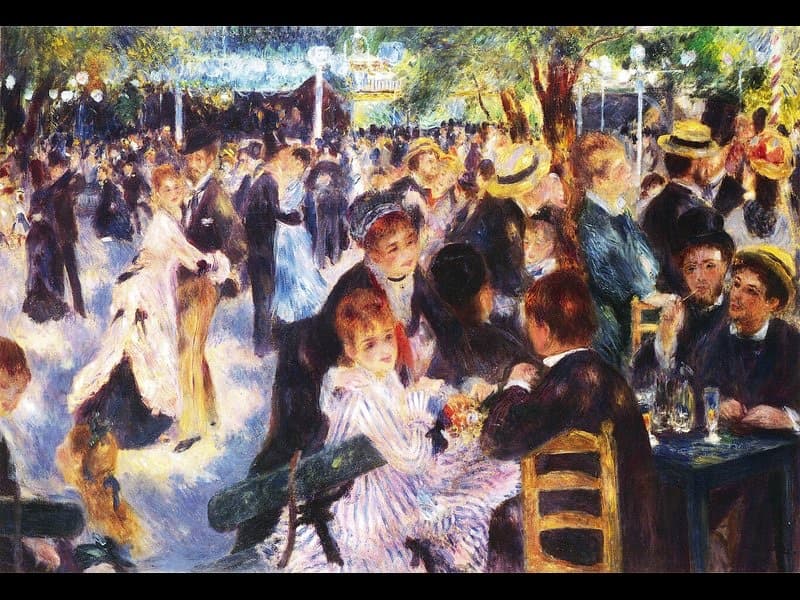
Dance at Moulin de la Galette
Renoir, 1876
Renoir's Impressionist painting captures a Sunday afternoon dance in Montmartre, with crowds enjoying music and movement in dappled sunlight. The spontaneous gathering for shared celebration connects to hexagram 16's theme of enthusiasm and harmonious response.
Wilhelm Commentary
Richard Wilhelm's classic translation and interpretation
The Judgment
The time of ENTHUSIASM derives from the fact that there is at hand an eminent man who is in sympathy with the spirit of the people and acts in accord with it. Hence he finds universal and willing obedience. To arouse enthusiasm it is necessary for a man to adjust himself and his ordinances to the character of those whom he has to lead. The inviolability of natural laws rests on this principle of movement along the line of least resistance. These laws are not forces external to things but represent the harmony of movement immanent in them. That is why the celestial bodies do not deviate from their orbits and why all events in nature occur with fixed regularity. It is the same with human society: only such laws are rooted in popular sentiment can be enforced, while laws violating this sentiment merely arouse resentment. Again, it is enthusiasm that enables us to install helpers for the completion of an undertaking without fear of secret opposition. It is enthusiasm too that can unify mass movements, as in war, so that they achieve victory.
The Image
When, at the beginning of summer, thunder–electrical energy–comes rushing forth from the earth again, and the first thunderstorm refreshes nature, a prolonged state of tension is resolved. Joy and relief make themselves felt. So too, music has power to ease tension within the heart and to loosen the grip of obscure emotions. The enthusiasm of the heart expresses itself involuntarily in a burst of song, in dance and rhythmic movement of the body. From immemorial times the inspiring effect of the invisible sound that moves all hearts, and draws them together, has mystified mankind. Rulers have made use of this natural taste for music; they elevated and regulated it. Music was looked upon as something serious and holy, designed to purify the feelings of men. It fell to music to glorify the virtues of heroes and thus to construct a bridge to the world of the unseen. In the temple men drew near to God with music and pantomimes (out of this later the theater developed). Religious feeling for the Creator of the world was united with the most sacred of human feelings, that of reverence for the ancestors. The ancestors were invited to these divine services as guests of the Ruler of Heaven and as representatives of humanity in the higher regions. This uniting of the human past with the Divinity in solemn moments of religious inspiration established the bond between God and man. The ruler who revered the Divinity in revering his ancestors became thereby the Son of Heaven, in whom the heavenly and the earthly world met in mystical contact. These ideas are the final summation of Chinese culture. Confucius has said of the great sacrifice at which these rites were performed: "He who could wholly comprehend this sacrifice could rule the world as though it were spinning on his hand. "
First (Bottom) Line
A man in an inferior position has aristocratic connections about which he boasts enthusiastically. This arrogance inevitably invites misfortune. Enthusiasm should never be an egotistic emotion; it is justified only when it is a general feeling that unites one with others.
Second Line
This describes a person who does not allow himself to be misled by any illusions. While others are letting themselves be dazzled by enthusiasm, he recognizes with perfect clarity the first signs of the time. Thus he neither flatters those above nor neglects those beneath him; he is as firm as a rock. When the first sign of discord appears, he knows the right moment for withdrawing and does not delay even for a day. Perseverance in such conduct will bring good fortune. Confucius says about this line: To know the seeds, that is divine indeed. In his association with those above him, the superior man does not flatter. In his association with those beneath him, he is not arrogant. For he knows the seeds. The seeds are the first imperceptible beginning of movement, the first trace of good fortune (or misfortune) that shows itself. The superior man perceives the seeds and immediately takes action. He does not wait even a whole day. In the Book of Changes it is said: "Firm as a rock. Not a whole day. Perseverance brings good fortune. " Firm as a rock, what need of a whole day? The judgment can be known. The superior man knows what is hidden and what is evident. He knows weakness, he knows strength as well. Hence the myriads look up to him.
Third Line
This line is the opposite of the preceding one: the latter bespeaks self-reliance, while here there is enthusiastic looking up to a leader. If a man hesitates too long, this also will bring remorse. The right moment for approach must be seized: only then will he do the right thing.
Fourth Line
This describes a man who is able to awaken enthusiasm through his own sureness and freedom from hesitation. He attracts people because he has no doubts and is wholly sincere. Owing to his confidence in them he wins their enthusiastic co-operation and attains success. Just as a clasp draws the hair together and holds it, so he draws men together by the support he gives them.
Fifth Line
Here enthusiasm is obstructed. A man is under constant pressure, which prevents him from breathing freely. However, this pressure has its advantage–it prevents him from consuming his powers in empty enthusiasm. Thus constant pressure can actually serve to keep one alive.
Sixth (Top) Line
It is a bad thing for a man to let himself be deluded by enthusiasm. But if this delusion has run its course, and he is still capable of changing, then he is freed of error. A sober awakening from false enthusiasm is quite possible and very favorable.