隨
Suí — Following
upper trigram
兌Lake (Joyful)lower trigram
震Thunder (Movement)The Judgment
元亨利貞。无咎。
Character-by-character gloss
Modern Interpretation
Supreme success. Perseverance furthers. No blame. To gain followers, first learn to follow. To lead, first serve. Only by adapting to others do you earn their joyful support.
The Image
澤中有雷,隨。君子以嚮晦入宴息。
Character-by-character gloss
Modern Interpretation
Thunder in the middle of the lake—energy resting within stillness. At nightfall, go indoors for rest. The wise person knows when to stop pushing and allow recovery. Following the natural rhythm.
「澤中有雷,隨。君子以嚮晦入宴息。」雷藏在湖底,是冬天的雷,休息中的雷。天黑了就該回家。這道理簡單到有點可笑——但多少人捨不得停下來?適應節奏,不是懶惰,是一種清醒。
The Six Lines
First (Bottom) Line
初九 官有渝。貞吉。出門交有功。
Modern Interpretation
Standards change. Perseverance brings good fortune. Going out and engaging with others yields results. Something shifts in the rules; stay true to principle while adapting to the change.
Second Line
六二 係小子。失丈夫。
Modern Interpretation
If you cling to the small child, you lose the strong man. Attachment to the lesser means forfeiting the greater. Choose carefully what you follow.
Third Line
六三 係丈夫。失小子。隨有求得。利居貞。
Modern Interpretation
If you cling to the strong man, you lose the small child. Following has gains—but always costs. What you seek, you find. Settle into what you've chosen.
Fourth Line
九四 隨有獲。貞凶。有孚在道以明。何咎。
Modern Interpretation
Following brings gain. Perseverance brings misfortune. But if you remain sincere and clear about your path—what blame? Success through following can corrupt if you lose your own direction.
Fifth Line
九五 孚于嘉。吉。
Modern Interpretation
Sincere in the excellent. Good fortune. When your allegiance aligns with what's genuinely good, fortune follows naturally.
Sixth (Top) Line
上六 拘係之。乃從維之。王用亨于西山。
Modern Interpretation
Bound and tied, then truly committed. The king makes offerings at Western Mountain. The deepest following requires being held fast first—then the connection becomes sacred.
Yilin Verse
From the Forest of Changes (焦氏易林) — 隨 Suí (Following)
鳥鳴東西,迎其群侶;不得自專,空返獨還。
Birds call east and west, welcoming their flock; unable to act on their own, they return alone and empty.
Full explanation
Thunder rests within the lake, and a bird calls east and west, seeking its flock. Yet it cannot take the lead on its own terms and returns alone, empty-handed. This is Following turning upon itself — the hexagram doubled, Sui meeting Sui. The bird embodies the follower who longs for community but lacks the initiative to form it: calling in all directions, it waits for others to gather rather than establishing a rallying point. From Following to Following, the lesson is recursive: pure adaptiveness without anchor becomes aimless. One who only follows can never convene; the flock the bird seeks will never assemble around a voice that offers no direction.
Masterpiece
A work of art reflecting this hexagram's essence
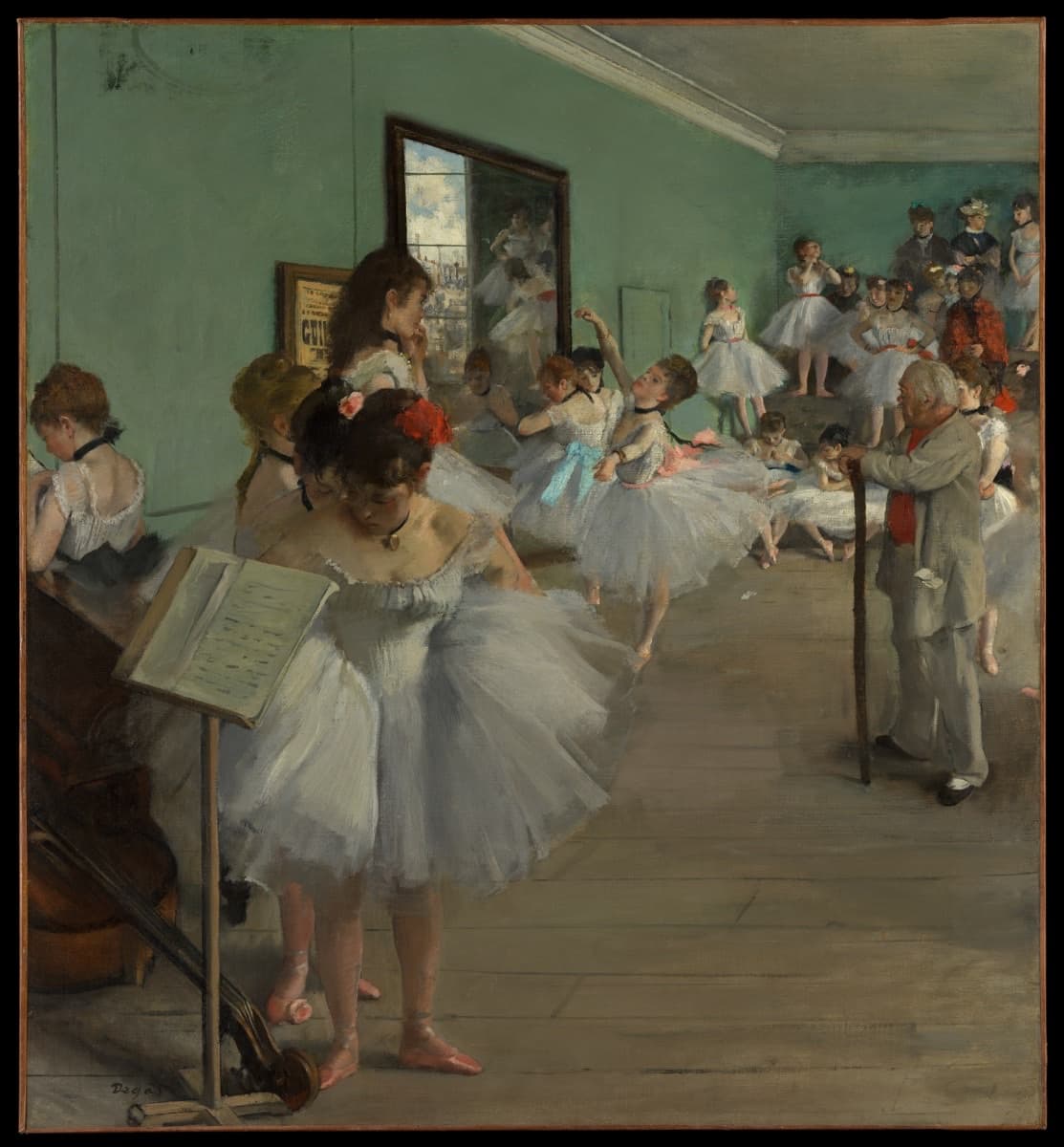
The Dance Class
Edgar Degas, 1874
Degas painted over 1,500 works featuring ballet dancers during his career, documenting the Paris Opera's rehearsal rooms. This painting shows young dancers receiving instruction from their ballet master, practicing movements that they must learn to replicate. The scene captures the relationship between teacher and students inherent to classical ballet training.
Wilhelm Commentary
Richard Wilhelm's classic translation and interpretation
The Judgment
In order to obtain a following one must first know how to adapt oneself. If a man would rule he must first learn to serve, for only in this way does he secure from those below him the joyous assent that is necessary if they are to follow him. If he has to obtain a following by force or cunning, by conspiracy or by creating factions, he invariably arouses resistance, which obstructs willing adherence. But even joyous movement can lead to evil consequences, hence the added stipulation, "Perseverance furthers"–that is, consistency in doing right–together with "No blame. " Just as we should not ask others to follow us unless this condition is fulfilled, so it is only under this condition that we can in turn follow others without coming to harm. The thought of obtaining a following through adaptation to the demands of the time is a great and significant idea; this is why the appended judgment is so favorable.
The Image
In the autumn electricity withdraws into the earth again and rests. Here it is the thunder in the middle of the lake that serves as the image–thunder in its winter rest, not thunder in motion. The idea of following in the sense of adaptation to the demands of the time grows out of this image. Thunder in the middle of the lake indicates times of darkness and rest. Similarly, a superior man, after being tirelessly active all day, allows himself rest and recuperation at night. No situation can become favorable until one is able to adapt to it and does not wear himself out with mistaken resistance.
First (Bottom) Line
There are exceptional conditions in which the relation between leader and followers changes. It is implicit in the idea of following and adaptation that if one wants to lead others, one must remain accessible and responsive to the views of those under him. At the same time, however, he must have firm principles, so that he does not vacillate where there is only a question of current opinion. Once we are ready to listen to the opinions of others, we must not associate exclusively with people who share our views or with members of our own party; instead, we must go out and mingle freely with all sorts of people, friends or foes. That is the only way to achieve something.
Second Line
In friendships and close relationships an individual must make a careful choice. He surrounds himself either with good or with bad company; he cannot have both at once. If he throws himself away on unworthy friends he loses connection with people of intellectual power who could further him in the good.
Third Line
When the right connection with distinguished people has been found, a certain loss naturally ensues. A man must part company with the inferior and superficial. But in his heart he will feel satisfied, because he seeks and needs for the development of his personality. The important thing is to remain firm. He must know what he wants and not be led astray by momentary inclinations.
Fourth Line
It often happens, when a man exerts a certain amount of influence, that he obtains a following by condescension toward inferiors. But the people who attach themselves to him are not honest in their intentions. They seek personal advantage and try to make themselves indispensable through flattery and subservience. If one becomes accustomed to such satellites and cannot do without them, it brings misfortune. Only when a man is completely free from his ego, and intent, by conviction, upon what is right and essential, does he acquire the clarity that enables him to see through such people, and become free of blame.
Fifth Line
Every man must have something he follows–something that serves him as a lodestar. He who follows with conviction the beautiful and the good may feel himself strengthened by this saying.
Sixth (Top) Line
This refers to a man, an exalted sage, who has already put the turmoil of the world behind him. But a follower appears who understands him and is not to be put off. So the sage comes back into the world and aids the other in his work. Thus there develops an eternal tie between the two. The allegory is chosen from the annals of the Chou dynasty. The rulers of this dynasty honored men who had served them well by awarding them a place in the royal family's temple of ancestors on the Western Mountain. In this way they were regarded as sharing in the destiny of the ruling family.