蠱
Gǔ — Work on the Decayed
upper trigram
艮Mountain (Stillness)lower trigram
巽Wind (Penetrating)The Judgment
元亨。利涉大川。先甲三日。後甲三日。
Character-by-character gloss
Modern Interpretation
Supreme success. It furthers one to cross the great water. Three days before the turning point, three days after. What was spoiled through neglect can be repaired through work. Deliberate carefully before and after beginning.
The Image
山下有風,蠱。君子以振民育德。
Character-by-character gloss
Modern Interpretation
Wind blows low on the mountain, spoiling vegetation. The person of character stirs the people and strengthens their spirit. Decay challenges us to renovate—both structures and souls.
「山下有風,蠱。君子以振民育德。」風吹山腳,被擋回來,把草木吹壞。這景象有點頹敗。但古人看見的是挑戰:既然壞了,就要修。先要喚醒人心,再慢慢培養品德。次序很重要。
The Six Lines
First (Bottom) Line
初六 幹父之蠱。有子。考无咎。厲終吉。
Modern Interpretation
Setting right the father's decay. If there is a son, no blame falls on the departed father. Danger, but good fortune in the end. The child corrects what the parent let slide.
Second Line
九二 幹母之蠱。不可貞。
Modern Interpretation
Setting right the mother's decay. One should not be too persistent. Gentler correction required here—rigidity would harm rather than heal.
Third Line
九三 幹父之蠱。小有悔。无大咎。
Modern Interpretation
Setting right the father's decay. Small regret, no great blame. Some friction in the repair, but nothing seriously wrong. The work proceeds.
Fourth Line
六四 裕父之蠱。往見吝。
Modern Interpretation
Tolerating the father's decay. Continuing brings humiliation. Passivity when action is required—watching the rot spread—this brings shame.
Fifth Line
六五 幹父之蠱。用譽。
Modern Interpretation
Setting right the father's decay. Meeting with praise. The correction is recognized and honored. The work earns reputation.
Sixth (Top) Line
上九 不事王侯。高尚其事。
Modern Interpretation
Not serving kings and princes. Making one's own work lofty. Some stand apart from public service to pursue higher aims. This is valid—not everyone must repair the common structures.
Yilin Verse
From the Forest of Changes (焦氏易林) — 蠱 Gǔ (Decay)
魴生江淮,一轉為百;周流天下,無有難惡。
The bream is born in rivers and streams; one fish multiplies to a hundred. Circling throughout the realm, encountering no hardship or evil.
Full explanation
Wind beneath the mountain turns upon itself — decay facing its own reflection. The bream is born in rivers and marshes; one turns into a hundred. Circulating freely through all under heaven, encountering nothing difficult or harmful. The fish multiplying effortlessly in its native waters evokes natural abundance without external intervention. When the source hexagram meets itself as target, the question becomes: can decay renew decay? The answer here is yes — through natural fertility and free circulation. From Work on the Decayed to itself, the insight is that corruption contains its own remedy when life-force flows unobstructed. The mountain's wind, rather than stagnating, circulates and regenerates.
Masterpiece
A work of art reflecting this hexagram's essence
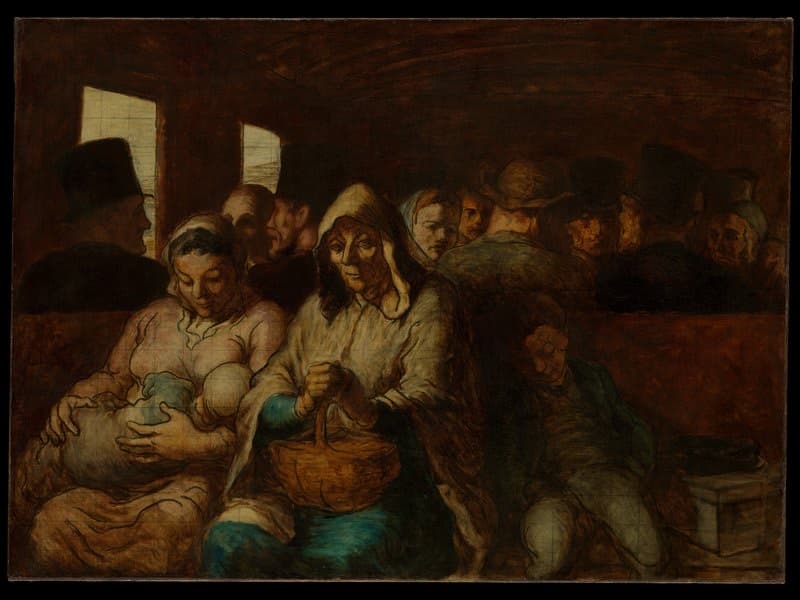
The Third-Class Carriage
Honore Daumier, 1864
Daumier, a political caricaturist and realist painter, depicted working-class Parisians in cramped railway carriages. The painting shows an elderly woman, a young mother nursing an infant, and a sleeping boy crowded together in third-class accommodations. The scene addresses the inherited conditions and social stratification of 19th-century French society.
Wilhelm Commentary
Richard Wilhelm's classic translation and interpretation
The Judgment
What has been spoiled through man's fault can be made good again through man's work. It is not immutable fate, as in the time of STANDSTILL, that has caused the state of corruption, but rather the abuse of human freedom. Work toward improving conditions promises well, because it accords the possibilities of the time. We must not recoil from work and danger–symbolized by crossing of the great water–but must take hold energetically. Success depends, however, on proper deliberation. This is expressed by the lines, "Before the starting point, three days. After the starting point, three days. " We must first know the cause of corruption before we can do away with them; hence it is necessary to be cautious during the time before the start. Then we must see to it that the new way is safely entered upon, so that a relapse may be avoided; therefore we must pay attention to the time after the start. Decisiveness and energy must take the place of the inertia and indifference that have led to decay, in order that the ending may be followed by a new beginning.
The Image
When the wind blows low on the mountain, it is thrown back and spoils the vegetation. This contains a challenge to improvement. It is the same with debasing attitudes and fashions; they corrupt human society. To do away with this corruption, the superior man must regenerate society. His methods likewise must be derived from the two trigrams, but in such a way that their effects unfold in orderly sequence. The superior man must first remove stagnation by stirring up public opinion, as the wind stirs everything, and must then strengthen and tranquillize the character of the people, as the mountain gives tranquillity and nourishment to all that grows in its vicinity.
First (Bottom) Line
Rigid adherence to tradition has resulted in decay. But the decay has not yet penetrated deeply and so can still be easily remedied. It is as if a son were compensating for the decay his father allowed to creep in. Then no blame attaches to the father. However, one must not overlook the danger or take the matter too lightly. Only if one is conscious of the danger connected with every reform will everything go well in the end.
Second Line
This refers to mistakes that as a result of weakness have brought about decay–hence the symbol, "what has been spoiled by the mother. " In setting things right in such a case, a certain gentle consideration is called for. In order not to wound, one should not attempt to proceed too drastically.
Third Line
This describes a man who proceeds a little too energetically in righting the mistakes of the past. Now and then, as a result, minor discourse and annoyances will surely develop. But too much energy is better than too little. Therefore, although he may at times have slight cause for regret, he remains free of any serious blame.
Fourth Line
This shows the situation of someone too weak to take measures against decay that has its roots in the past and is just beginning to manifest itself. It is allowed to run its course. If this continues, humiliation will result.
Fifth Line
An individual is confronted with corruption originating from neglect in former times. He lacks the power to ward it off alone, but with able helpers he can at least bring about a thorough reform, if he cannot create a new beginning, and this also is praiseworthy.
Sixth (Top) Line
Not every man has an obligation to mingle in the affairs of the world. There are some who are developed to such a degree that they are justified in letting the world go its own way and refusing to enter public life with a view to reforming it. But this does not imply a right to remain idle or to sit back and merely criticize. Such withdrawal is justified only when we strive to realize in ourselves the higher aims of mankind. For although the sage remains distant from the turmoil of daily life, he creates incomparable human values for the future.