遯
Dùn — Retreat
upper trigram
乾Heaven (Strong)lower trigram
艮Mountain (Stillness)The Judgment
亨。小利貞。
Character-by-character gloss
Modern Interpretation
Success. In small matters, persistence furthers. Hostile forces advance. This isn't the time to fight—it's the time to withdraw strategically. Retreat isn't flight. Flight is panic; retreat is strength. The key is recognizing the right moment while you still have options. Make the advance difficult through persistent small resistances while preparing your countermove.
The Image
天下有山,遯。君子以遠小人,不惡而嚴。
Character-by-character gloss
Modern Interpretation
Mountain beneath heaven—the mountain rises but cannot reach heaven's height. Keep the inferior at distance through reserve, not hatred. Hatred binds you to what you hate. Dignified distance stops the advance without creating entanglement.
「天下有山,遯。君子以遠小人,不惡而嚴。」山在天下,但永遠觸不到天。天往上退,不是因為恨山,只是保持距離。恨會把你綁住,冷淡反而自由。這道理我懂,但做起來很難。
The Six Lines
First (Bottom) Line
初六 遯尾厲。勿用有攸往。
Modern Interpretation
At the tail end of the retreat—dangerous position. Those in back face the pursuing enemy directly. Don't try anything from here. Stillness is the only escape when you're this exposed.
Second Line
六二 執之用黃牛之革。莫之勝說。
Modern Interpretation
Held fast with yellow oxhide—impossible to break free. Someone clings to you with the strength of genuine purpose. Their grip serves what's right. Let them hold; this persistence furthers the small.
Third Line
九三 係遯。有疾厲。畜臣妾吉。
Modern Interpretation
A halted retreat—nerve-wracking and dangerous. You're held back when you should be withdrawing. Take these clinging people into your service to maintain some initiative. Not ideal, but it's the only way to preserve agency.
Fourth Line
九四 好遯。君子吉。小人否。
Modern Interpretation
Voluntary retreat brings good fortune to the capable person, downfall to the dependent. Leaving willingly and friendly requires no violence to your convictions. The one who loses is whoever needed your guidance.
Fifth Line
九五 嘉遯貞吉。
Modern Interpretation
Friendly retreat. Recognize the moment to leave while amenities can still be observed. Absolute firmness of decision, but no ugly scenes. Don't be swayed by irrelevant considerations.
Sixth (Top) Line
上九 肥遯无不利。
Modern Interpretation
Cheerful retreat. Inner detachment is complete. No doubt about departure; the way ahead is clear. When you can choose what's right without further thought, everything serves your purpose.
Yilin Verse
From the Forest of Changes (焦氏易林) — 遯 Dùn (Retreat)
三塗五岳,陽城太室,神明所保,獨無兵革。
The three passes and Five Sacred Peaks; Yangcheng and Taishi Mountain. What the spirits protect and preserve; alone, free from weapons and war.
Full explanation
Heaven above the mountain remains as heaven above the mountain — Retreat doubled, the hexagram reflecting upon itself. The Three Tu passes and the Five Sacred Mountains, Yangcheng and Taishi Peak — these are the sacred precincts that the gods themselves protect, and alone they are spared the ravages of war. The Three Tu refers to the strategic mountain passes near Luoyang; Taishi is the main peak of Mount Song, the Central Sacred Mountain, near the ancient site of Yangcheng. These are the heartland of Chinese sacred geography. From Retreat to Retreat, the verse affirms that the most complete withdrawal is the mountain itself — the divine sanctuary where even armies dare not trespass. When retreat is total and principled, it becomes inviolable, a sacred space that needs no defense because its very nature forbids desecration.
Masterpiece
A work of art reflecting this hexagram's essence
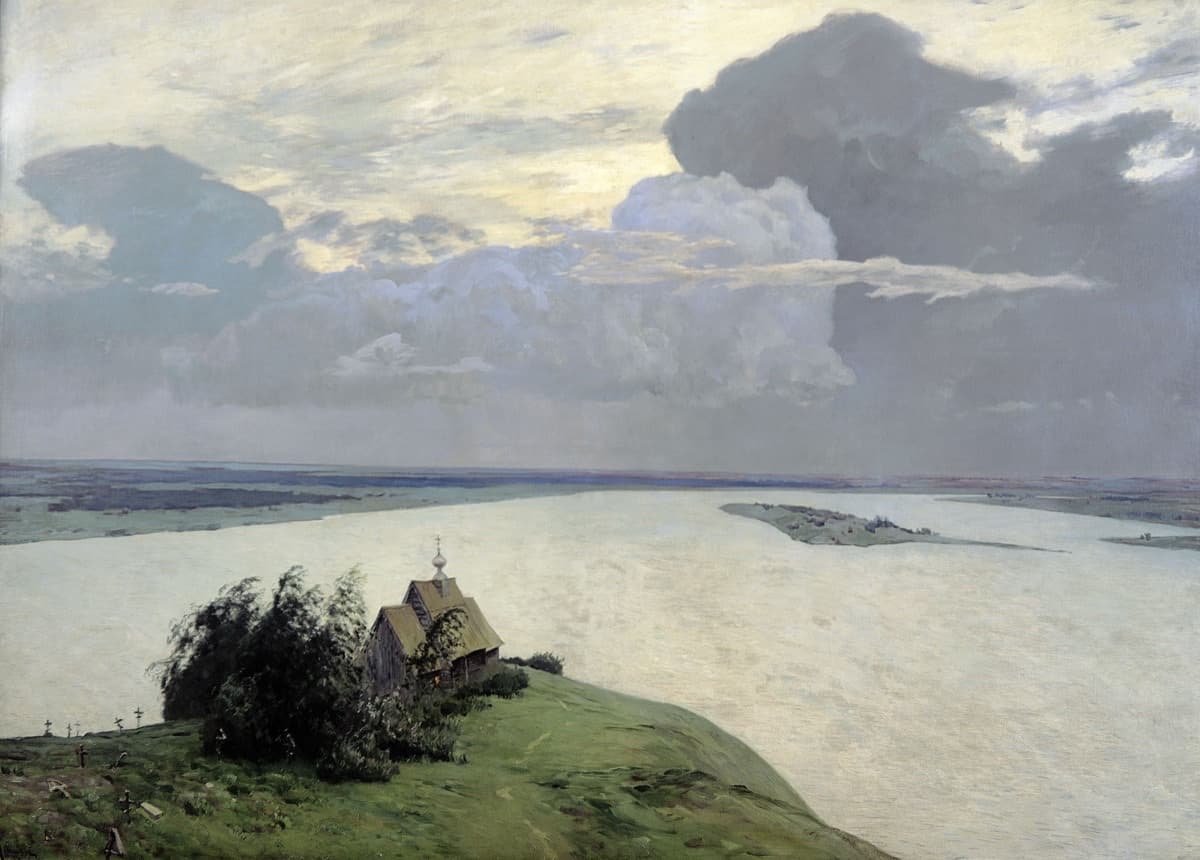
Over Eternal Peace
Isaac Levitan, 1894
Levitan's panoramic landscape depicts a vast monastery overlooking an expansive river under dramatic clouds. The painting captures withdrawal to elevated spiritual perspective, removed from worldly concerns—the essence of hexagram 33's retreat.
Wilhelm Commentary
Richard Wilhelm's classic translation and interpretation
The Judgment
Conditions are such that the hostile forces favored by the time are advancing. In this case retreat is the right course, and it is not to be confused with flight. Flight means saving oneself under any circumstances, whereas retreat is a sign of strength. We must be careful not to miss the right moment while we are in full possession of power and position. Then we shall be able to interpret the signs of the time before it is too late and to prepare for provisional retreat instead of being drawn into a desperate life-and-death struggle. Thus we do not simply abandon the field to the opponent; we make it difficult for him to advance by showing perseverance in single acts of resistance. In this way we prepare, while retreating, for the counter-movement. Understanding the laws of a constructive retreat of this sort is not easy. The meaning that lies hidden in such a time is important.
The Image
The mountain rises up under heaven, but owing to its nature it finally comes to a stop. Heaven on the other hand retreats upward before it into the distance and remains out of reach. This symbolizes the behavior of the superior man toward a climbing inferior; he retreats into his own thoughts as the inferior man comes forward. He does not hate him, for hatred is a form of subjective involvement by which we are bound to the hated object. The superior man shows strength (heaven) in that he brings the inferior man to a standstill (mountain) by his dignified reserve.
First (Bottom) Line
Since the hexagram is the picture of something that is retreating, the lowest line represents the tail and the top line the head. In a retreat it is advantageous to be at the front. Here one is at the back, in immediate contact with the pursuing enemy. This is dangerous, and under such circumstances it is not advisable to undertake anything. Keeping still is the easiest way of escaping from the threatening danger.
Second Line
Yellow is the color of the middle. It indicates that which is correct and in line with duty. Oxhide is strong and not to be torn. While the superior men retreat and the inferior press after them, the inferior man represented here holds on so firmly and tightly to the superior man that the latter cannot shake him off. And because he is in quest of what is right and so strong in purpose, he reaches his goal. Thus the line confirms what is said in the Judgment: "In what is small"–here equivalent to "in the inferior man"–"perseverance furthers. "
Third Line
When it is time to retreat it is both unpleasant and dangerous to be held back, because then one no longer has freedom of action. In such a case the only expedient is to take into one's service, so to speak, those who refuse to let one go, so that one may at least keep one's initiative and not fall helplessly under their domination. But even with this expedient the situation is far from satisfactory–for what can one hope to accomplish with such servants?
Fourth Line
In retreating the superior man is intent on taking his departure willingly and in all friendliness. He easily adjusts his mind to retreat, because in retreating he does not have to do violence to his convictions. The only one who suffers is the inferior man from whom he retreats, who will degenerate when deprived of the guidance of the superior man.
Fifth Line
It is the business of the superior man to recognize in time that the moment for retreat has come. If the right moment is chosen, the retreat can be carried out within the forms of perfect friendliness, without the necessity of disagreeable discussions. Yet, for all the observance of amenities, absolute firmness of decision is necessary if one is not to be led astray by irrelevant considerations.
Sixth (Top) Line
The situation is unequivocal. Inner detachment has become an established fact, and we are at liberty to depart. When one sees the way ahead thus clearly, free of all doubt, a cheerful mood sets in, and one chooses what is right without further thought. Such a clear path ahead always leads to the good.