恆
Héng — Duration
upper trigram
震Thunder (Movement)lower trigram
巽Wind (Penetrating)The Judgment
亨。无咎。利貞。利有攸往。
Character-by-character gloss
Modern Interpretation
Success without blame. Persistence furthers. It is favorable to have somewhere to go. Duration isn't stagnation—standing still is regression. True duration is self-renewing movement, following immutable laws, beginning fresh at every ending. Like celestial orbits, like seasons, the pattern continues because it keeps moving.
The Image
雷風,恆。君子以立不易方。
Character-by-character gloss
Modern Interpretation
Thunder and wind—extreme mobility, yet the laws governing them endure. The superior person stands firm without rigidity. What endures is the inner directive, not the external position. Change with the time while keeping the unswerving center.
雷風——極端的流動,但支配它們的規律是恆久的。君子因此「立不易方」——站穩但不僵硬。持久的是內在的方向,不是外在的位置。隨時勢變化,但不動搖的中心不變。
The Six Lines
First (Bottom) Line
初六 浚恆貞凶。无攸利。
Modern Interpretation
Seeking duration too quickly brings persistent misfortune. Nothing furthers. What lasts must be built gradually through sustained work. Demanding too much at once means achieving nothing in the end.
Second Line
九二 悔亡。
Modern Interpretation
Remorse disappears. Your character exceeds your current circumstances. Control inner strength to avoid excess. Duration makes this restraint possible.
Third Line
九三 不恆其德。或承之羞。貞吝。
Modern Interpretation
Inconsistency in character meets disgrace. Hope or fear from outside destroys inner constancy. The resulting humiliations aren't random—they're logical consequences of your own volatility.
Fourth Line
九四 田无禽。
Modern Interpretation
No game in the field. You can't catch what isn't there. Persistence alone isn't enough; you must seek in the right place. Effort misdirected wastes everything.
Fifth Line
六五 恒其德貞。婦人吉。夫子凶。
Modern Interpretation
Giving duration to character through perseverance. Good for a woman, not for a man. Holding conservatively to tradition works for some roles. Others require flexibility—doing what the moment demands rather than what was done before.
Sixth (Top) Line
上六 振恆凶。
Modern Interpretation
Restlessness as permanent state. Perpetual hurry without inner composure. This prevents thoroughness and becomes dangerous in positions of authority. Misfortune.
Yilin Verse
From the Forest of Changes (焦氏易林) — 恆 Héng (Duration)
黃帝所生,伏羲之宗,兵刀不至,利以居止。
Where the Yellow Emperor was born, the ancestral lineage of Fu Xi. Swords and blades do not reach here; it is fitting to dwell and remain.
Full explanation
Thunder above wind doubled upon itself — Duration transformed back into Duration. The Yellow Emperor's birthplace, Fuxi's ancestral lineage: this is the origin point of civilization itself. No weapons or blades reach here; it is favorable to dwell and rest. The verse names the two primordial culture-heroes whose legacies define the Chinese cosmological tradition. The Yellow Emperor brought order through invention and warfare; Fuxi devised the trigrams from observing nature. Together they represent the deepest foundation of enduring civilization. When Duration returns to Duration, the pattern is self-reinforcing: what endures is the very ground of culture. The dwelling place of these origins needs no defense because its constancy is ontological — it is the source from which all other patterns flow.
Masterpiece
A work of art reflecting this hexagram's essence
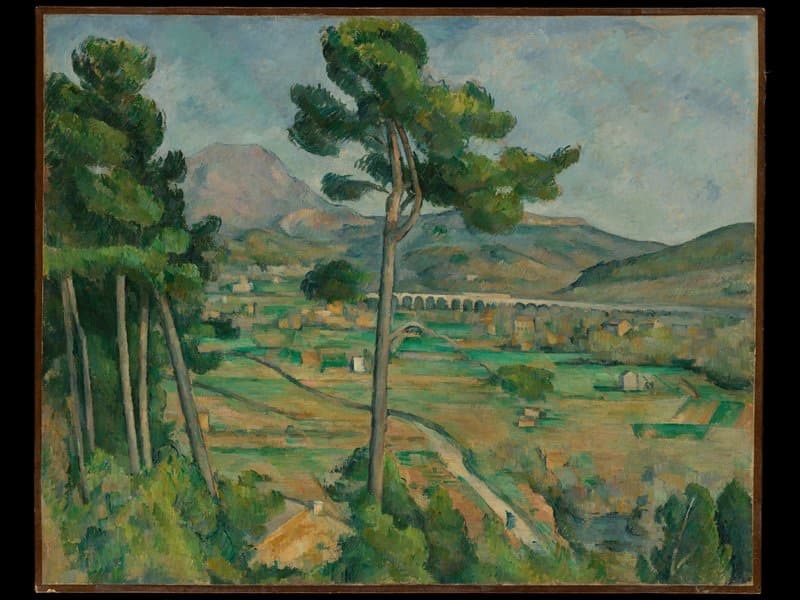
Mont Sainte-Victoire and the Viaduct of the Arc River Valley
Paul Cezanne, 1882–85
Cézanne painted Mont Sainte-Victoire repeatedly throughout his career, studying the same mountain from different perspectives over decades. The enduring presence of the mountain and the man-made viaduct demonstrate persistence through time—the hexagram's theme of duration achieved through constancy of purpose rather than force.
Wilhelm Commentary
Richard Wilhelm's classic translation and interpretation
The Judgment
Duration is a state whose movement is not worn down by hindrances. It is not a state of rest, for mere standstill is regression. Duration is rather the self- contained and therefore self-renewing movement of an organized, firmly integrated whole, taking place in accordance with immutable laws and beginning anew at every ending. The end is reached by an inward movement, by inhalation, systole, contraction, and this movement turns into a new beginning, in which the movement is directed outward, in exhalation, diastole, expansion. Heavenly bodies exemplify duration. They move in their fixed orbits, and because of this their light-giving power endures. The seasons of the year follow a fixed law of change and transformation, hence can produce effects that endure. So likewise the dedicated man embodies an enduring meaning in his way of life, and thereby the world is formed. In that which gives things their duration, we can come to understand the nature of all beings in heaven and on earth.
The Image
Thunder rolls, and the wind blows; both are examples of extreme mobility and so are seemingly the very opposite of duration, but the laws governing their appearance and subsidence, their coming and going, endure. In the same way the independence of the superior man is not based on rigidity and immobility of character. He always keeps abreast of the time and changes with it. What endures is the unswerving directive, the inner law of his being, which determines all his actions.
First (Bottom) Line
Whatever endures can be created only gradually by long-continued work and careful reflection. In the same sense Lao-tse says: "If we wish to compress something, we must first let it fully expand. " He who demands too much at once is acting precipitately, and because he attempts too much, he ends by succeeding in nothing.
Second Line
The situation is abnormal. A man's force of character is greater than the available material power. Thus he might be afraid of allowing himself to attempt something beyond his strength. However, since it is the time of DURATION, it is possible for him to control his inner strength and so to avoid excess. Cause for remorse then disappears.
Third Line
If a man remains at the mercy of moods of hope or fear aroused by the outer world, he loses his inner consistency of character. Such inconsistency invariably leads to distressing experiences. These humiliations often come from an unforeseen quarter. Such experiences are not merely effects produced by the external world, but logical consequences evoked by his own nature.
Fourth Line
If we are in pursuit of game and want to get a shot at a quarry, we must set about it in the right way. A man who persists in stalking game in a place where there is none may wait forever without finding any. Persistence in search is not enough. What is not sought in the right way is not found.
Fifth Line
A woman should follow a man her whole life long, but a man should at all times hold to what is his duty at the given moment. Should he persistently seek to conform to the woman, it would be a mistake for him. Accordingly it is altogether right for a woman to hold conservatively to tradition, but a man must always be flexible and adaptable and allow himself to be guided solely by what his duty requires of him at the moment.
Sixth (Top) Line
There are people who live in a state of perpetual hurry without ever attaining inner composure. Restlessness not only prevents all thoroughness but actually becomes a danger if it is dominant in places of authority.