睽
Kuí — Opposition
upper trigram
離Fire (Clinging)lower trigram
兌Lake (Joyful)The Judgment
小事吉。
Character-by-character gloss
Modern Interpretation
In small matters, good fortune. When people live in opposition and estrangement, they cannot undertake great things together—their views diverge too widely. Don't proceed brusquely; limit yourself to gradual effects in small matters. Opposition doesn't preclude all agreement. Polarity within a comprehensive whole has useful functions. Heaven and earth, man and woman—opposites that, reconciled, bring creation.
The Image
上火下澤,睽。君子以同而異。
Character-by-character gloss
Modern Interpretation
Fire above, lake below—never mingling, each retaining its nature. The cultured person is never led into baseness through association with others. Regardless of all commingling, preserve your individuality.
「上火下澤,睽。君子以同而異。」火往上燒,水往下流,永遠不會混在一起,各自保持本性。有教養的人也是這樣:不管跟什麼人來往,都不會被拖進庸俗裡去。在所有交融之中,保持自己的個性。
The Six Lines
First (Bottom) Line
初九 悔亡。喪馬勿逐自復。見惡人。无咎。
Modern Interpretation
Remorse disappears. If you lose your horse, don't run after it—it returns by itself. Someone temporarily estranged through misunderstanding returns if left alone. When evil people attach through misunderstanding, simply endure them. They withdraw eventually. Don't force it.
Second Line
九二 遇主于巷。无咎。
Modern Interpretation
Meeting your lord in a narrow street. No blame. Misunderstandings make proper meetings impossible. An accidental, informal encounter serves the purpose when inner affinity exists.
Third Line
六三 見輿曳。其牛掣。其人天且劓。无初有終。
Modern Interpretation
The wagon dragged back, oxen halted, a man's hair and nose cut off. Everything conspires against you. Despite the opposition, cleave to the one you know you belong with. Bad beginning, good end.
Fourth Line
九四 睽孤。遇元夫。交孚。厲无咎。
Modern Interpretation
Isolated through opposition. You meet a like-minded person you can trust completely. Despite the danger, no blame. Will achieves its aim; you become free of faults through this true connection.
Fifth Line
六五 悔亡。厥宗噬膚。往何咎。
Modern Interpretation
Remorse disappears. The companion bites through the wrappings. Going to him—how could it be a mistake? You fail to recognize a sincere person because of general estrangement. When they reveal their true character, go to meet them.
Sixth (Top) Line
上九 睽孤。見豕負塗。載鬼一車。先張之弧。後說之弧。匪寇婚媾。往遇雨則吉。
Modern Interpretation
Isolated through opposition, you see your companion as a pig covered with dirt, a wagon full of devils. First drawing a bow, then laying it aside. Not a robber—he will woo at the right time. As you go, rain falls, then good fortune. Misunderstanding reaches climax and reverses. Tension dissolves like rain after a thunderstorm.
Yilin Verse
From the Forest of Changes (焦氏易林) — 睽 Kuí (Opposition)
倉盈庾億,宜稼黍稷,年歲有息。
Granaries brimming, stores in the billions; fit for planting millet and grain. The year yields its increase.
Full explanation
Fire above the lake returning to itself — Opposition contemplating its own reflection. Yet the verse describes not discord but abundance: granaries overflow with billions of measures, the land is perfectly suited for millet and grain, and the harvest yields surplus year upon year. When Opposition meets itself, the doubled estrangement paradoxically cancels out: two mirrors facing each other reveal not infinite regression but clarity. The fire-lake tension, confronting its own nature, resolves into the recognition that opposing forces held in stable equilibrium are the very mechanism of agricultural prosperity — sun above, water below, each feeding the other. The same hexagram sustained becomes its own remedy through self-aware balance.
Masterpiece
A work of art reflecting this hexagram's essence
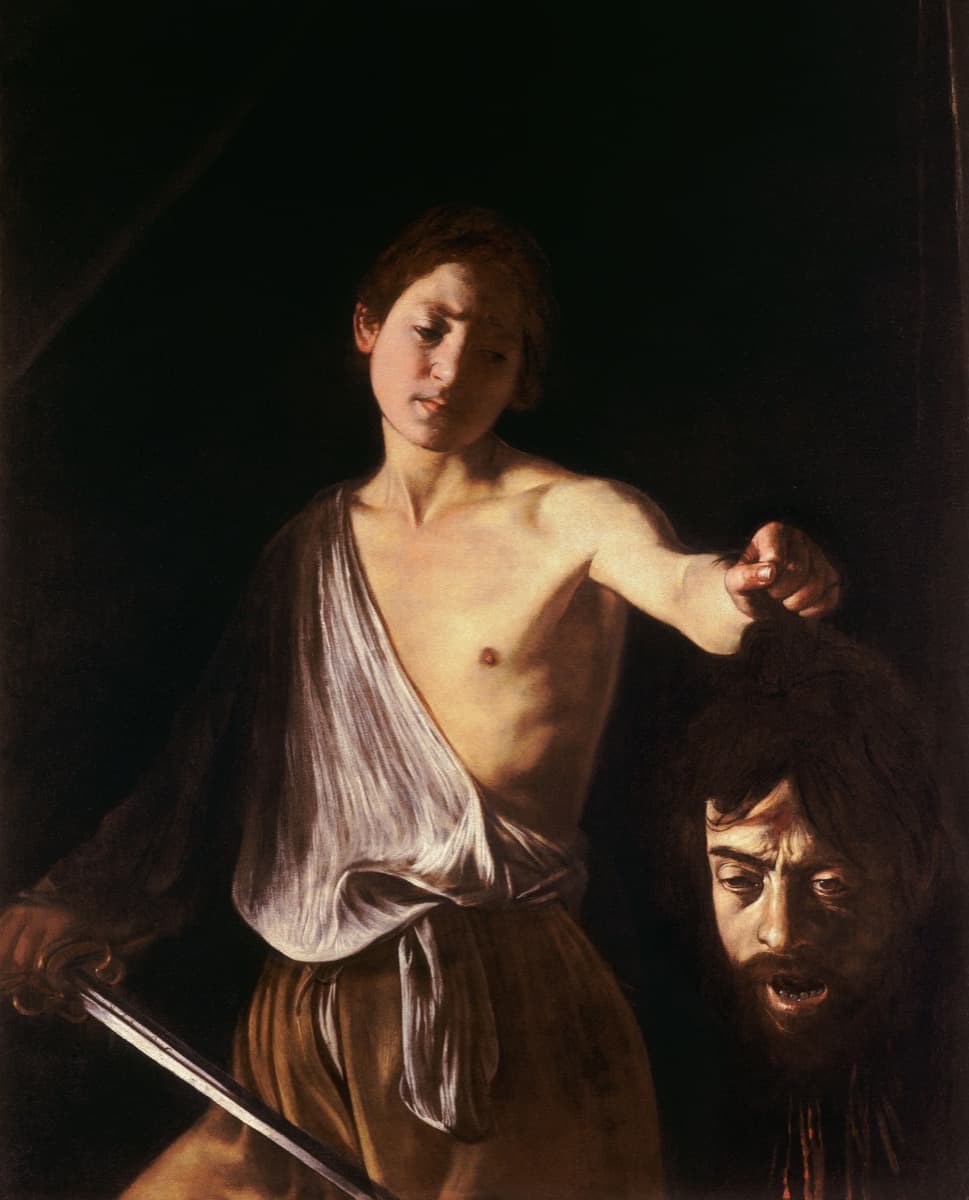
David Goliath
Caravaggio, Unknown
Caravaggio painted this dramatic work around 1599-1607 showing the young David holding the severed head of Goliath. The stark contrast between youth and giant, victory and defeat, illustrates fundamental opposition. Goliath's face may be a self-portrait, suggesting internal conflict.
Wilhelm Commentary
Richard Wilhelm's classic translation and interpretation
The Judgment
When people live in opposition and estrangement they cannot carry out a great undertaking in common; their points of view diverge too widely. In such circumstances one should above all not proceed brusquely, for that would only increase the existing opposition; instead, one should limit oneself to producing gradual effects in small matters. Here success can still be expected, because the situation is such that the opposition does not preclude all agreement. In general, opposition appears as an obstruction, but when it represents polarity within a comprehensive whole, it has also its useful and important functions. The oppositions of heaven and earth, spirit and nature, man and woman, when reconciled, bring about the creation and reproduction of life. In the world of visible things, the principle of opposites makes possible the differentiation by categories through which order is brought into the world.
The Image
The two elements, fire and water, never mingle but even when in contact retain their own natures. So the cultured man is never led into baseness or vulgarity through intercourse or community of interests with persons of another sort; regardless of all commingling, he will always preserve his individuality.
First (Bottom) Line
Even in times when oppositions prevail, mistakes can be avoided, so that remorse disappears. When opposition begins to manifest itself, a man must not try to bring about unity by force, for by so doing he would only achieve the contrary, just as a horse goes farther and farther away if one runs after it. If it is one's own horse, one can safely let it go; it will come back of its own accord. So too when someone who belongs with us is momentarily estranged because of a misunderstanding, he will return of his own accord if we leave matters to him. One the other hand, it is well to be cautious when evil men who do not belong with us force themselves upon us, again as the result of a misunderstanding. Here the important thing is to avoid mistakes. We must not try to shake off these evil men by force; this would give rise to real hostility. We must simply endure them. They will eventually withdraw of their own accord.
Second Line
As a result of misunderstandings, it has become impossible for people who by nature belong together to meet in the correct way. This being so, an accidental meeting under informal circumstances may serve the purpose, provided there is an inner affinity between them.
Third Line
Often it seems to a man as though everything were conspiring against him. He sees himself checked and hindered in his progress, insulted and dishonored. However, he must not let himself be misled; despite this opposition, he must cleave to the man with whom he knows he belongs. Thus, notwithstanding the bad beginning, the matter will end well.
Fourth Line
If a man finds himself in a company of people from whom he is separated by an inner opposition, he becomes isolated. But if in such a situation a man meets someone who fundamentally, by the very law of his being, is kin to him, and whom he can trust completely, he overcomes all the dangers of isolation. His will achieves its aim, and he becomes free of faults.
Fifth Line
Coming upon a sincere man, one fails to recognize him at first because of the general estrangement. However, he bites his way through the wrappings that are causing the separation. When such a companion thus reveals himself in his true character, it is one's duty to go to meet him and to work with him.
Sixth (Top) Line
Here the isolation is due to misunderstanding; it is brought about not by outer circumstances but by inner conditions. A man misjudges his best friends, taking them to be as unclean as a dirty pig in and as dangerous as a wagon full of devils. He adopts an attitude of defense. But in the end, realizing his mistake, he lays aside the bow, perceiving that the other is approaching with the best intentions for the purpose of close union. Thus the tension is relieved. The union resolves the tension, just as falling rain relieves the sultriness preceding a thunderstorm. All goes well, for just when opposition reaches its climax it changes over to its antithesis.