家人
Jiā Rén — The Family
upper trigram
巽Wind (Penetrating)lower trigram
離Fire (Clinging)The Judgment
利女貞。
Character-by-character gloss
Modern Interpretation
The perseverance of the woman furthers. The laws within the household, transferred to outside life, keep the state and world in order. Influence works from within outward, like wind created by fire. Each position has its proper function. Strong leadership from the head, faithful management of the center. The family is society in embryo.
The Image
風自火出,家人。君子以言有物,而行有恆。
Character-by-character gloss
Modern Interpretation
Wind comes forth from fire. Substance in words, duration in conduct. Words have power only when based on something real, pertinent to specific circumstances. General admonitions accomplish nothing. Words must be supported by consistent conduct. If words and behavior don't accord, no effect.
「風自火出,家人。君子以言有物,而行有恆。」風從火裡出來,熱量變成動力。說話要有內容,做事要有持續。空泛的話沒有用,一定要針對具體情況。而且,言行要一致——不一致的話,什麼效果都沒有。
The Six Lines
First (Bottom) Line
初九 閑有家。悔亡。
Modern Interpretation
Firm seclusion within the family. Remorse disappears. Each member knows their place from the start. Establish order before the child's will is directed elsewhere. Begin late when passions have grown strong and you'll face resistance. Breaking a child's will is easier avoided than accomplished.
Second Line
六二 无攸遂。在中饋。貞吉。
Modern Interpretation
She should not follow whims but attend within to the food. Persistence brings good fortune. Great duties exist without having to look for them. The center of social and religious life of the family. In general: seek nothing by force; confine yourself to duties at hand.
Third Line
九三 家人嗃嗃。悔厲吉。婦子嘻嘻。終吝。
Modern Interpretation
When tempers flare in the family, too great severity brings remorse. Good fortune nonetheless. Laxity leads to disgrace. Build strong dikes within which freedom of movement is allowed. In doubtful cases, err toward strictness. Discipline preserves; weakness destroys.
Fourth Line
六四 富家大吉。
Modern Interpretation
She is the treasure of the house. Great good fortune. Well-being depends on sound balance between expenditure and income. The faithful steward whose measures further general welfare.
Fifth Line
九五 王假有家。勿恤吉。
Modern Interpretation
As a king he approaches his family. Fear not. Good fortune. The fatherly person richly endowed in mind. Nothing to make himself feared—the family trusts him because love governs. Character exercises the right influence without force.
Sixth (Top) Line
上九 有孚威如。終吉。
Modern Interpretation
His work commands respect. Good fortune in the end. Order depends ultimately on the master's character. Cultivate personality until it works through inner truth. In a ruling position, assume responsibility by your own accord.
Yilin Verse
From the Forest of Changes (焦氏易林) — 家人 Jiā Rén (Family)
天命赤烏,與君徼期。征伐无道,誅其君傲,居止何憂?
Heaven commands the red bird, setting the appointed time with the lord. He campaigns against the lawless, executing their arrogant ruler. Where he dwells and rests, what worry is there?
Full explanation
Wind from fire returns to its own hearth: The Family transforms into itself. Heaven sends the Red Crow as an omen, granting the ruler a fixed appointment. He marches to punish the lawless and executes the arrogant tyrant — then settles peacefully with nothing to fear. The Red Crow (赤烏) is a celebrated portent associated with King Wu of Zhou's conquest of Shang: according to tradition, a fiery bird descended upon the king's tent as confirmation of heaven's mandate. The verse recapitulates the founding myth of proper governance: divine sanction, righteous conquest, and domestic peace. When The Family returns to itself, the message is that true household order rests on mandate from above, executed with justice, and culminating in the simple security of home.
Masterpiece
A work of art reflecting this hexagram's essence
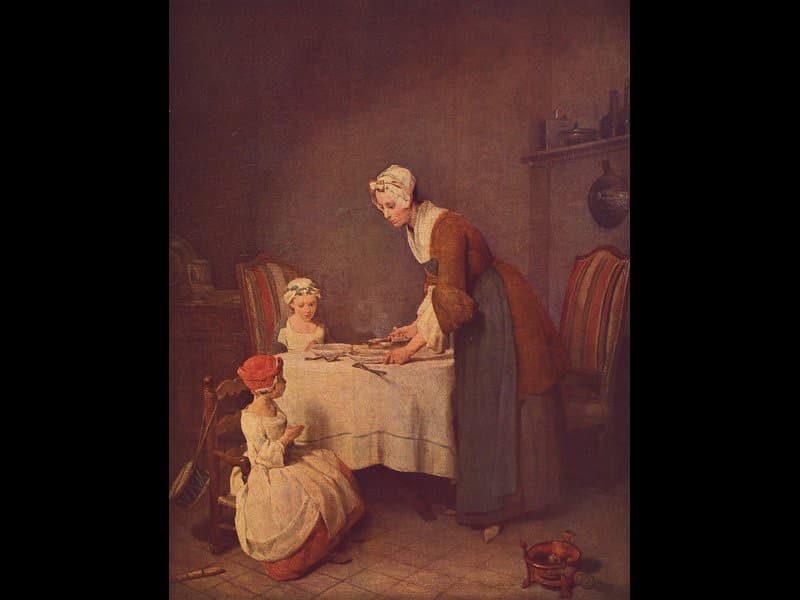
Saying Grace
Chardin, Unknown
Jean-Baptiste-Siméon Chardin painted multiple versions of this domestic scene in the 1740s showing a mother teaching her children to pray before a meal. The quiet interior depicts traditional family instruction and ritual, connecting to the hexagram's theme of the family unit and household order.
Wilhelm Commentary
Richard Wilhelm's classic translation and interpretation
The Judgment
The foundation of the family is the relationship between husband and wife. The tie that holds the family together lies in the loyalty and perseverance of the wife. The tie that holds the family together lies in the loyalty and perseverance of the wife. Her place is within (second line), while that of the husband is without (fifth line). It is in accord with the great laws of nature that husband and wife take their proper places. Within the family a strong authority is needed; this is represented by the parents. If the father is really a father and the son a son, if the elder brother fulfills his position, and the younger fulfills his, if the husband is really a husband and the wife a wife, then the family is in order. When the family is in order, all the social relationships of mankind will be in order. Three of the five social relationships are to be found within the family–that between father and son, which is the relation of love, that between the husband and wife, which is the relation of chaste conduct, and that between elder and younger brother, which is the relation of correctness. The loving reverence of the son is then carried over to the prince in the form of faithfulness to duty; the affection and correctness of behavior existing between the two brothers are extended to a friend in the form of loyalty, and to a person of superior rank in the form of deference. The family is society in embryo; it is the native soil on which performance of moral duty is made easy through natural affection, so that within a small circle a basis of moral practice is created, and this is later widened to include human relationships in general.
The Image
Heat creates energy: this is signified by the wind stirred up by the fire and issuing forth form it. This represents influence working from within outward. The same thing is needed in the regulation of the family. Here too the influence on others must proceed form one's own person. In order to be capable of producing such an influence, one's words must have power, and this they can have only if they are based on something real, just as flame depends on its fuel Words have influence only when they are pertinent and clearly related to definite circumstances. General discourses and admonitions have no effect whatsoever. Furthermore, the words must be supported by one's entire conduct, just as the wind is made effective by its duration. Only firm and consistent conduct will make such an impression on others that they can adapt and conform to it. If words and conduct are not in accord and not consistent, they will have no effect.
First (Bottom) Line
The family must form a well-defined unit within which each member knows his place. From the beginning each child must be accustomed to firmly established rules of order, before ever its will is directed to other things. If we begin too late to enforce order, when the will of the child has already been overindulged, the whims and passions, grown stronger with the years, offer resistance and give cause for remorse. If we insist on order from the outset, occasions for remorse may arise–in general social life these are unavoidable–but the remorse always disappears again, and everything rights itself. For there is nothing more easily avoided and more difficult to carry through than "breaking a child's will. "
Second Line
The wife must always be guided by the will of the master of the house, be he father, husband, or grown son. There, without having to look for them, she has great and important duties. She must attend to the nourishment of her family and to the food for the sacrifice. In this way she becomes the center of the social and religious life of the family, and her perseverance in this position brings good fortune to the whole house. In relation to general conditions, the counsel here is to seek nothing by means of force, but quietly to confine oneself to the duties at hand.
Third Line
In the family the proper mean between severity and indulgence ought to prevail. Too great severity toward one's own flesh and blood leads to remorse. The wise thing is to build strong dikes within which complete freedom of movement is allowed each individual. But in doubtful instances too great severity, despite occasional mistakes, is preferable, because it preserves discipline in the family, whereas too great weakness leads to disgrace.
Fourth Line
It is upon the woman of the house that the well-being of the family depends. Well-being prevails when expenditures and income are soundly balanced. This leads to great good fortune. In the sphere of public life, this line refers to the faithful steward whose measures further the general welfare.
Fifth Line
A king is the symbol of a fatherly man who is richly endowed in mind. He does nothing to make himself feared; on the contrary, the whole family can trust him, because love governs their intercourse. His character of itself exercises the right influence.
Sixth (Top) Line
In the last analysis, order within the family depends on the character of the master of the house. If he cultivates his personality so that it works impressively through the force of inner truth, all goes well with the family. In a ruling position one must of his own accord assume responsibility.