師
Shī — The Army
upper trigram
坤Earth (Yielding)lower trigram
坎Water (Danger)The Judgment
貞。丈人吉。无咎。
Character-by-character gloss
Modern Interpretation
The mass needs organization to become a force. This requires a strong leader—not through brutality but through character that inspires loyalty. Discipline achieved through respect, not fear. Such leadership brings good fortune without blame.
The Image
地中有水,師。君子以容民畜眾。
Character-by-character gloss
Modern Interpretation
Water hidden within the earth—the military power of a people is invisibly present in the masses. The leader of character increases this latent power through generosity, so when danger comes, every citizen becomes a soldier.
「地中有水,師。」水藏在地裡——人民的力量隱藏在眾人中間。有品格的領袖用寬厚來培養這種潛力,危難來時,人人都能變成戰士。說來容易,做起來誰知道。
The Six Lines
First (Bottom) Line
初六 師出以律。否臧凶。
Modern Interpretation
An army must set forth in proper order. If discipline breaks down at the start, the entire campaign fails. A just cause and valid orders are non-negotiable foundations.
Second Line
九二 在師中吉。无咎。王三錫命。
Modern Interpretation
The leader stays in the midst of the army, sharing hardship and fortune. Good fortune, no blame. Recognition comes naturally—the king bestows honors because they're deserved.
Third Line
六三 師或輿尸。凶。
Modern Interpretation
The army carries corpses in the wagon—defeat. This happens when someone other than the rightful leader interferes with command. Multiple authorities mean no authority.
Fourth Line
六四 師左次。无咎。
Modern Interpretation
The army retreats. No blame. Facing a superior enemy, orderly withdrawal is the only correct procedure. Knowing when not to fight is as crucial as knowing how.
Fifth Line
六五 田有禽。利執言。无咎。長子帥師。弟子輿尸。貞凶。
Modern Interpretation
Game appears in the field—now is the time to act. Let the experienced leader command. If the young and inexperienced take charge, the result is corpses. Persisting with wrong leadership brings disaster.
Sixth (Top) Line
上六 大君有命。開國承家。小人勿用。
Modern Interpretation
Victory achieved. The great prince distributes rewards, establishes order. But inferior people must not be employed in this—they'll corrupt the peace that was won.
Yilin Verse
From the Forest of Changes (焦氏易林) — 師 Shī (Army)
烏鳴呼子,哺以酒脯。高樓之處,子來歸母。穡人成功,年歲大有,妬婦無子。
The crow calls its young, feeding them wine and dried meat. In a high tower's dwelling, the child returns to its mother. The farmer succeeds; the year's harvest is great -- but the jealous wife has no child.
Full explanation
Water hidden within the earth returns to itself — the army unchanged, source and destination the same. A crow calls to its young and feeds them with wine and dried meat from a high tower, and the fledglings come home to their mother. The farmer's work succeeds, the year's harvest is abundant, yet a jealous wife remains childless. The verse layers domestic warmth against private sorrow: communal success cannot console personal barrenness. From The Army to The Army, there is no transformation — only the cycle repeating. Plenty flows for those aligned with the collective rhythm, while those consumed by envy find themselves excluded from the very abundance they covet.
Masterpiece
A work of art reflecting this hexagram's essence
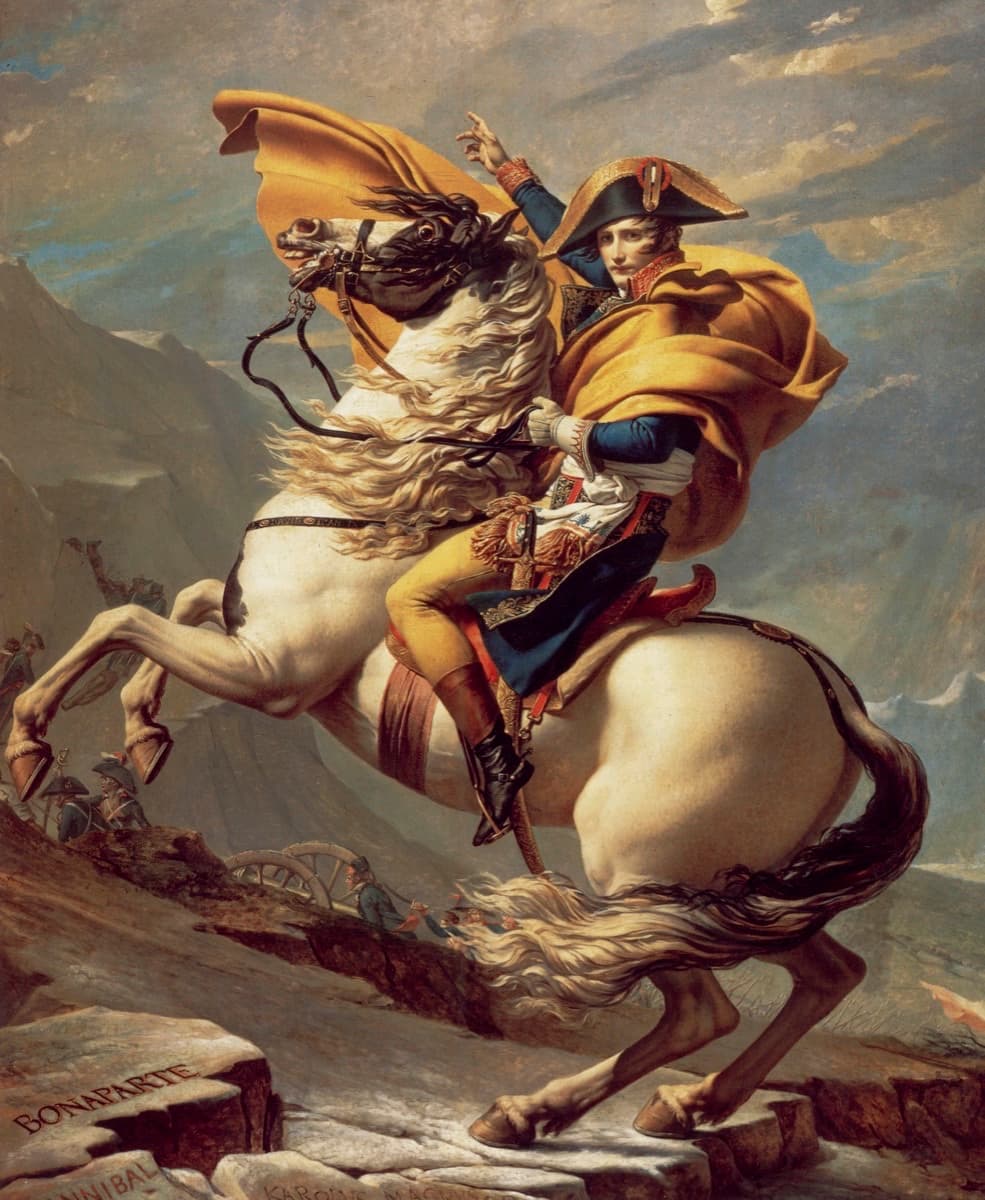
Napoleon Crossing the Alps
Jacques-Louis David, 1801
David painted Napoleon on horseback leading his army across the Alps in 1800. The Neoclassical portrait shows the commander directing his troops, illustrating organized military force under centralized leadership.
Wilhelm Commentary
Richard Wilhelm's classic translation and interpretation
The Judgment
An army is a mass that needs organization in order to become a fighting force. Without strict discipline nothing can be accomplished, but this discipline must not be achieved by force. It requires a strong man who captures the hearts of the people and awakens their enthusiasm. In order that he may develop his abilities he needs the complete confidence of his ruler, who must entrust him with full responsibility as long as the war lasts. But war is always a dangerous thing and brings with it destruction and devastation. Therefore it should not be resorted to rashly but, like a poisonous drug, should be used as a last recourse. The justifying cause of a war, and clear and intelligible war aims, ought to be explained to the people by an experienced leader. Unless there is a quite definite war aim to which the people can consciously pledge themselves, the unity and strength of conviction that lead to victory will not be forthcoming. But the leader must also look to it that the passion of war and the delirium of victory do not give rise to unjust acts that will not meet with general approval. If justice and perseverance are the basis of action, all goes well.
The Image
Ground water is invisibly present within the earth. In the same way the military power of a people is invisibly present in the masses. When danger threatens, every peasant becomes a soldier; when the war ends, he goes back to his plow. He who is generous toward the people wins their love, and a people living under a mild rule becomes strong and powerful. Only a people economically strong can be important in military power. Such power must therefore be cultivated by improving the economic condition of the people and by humane government. Only when there is this invisible bond between government and people, so that the people are sheltered by their government as ground water is sheltered by the earth, is it possible to wage a victorious war.
First (Bottom) Line
At the beginning of a military enterprise, order is imperative. A just and valid cause must exist, and the obedience and coordination of the troops must be well organized, otherwise the result is inevitably failure.
Second Line
The leader should be in the midst of his army, in touch with it, sharing good and bad with the masses he leads. This alone makes him equal to the heavy demands made upon him. He needs also the recognition of the ruler. The decorations he receives are justified, because there is no question of personal preferment here: the whole army, whose center he is, is honored in his person.
Third Line
Here we have a choice of two explanations. One points to defeat because someone other than the chosen leader interferes with the command; the other is similar in its general meaning, but the expression, "carries corpses in the wagon," is interpreted differently. At burials and at sacrifices to the dead it was customary in China for the deceased to whom the sacrifice was made to be represented by a boy of the family, who sat in the dead man's place and was honored as his representative. On the basis of this custom the text is interpreted as meaning that a "corpse boy" is sitting in the wagon, or, in other words, that authority is not being exercised by the proper leaders but has been usurped by others. Perhaps the whole difficulty clears up if it is inferred that there has been an error in copying. The character fan, meaning "all," may have been misread as shih, which means "corpse. " Allowing for this error, the meaning would be that if the multitude assumes leadership of the army (rides in the wagon), misfortune will ensue.
Fourth Line
In the face of a superior enemy, with whom it would be hopeless to engage in battle, an orderly retreat is the only correct procedure, because it will save the army from defeat and disintegration. It is by no means a sign of courage or strength to insist upon engaging in a hopeless struggle regardless of circumstances.
Fifth Line
Game is in the field–it has left its usual haunts in the forest and is devastating the fields. This points to an enemy invasion. Energetic combat and punishment are here thoroughly justified, but they must not degenerate into a wild melee in which everyone fends for himself. Despite the greatest degree of perseverance and bravery, this would lead to misfortune. The army must be directed by an experienced leader. It is a matter of waging war, not of permitting the mob to slaughter all who fall into their hands; if they do, defeat will be the result, and despite all perseverance there is danger of misfortune.
Sixth (Top) Line
The war has ended successfully, victory is won, and the king divided estates and fiefs among his faithful vassals. But it is important that inferior people should not come into power. If they have helped, let them be paid off with money, but they should not be awarded lands or the privileges of rulers, lest power be abused.