比
Bǐ — Holding Together
upper trigram
坎Water (Danger)lower trigram
坤Earth (Yielding)The Judgment
吉。原筮元永貞。无咎。不寧方來。後夫凶。
Character-by-character gloss
Modern Interpretation
Good fortune through union. But ask yourself honestly: do you have the constancy this requires? Those unsure will gradually join. Those who arrive too late meet misfortune—the group has already formed without them.
The Image
地上有水,比。先王以建萬國,親諸侯。
Character-by-character gloss
Modern Interpretation
Water on earth—it fills every hollow and clings fast. Ancient kings understood this: they established states and cultivated relationships because power requires alliance. Isolation is weakness.
「地上有水,比。」水在地上——填滿每個低窪,緊緊依附。古代的王明白這點:建立國家、經營關係,因為力量需要聯盟。孤立就是弱。
The Six Lines
First (Bottom) Line
初六 有孚比之。无咎。有孚盈缶。終來有它吉。
Modern Interpretation
Hold to the center with truth and loyalty—no blame in this. Sincerity like a full earthen bowl, nothing held back. From this foundation, good fortune comes from unexpected directions.
Second Line
六二 比之自內。貞吉。
Modern Interpretation
Hold to the center from within. This means responding correctly to what's asked of you, not seeking to be noticed. Inner connection persevered brings good fortune.
Third Line
六三 比之匪人。
Modern Interpretation
You're holding together with the wrong people. They don't belong to your sphere. Beware of false intimacy—proximity doesn't create genuine alliance.
Fourth Line
六四 外比之。貞吉。
Modern Interpretation
Now hold outwardly as well—make the connection visible and public. The relationship with the center is established; loyalty can be openly shown. Perseverance brings good fortune.
Fifth Line
九五 顯比。王用三驅。失前禽。邑人不誡。吉。
Modern Interpretation
The king hunts using beaters on three sides only—game that escapes in front is allowed to go. This is holding together through freedom, not force. Those who come, come willingly. No warnings needed.
Sixth (Top) Line
上六 比之无首。凶。
Modern Interpretation
No head for holding together. If the beginning was wrong, no right ending is possible. The moment to join has passed. Misfortune.
Yilin Verse
From the Forest of Changes (焦氏易林) — 比 Bǐ (Holding Together)
鹿得美草,鳴呼其友。九族和睦,不憂飢乏。長子入獄,霜降族哭。
The deer finds fine grass, calling out to its friends. The nine clans live in harmony; no worry of hunger or want. The eldest son enters prison; when frost falls, the clan weeps.
Full explanation
Water upon earth, doubled — Holding Together transforming into itself. A deer finds sweet grass and calls out to its companions, echoing the Shijing ode 'Luming': the nine clans gather in harmony, free from hunger and want. Yet the verse pivots sharply: the eldest son enters prison, and when frost descends, the clan weeps together. The frost-descent execution season signals judicial punishment at autumn's appointed time. Both halves are expressions of Bi: the deer calling friends is alliance in joy; the clan weeping for a condemned kinsman is alliance in grief. Holding Together does not dissolve when fortune turns — it deepens. The same bonds that share abundance must also bear collective sorrow.
Masterpiece
A work of art reflecting this hexagram's essence
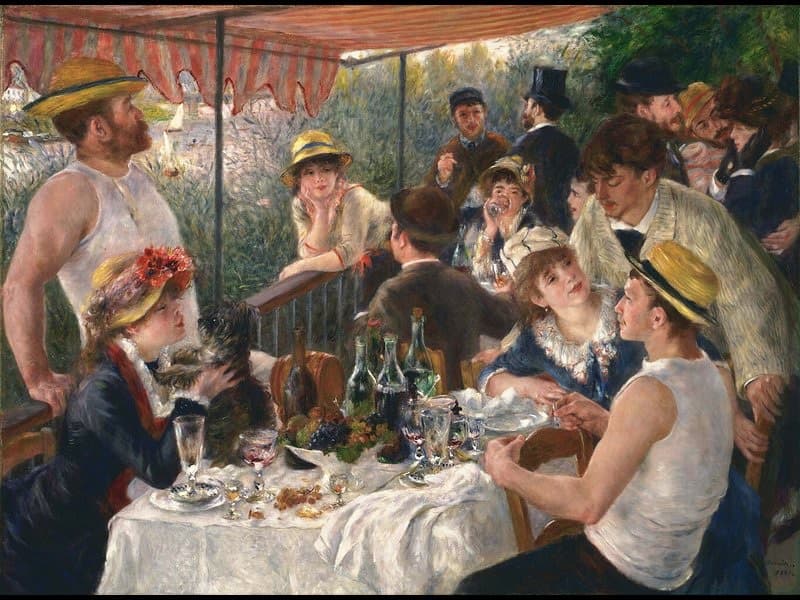
Luncheon of the Boating Party
Renoir, Unknown
Renoir's 1881 Impressionist painting depicts friends gathering for lunch on a balcony overlooking the Seine. The convivial scene shows people coming together in harmony, representing the theme of holding together or union.
Wilhelm Commentary
Richard Wilhelm's classic translation and interpretation
The Judgment
What is required is that we unite with others, in order that all may complement and aid one another through holding together. But such holding together calls for a central figure around whom other persons may unite. To become a center of influence holding people together is a grave matter and fraught with great responsibility. It requires greatness of spirit, consistency, and strength. Therefore let him who wishes to gather others about him ask himself whether he is equal to the undertaking, for anyone attempting the task without a real calling for it only makes confusion worse than if no union at all had taken place. But when there is a real rallying point, those who at first are hesitant or uncertain gradually come in of their own accord. Late-comers must suffer the consequences, for in holding together the question of the right time is also important. Relationships are formed and firmly established according to definite inner laws. Common experiences strengthen these ties, and he who comes too late to share in these basic experiences must suffer for it if, as a straggler, he finds the door locked. If a man has recognized the necessity for union and does not feel strong enough to function as the center, it is his duty to become a member of some other organic fellowship.
The Image
Water fills up all the empty places on the earth and clings fast to it. The social organization of ancient China was based on this principle of the holding together of dependents and rulers. Water flows to unite with water, because all parts of it are subject to the same laws. So too should human society hold together through a community of interests that allows each individual to feel himself a member of a whole. The central power of a social organization must see to it that every member finds that his true interest lies in holding together with it, as was the case in the paternal relationship between king and vassals in ancient China.
First (Bottom) Line
Fundamental sincerity is the only proper basis for forming relationships. This attitude, symbolized by a full earthen bowl, in which the content is everything and the empty form nothing, shows itself not in clever words but through the strength of what lies within the speaker. This strength is so great that it has power to attract good fortune to itself from without.
Second Line
If a person responds perseveringly and in the right way to the behests from above that summon him to action, his relations with others are intrinsic and he does not lose himself. But if a man seeks association with others as if he were an obsequious office hunter, he throws himself away. He does not follow the path of the superior man, who never loses his dignity.
Third Line
We are often among people who do not belong to our own sphere. In that case we must beware of being drawn into false intimacy through force of habit. Needless to say, this would have evil consequences. Maintaining sociability without intimacy is the only right attitude toward such people, because otherwise we should not be free to enter into relationship with people of our own kind later on.
Fourth Line
Here the relations with a man who is the center of union are well established. Then we may, and indeed we should, show our attachment openly. But we must remain constant and not allow ourselves to be led astray.
Fifth Line
In the royal hunts of ancient China it was customary to drive up the game from three sides, but on the fourth the animals had a chance to run off. If they failed to do this they had to pass through a gate behind which the king stood ready to shoot. Only animals that entered here were shot; those that ran off in front were permitted to escape. This custom accorded with a kingly attitude; the royal hunter did not wish to turn the chase into a slaughter, but held that the kill should consist only of those animals which had so to speak voluntarily exposed themselves. There is depicted here a ruler, or influential man, to whom people are attracted. Those who come to him he accepts, those who do not come are allowed to go their own way. He invites none, flatters none–all come of their own free will. In this way there develops a voluntary dependence among those who hold him. They do not have to be constantly on their guard but may express their opinions openly. Police measures are not necessary, and they cleave to their ruler of their own volition. The same principle of freedom is valid for life in general. We should not woo favor from people. If a man cultivates within himself the purity and the strength that are necessary for one who is the center of a fellowship, those who are meant for him come of their own accord.
Sixth (Top) Line
The head is the beginning. If the beginning is not right, there is no hope of a right ending. If we have missed the right moment for union and go on hesitating to give complete and full devotion, we shall regret the error when it is too late.