Images 1–15
推背圖 象一至象十五
Image 1 — Jiǎzǐ
第一象 甲子
Prophecy
讖曰
茫茫天地 不知所止 日月循環 周而復始
Vast is heaven and earth, no knowing where they end. Sun and moon turn in their circuit, and having gone round, begin again.
Ode
頌曰
自從盤古迄希夷 虎鬥龍爭事正奇 悟得循環眞諦在 試於唐後論元機
From Pangu down to Xiyi, tigers fought and dragons struggled — strange business indeed. Grasp that the true meaning lies in the turning, and try reckoning the hidden mechanism for the age after Tang.
Commentary
聖歎曰
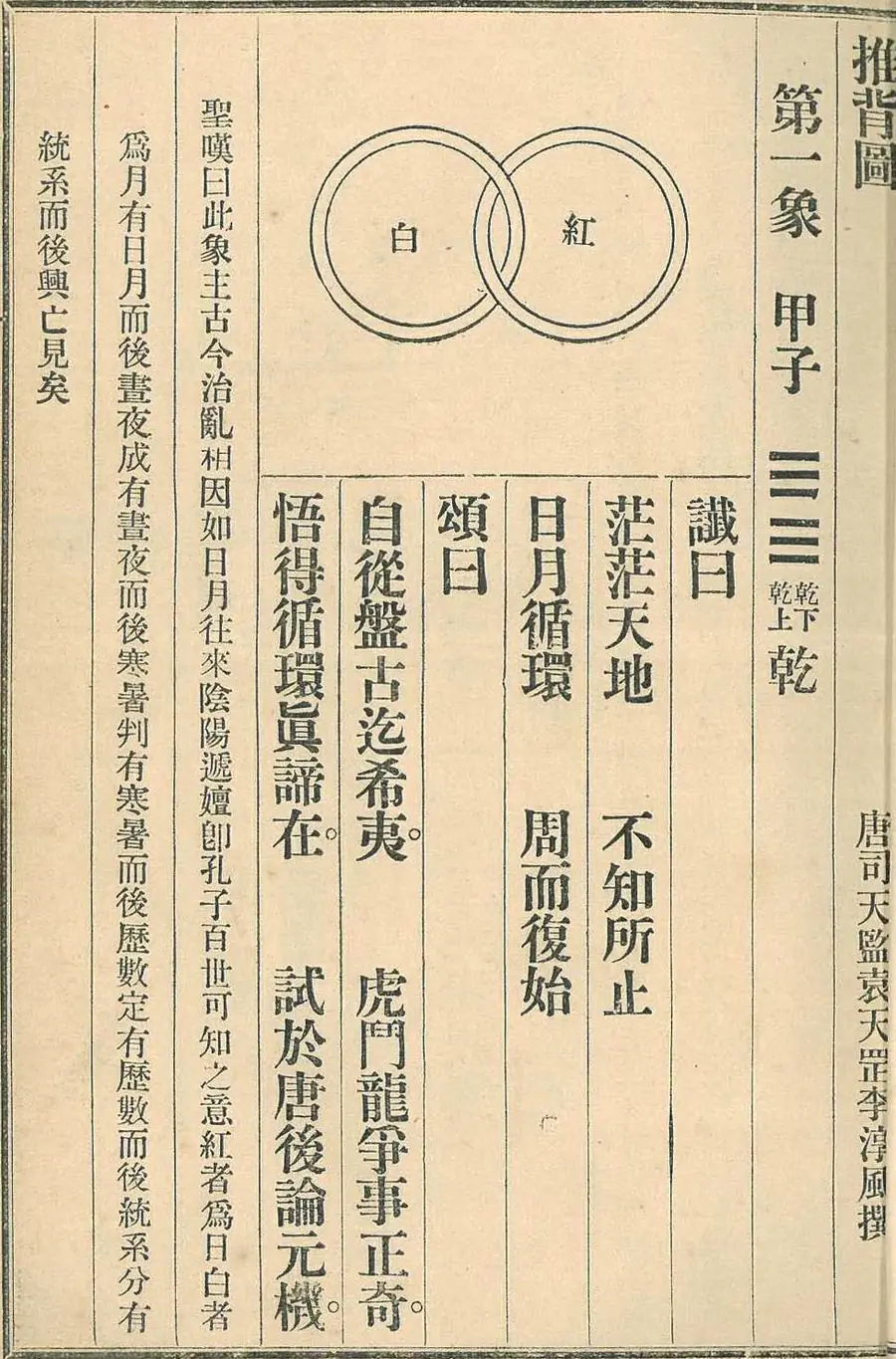
聖嘆曰此象主古今治亂相因如日月往來陰陽遞嬗卽孔子百世可知之意紅者爲日白者
Shengtan says: this image concerns how order and disorder have caused each other from antiquity to now, as sun and moon come and go and yin and yang give way by turns — which is just Confucius's meaning when he said that a hundred generations could be known in advance. The red one is the sun; the white one
Commentary
聖歎曰
爲月有日月而後晝夜成有晝夜而後寒暑判有寒暑而後歷數定有歷數而後統系分有
is the moon. Once there are sun and moon, day and night are formed; once there are day and night, cold and heat are divided; once there are cold and heat, the calendar is fixed; once there is a calendar, lines of succession are distinguished; and once there are
Commentary
聖歎曰
統系而後興亡見矣
lines of succession, rise and fall become visible.
Image 2 — Yǐchǒu
第二象 乙丑
Prophecy
讖曰
纍纍碩果 莫明其數 一果一仁 卽新卽故
Clustered, the swelling fruits, no one making their number plain. Each fruit, one kernel — at once the new and the old.
Ode
頌曰
萬物土中生 二九先成實 一統定中原 陰盛陽先竭
All things are born out of earth. At twice-nine they first bear fruit. One rule settles the Central Plain. When yin waxes, yang is first spent.
Commentary
聖歎曰
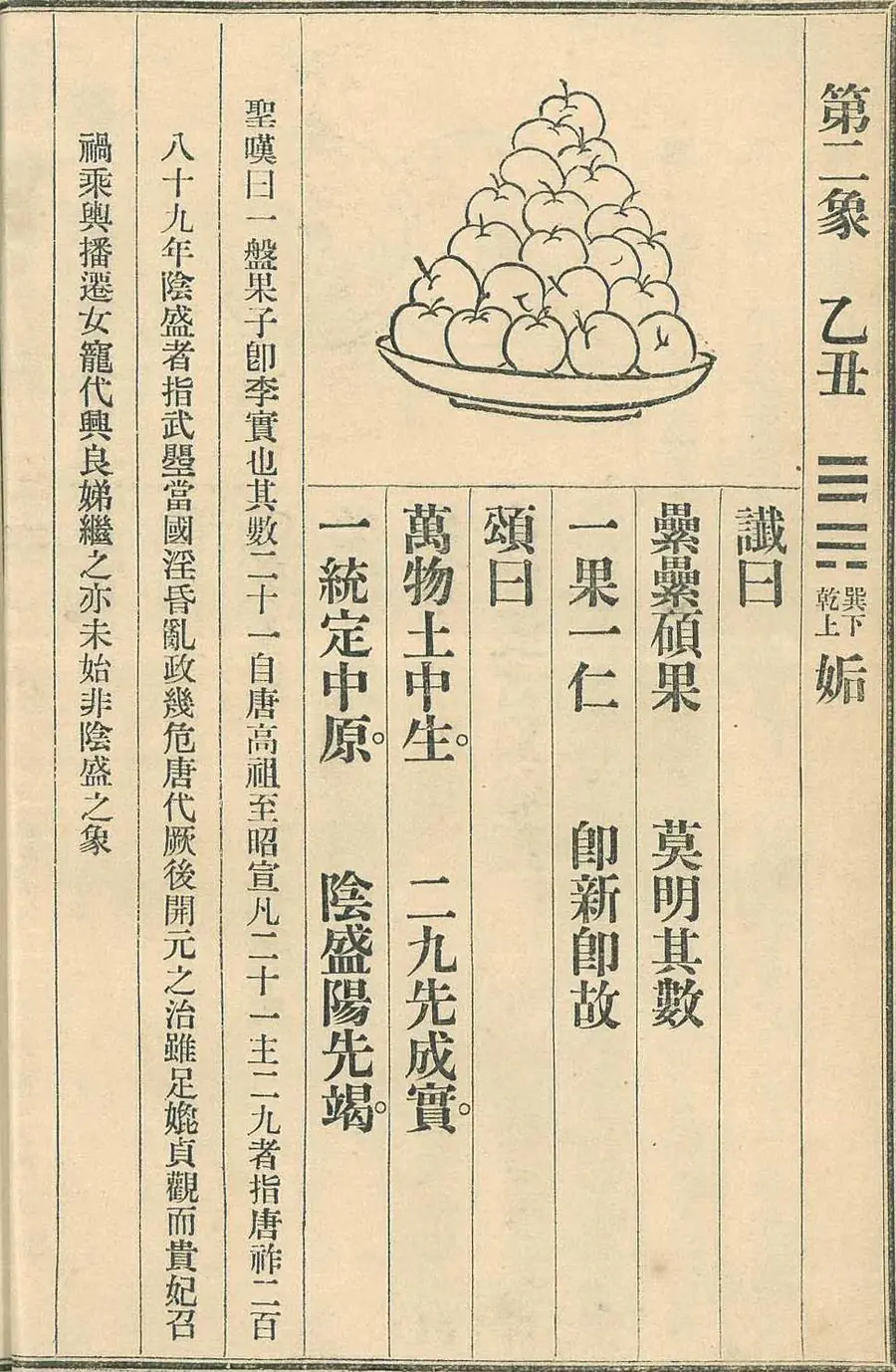
聖嘆曰一盤果子卽李實也其數二十一自唐高祖至昭宣凡二十一主二九者指唐祚二百
Shengtan says: the plate of fruit is Li's fruit — the surname of the house. Their number is twenty-one: from Tang Gaozu down to Zhaoxuan there were twenty-one sovereigns in all. 'Twice nine' points to the Tang mandate lasting two hundred
Commentary
聖歎曰
八十九年陰盛者指武曌當國淫昏亂政幾危唐代厥後開元之治雖足□貞觀而貴妃召
and eighty-nine years. 'Yin waxing' points to Wu Zhao holding the state — licentious and benighted, throwing the government into disorder and coming close to ending the Tang. Afterwards the good order of the Kaiyuan reign was enough to ⟦match⟧ the Zhenguan, and yet the Precious Consort brought on
Commentary
聖歎曰
禍乘輿播遷女寵代興良娣繼之亦未始非陰盛之象
disaster: the imperial carriage was driven into exile, and favoured women rose one after another, the Liangdi consort following her — which was likewise, from the first, an image of yin waxing.
Image 3 — Bǐngyín
第三象 丙寅
Prophecy
讖曰
日月當空 照臨下土 撲朔迷離 不文亦武
Sun and moon stand in the sky, shining down on the earth below. Blurred and hard to tell apart — not civil, and martial too.
Ode
頌曰
參遍空王色相空 一朝重入帝王宮 遺枝撥盡根猶在 喔喔晨雞孰是雄
Having sought the Void King through and through, form and semblance are void. One morning she entered the sovereign's palace again. The remaining branches stripped away, the root is still there. Cock-a-doodle — the morning hen. Which one is the cock?
Commentary
聖歎曰
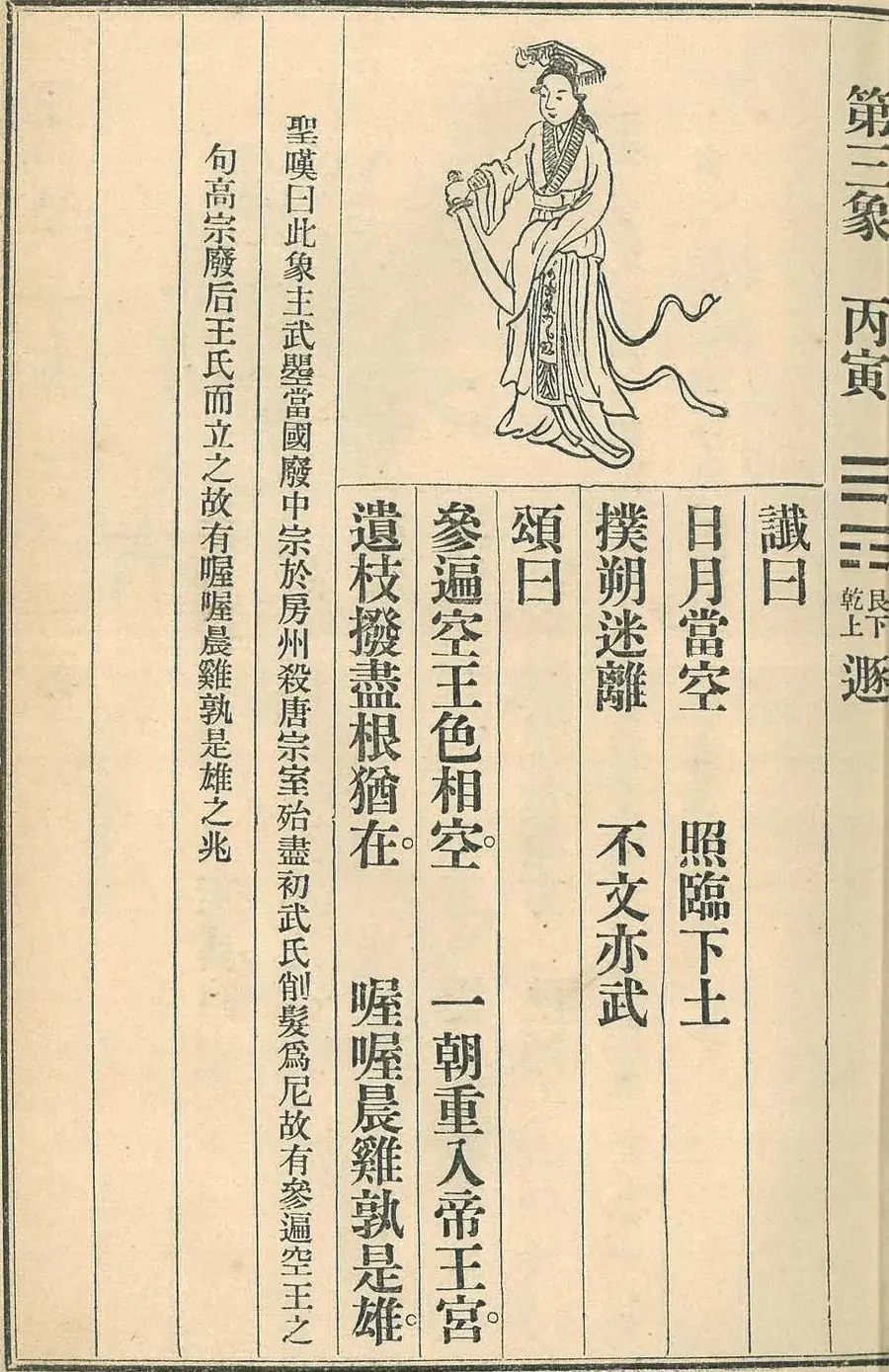
聖嘆曰此象主武曌當國廢中宗於房州殺唐宗室殆盡初武氏削髮爲尼故有參遍空王之
Shengtan says: this image concerns Wu Zhao holding the state. She deposed Zhongzong to Fangzhou and killed off the Tang imperial clan almost to a man. Early on the Wu woman shaved her head and became a nun, and so there is the line about seeking the Void King through
Commentary
聖歎曰
句高宗廢后王氏而立之故有喔喔晨雞孰是雄之兆
and through. Gaozong deposed Empress Wang and set her up in her place, and so there is the omen of 'cock-a-doodle, the morning hen — which one is the cock?'
Image 4 — Dīngmǎo
第四象 丁卯
Prophecy
讖曰
飛者不飛 走者自走 振羽高岡 乃克有後
The flier does not fly. The runner runs of himself. It beats its wings on the high ridge, and so is able to have descendants.
Ode
頌曰
威行靑女實權奇 極目蕭條十八枝 賴有猴兒齊着力 已傾大樹仗扶持
The Azure Maiden's power ran wide; her grip was strange indeed. As far as the eye could see, the eighteen branches lay desolate. It fell to the monkeys to put their strength together — the great tree already leaning was held up by their hands.
Commentary
聖歎曰
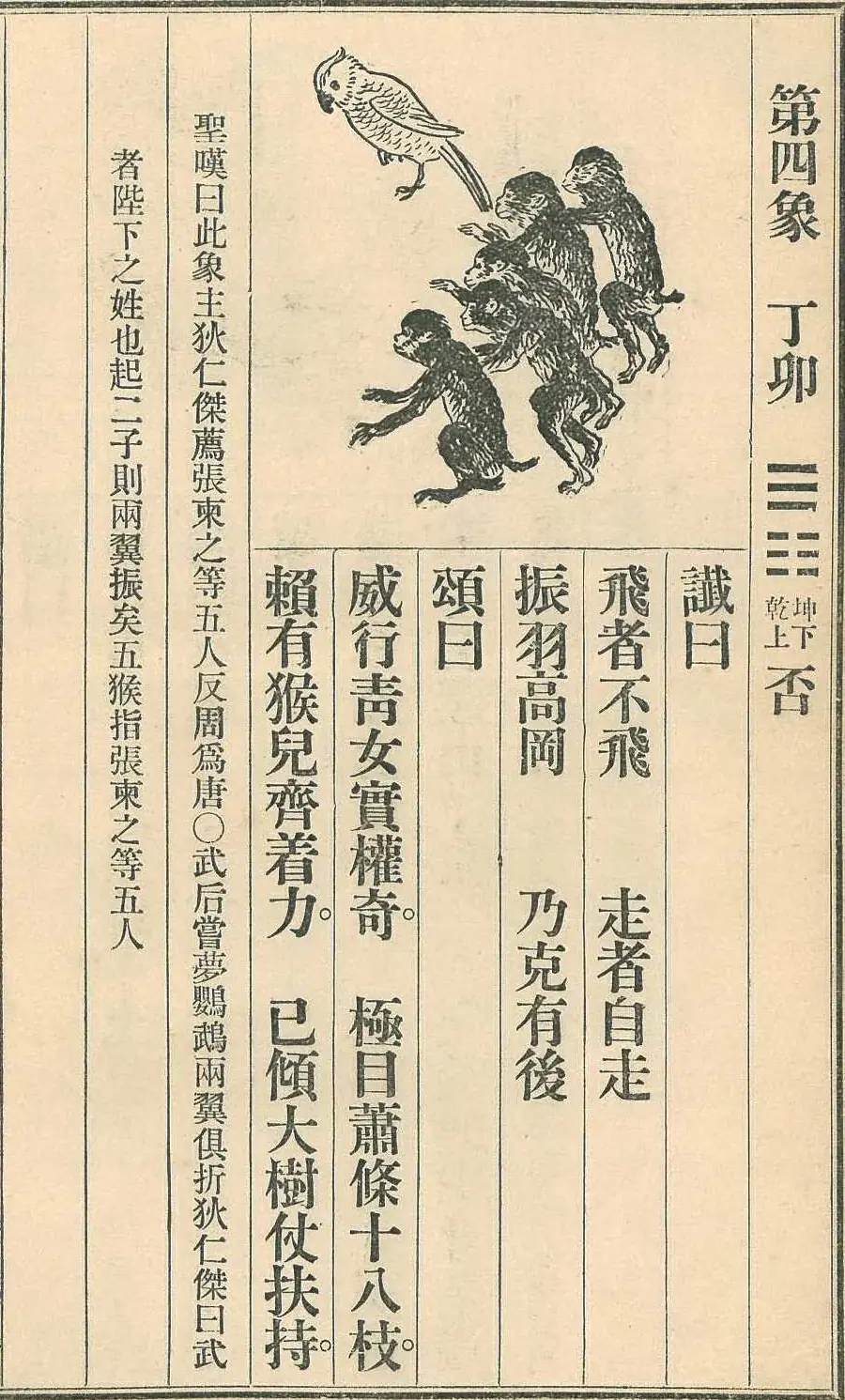
聖嘆曰此象主狄仁傑薦張柬之等五人反周爲唐○武后嘗夢鸚鵡兩翼俱折狄仁傑曰武
Shengtan says: this image concerns Di Renjie recommending Zhang Jianzhi and four others, who turned the Zhou back into the Tang. ○ Empress Wu once dreamt of a parrot with both wings broken. Di Renjie said: 'Wu
Commentary
聖歎曰
者陛下之姓也起二子則兩翼振矣五猴指張柬之等五人
is Your Majesty's surname; raise up your two sons and the two wings will beat again.' The five monkeys point to Zhang Jianzhi and the four others.
Image 5 — Wùchén
第五象 戊辰
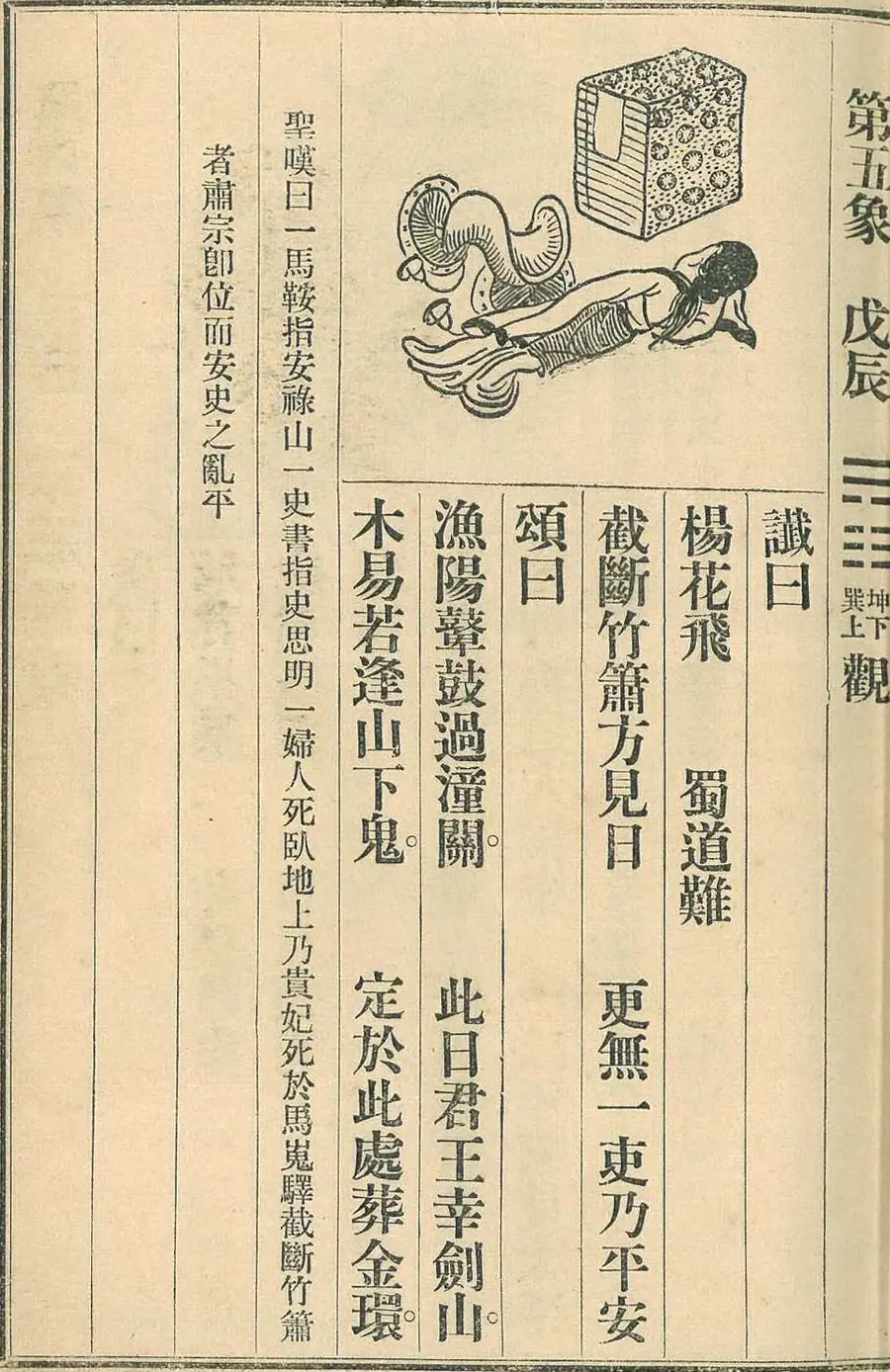
Prophecy
讖曰
楊花飛 蜀道難 截斷竹簫方見日 更無一吏乃平安
Willow catkins fly. The road to Shu is hard. Cut the bamboo from the flute and only then see it. With not one clerk left, there is peace.
Ode
頌曰
漁陽鼙鼓過潼關 此日君王幸劍山 木易若逢山下鬼 定於此處葬金環
The war drums of Yuyang come through Tong Pass. On this day the sovereign favours Sword Mountain. If Wood-and-Yi should meet the Ghost-under-the-Mountain, then here the golden ring is buried.
Commentary
聖歎曰
聖嘆曰一馬鞍指安祿山一史書指史思明一婦人死臥地上乃貴妃死於馬嵬驛截斷竹簫
Shengtan says: one saddle points to An Lushan; one history book points to Shi Siming; one woman lying dead on the ground is the Precious Consort dying at the Mawei post-station. As for 'cut the bamboo from the flute'
Commentary
聖歎曰
者肅宗卽位而安史之亂平
— it is that Suzong took the throne, and the An–Shi rebellion was put down.
Image 6 — Jǐsì
第六象 己巳
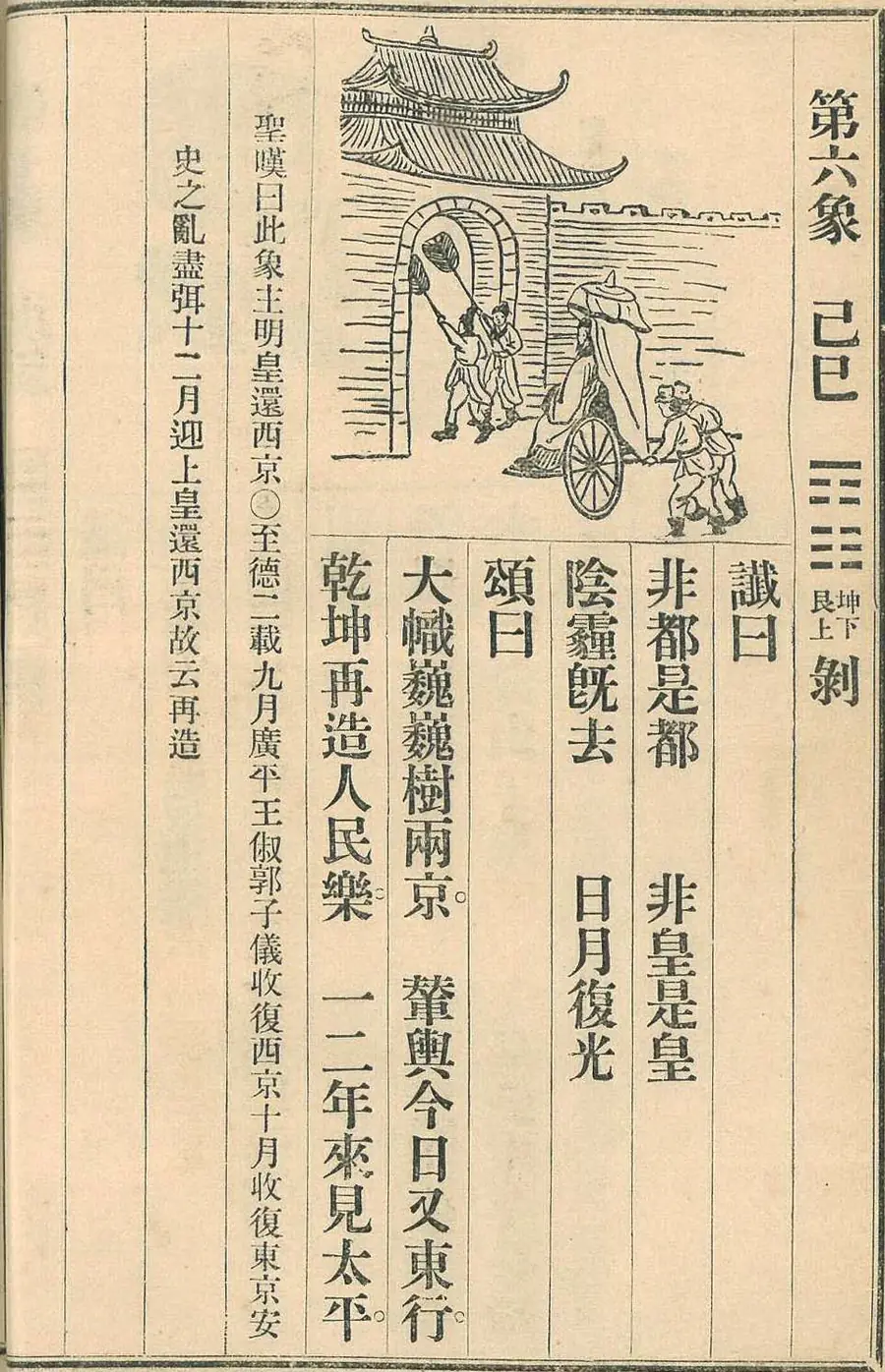
Prophecy
讖曰
非都是都 非皇是皇 陰霾旣去 日月復光
Not the capital, yet the capital. Not the sovereign, yet the sovereign. The murk once gone, sun and moon shine again.
Ode
頌曰
大幟巍巍樹兩京 輦輿今日又東行 乾坤再造人民樂 一二年來見太平
The great banner towers, planted in the two capitals. Today the imperial carriage travels east once more. Heaven and earth remade, the people rejoice. Within a year or two, great peace is in sight.
Commentary
聖歎曰
聖嘆曰此象主明皇還西京○至德二載九月廣平王俶郭子儀收復西京十月收復東京安
Shengtan says: this image concerns Minghuang returning to the western capital. ○ In the ninth month of the second year of Zhide, Prince Guangping Chu and Guo Ziyi recovered the western capital; in the tenth month they recovered the eastern capital. The An–
Commentary
聖歎曰
史之亂盡弭十二月迎上皇還西京故云再造
Shi rebellion was wholly quelled. In the twelfth month they welcomed the Retired Emperor back to the western capital, and so the text says 'remade'.
Image 7 — Gēngwǔ
第七象 庚午
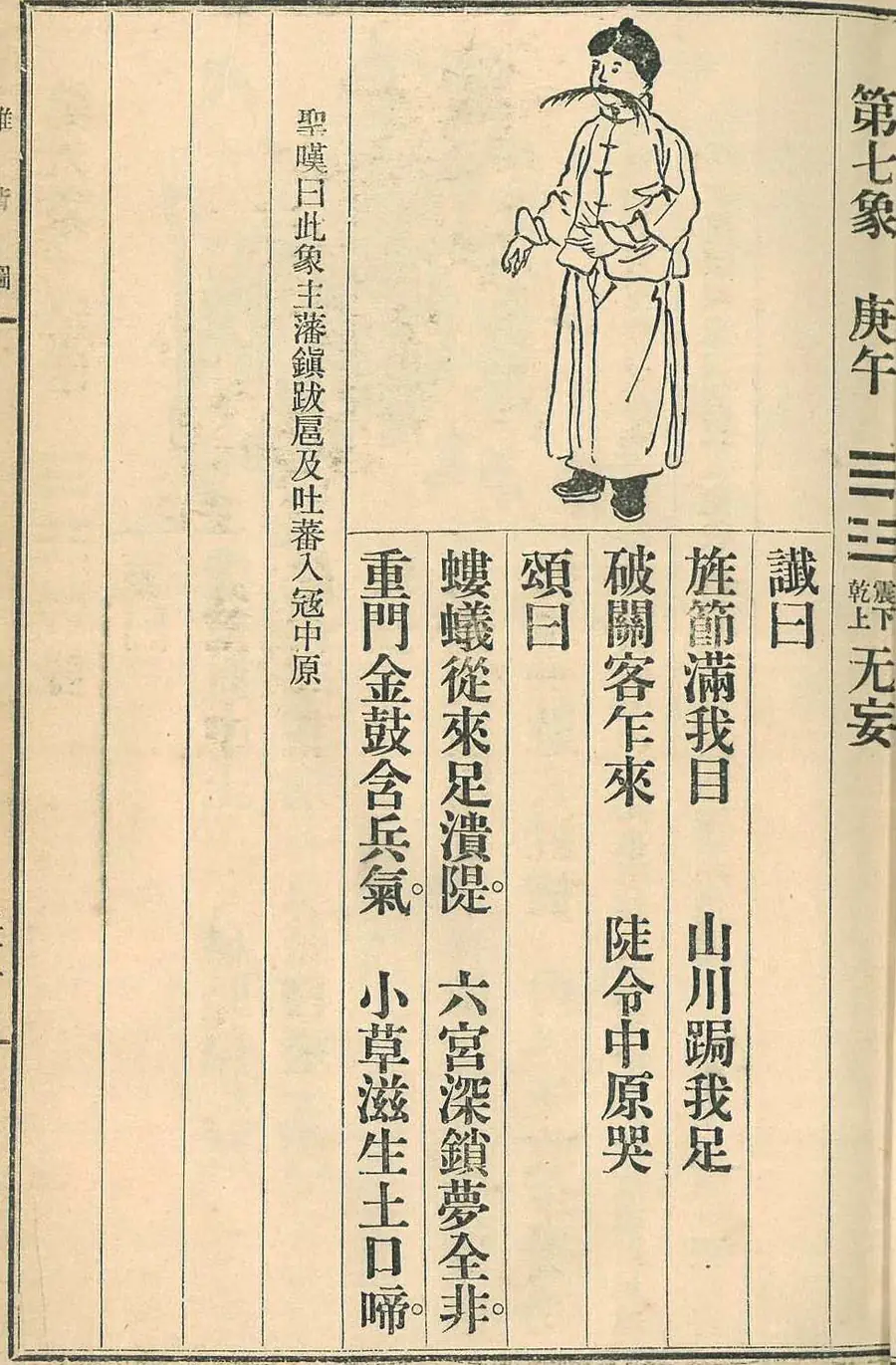
Prophecy
讖曰
旌節滿我目 山川跼我足 破關客乍來 陡令中原哭
Banners and staves of office fill my eyes. Mountains and rivers cramp my feet. The guests who broke the pass came all at once, and suddenly set the Central Plain weeping.
Ode
頌曰
螻蟻從來足潰隄 六宮深鎖夢全非 重門金鼓含兵氣 小草滋生土口啼
Mole crickets and ants have always been enough to burst a dyke. The six palaces locked deep, the dream is all awry. Behind layered gates, gong and drum hold the breath of war. Small grasses spring up, and the earth-mouth cries.
Commentary
聖歎曰
聖嘆曰此象主藩鎮跋扈及吐蕃入寇中原
Shengtan says: this image concerns the regional commanders running unchecked, and the Tibetans invading the Central Plain.
Image 8 — Xīnwèi
第八象 辛未
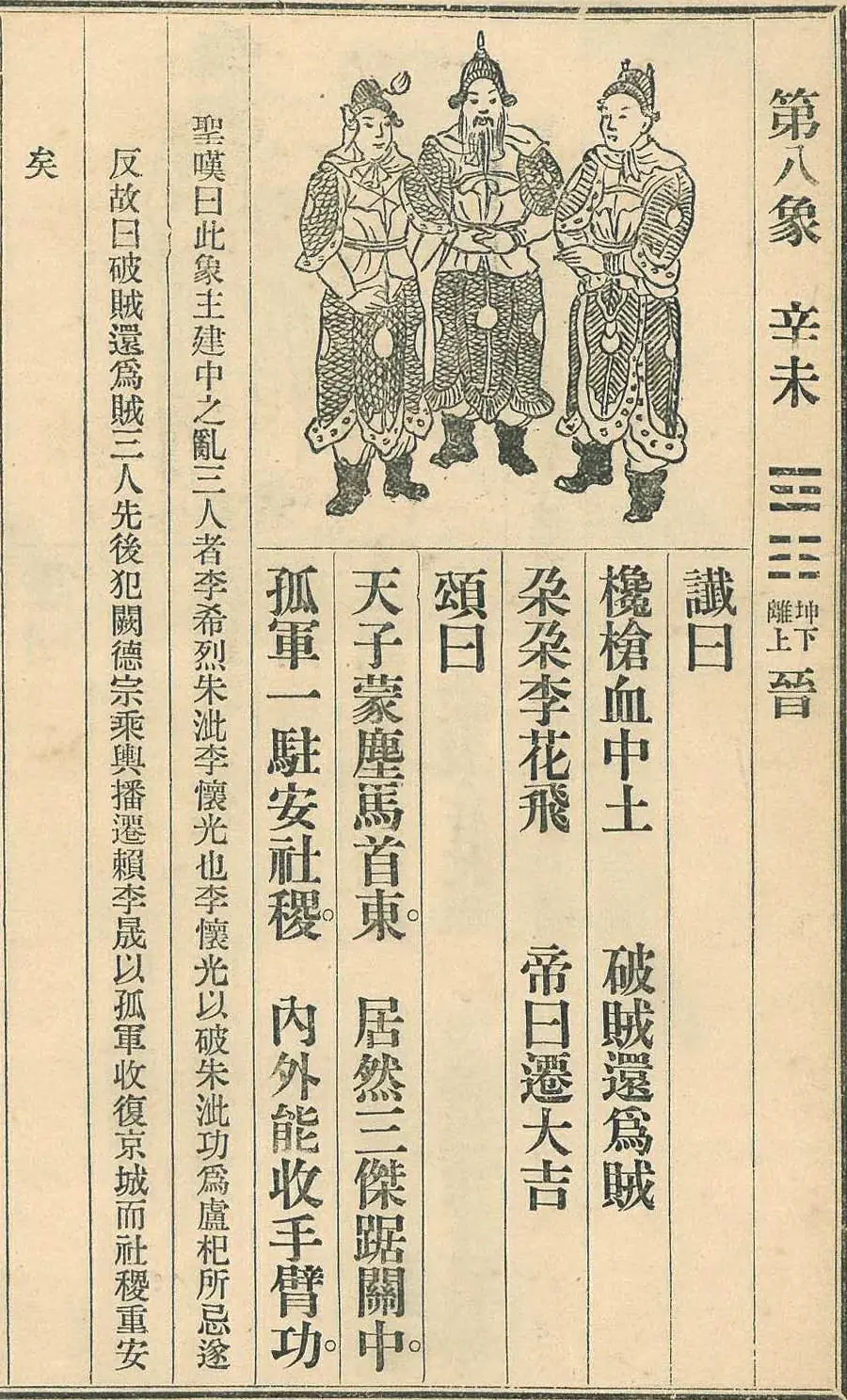
Prophecy
讖曰
欃槍血中土 破賊還爲賊 朶朶李花飛 帝曰遷大吉
The comet bloodies the central land. He who broke the rebels becomes a rebel in turn. Cluster on cluster, the plum blossom flies. The emperor says: to move is greatly auspicious.
Ode
頌曰
天子蒙塵馬首東 居然三傑踞關中 孤軍一駐安社稷 內外能收手臂功
The Son of Heaven eats dust, his horse's head turned east. And there, sure enough, three champions squat in Guanzhong. One lone army halts, and the altars are made safe. Within and without, the merit of arm and hand is gathered in.
Commentary
聖歎曰
聖嘆曰此象主建中之亂三人者李希烈朱泚李懷光也李懷光以破朱泚功爲盧杞所忌遂
Shengtan says: this image concerns the disorder of the Jianzhong era. The three men are Li Xilie, Zhu Ci and Li Huaiguang. Li Huaiguang, for the merit of breaking Zhu Ci, was resented by Lu Qi, and thereupon
Commentary
聖歎曰
反故曰破賊還爲賊三人先後犯闕德宗乘輿播遷賴李晟以孤軍收復京城而社稷重安
rebelled — hence 'he who broke the rebels becomes a rebel in turn'. The three men assaulted the palace gates one after another; Dezong's carriage went into exile; and it fell to Li Sheng, with a lone army, to recover the capital, so that the altars were secure
Commentary
聖歎曰
矣
once more.
Image 9 — Rénshēn
第九象 壬申
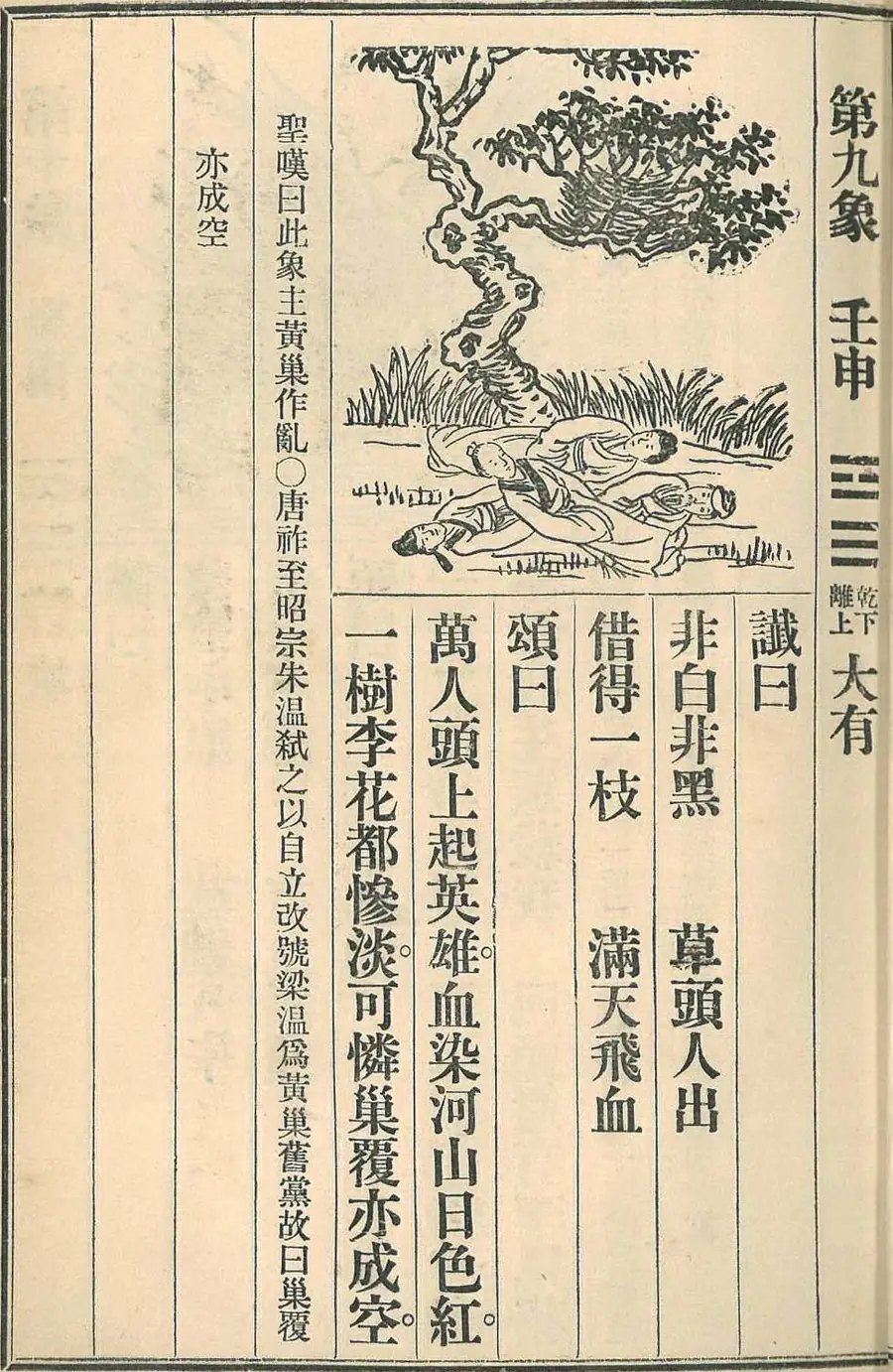
Prophecy
讖曰
非白非黑 草頭人出 借得一枝 滿天飛血
Neither white nor black. Under the grass-head a man comes out. He borrows a single branch, and blood flies across the whole sky.
Ode
頌曰
萬人頭上起英雄 血染河山日色紅 一樹李花都慘淡 可憐巢覆亦成空
Above ten thousand heads a hero rises. Blood dyes the rivers and hills; the sun's colour is red. A whole tree of plum blossom is dimmed. And pity — the nest overturned also comes to nothing.
Commentary
聖歎曰
聖嘆曰此象主黃巢作亂○唐祚至昭宗朱溫弑之以自立改號梁溫爲黃巢舊黨故曰巢覆
Shengtan says: this image concerns Huang Chao raising rebellion. ○ The Tang mandate came down to Zhaozong, whom Zhu Wen murdered in order to set himself up, changing the dynastic name to Liang. Wen had been of Huang Chao's old faction, and so the text says 'the nest overturned'.
Commentary
聖歎曰
亦成空
— and also comes to nothing.
Image 10 — Guǐyǒu
第十象 癸酉
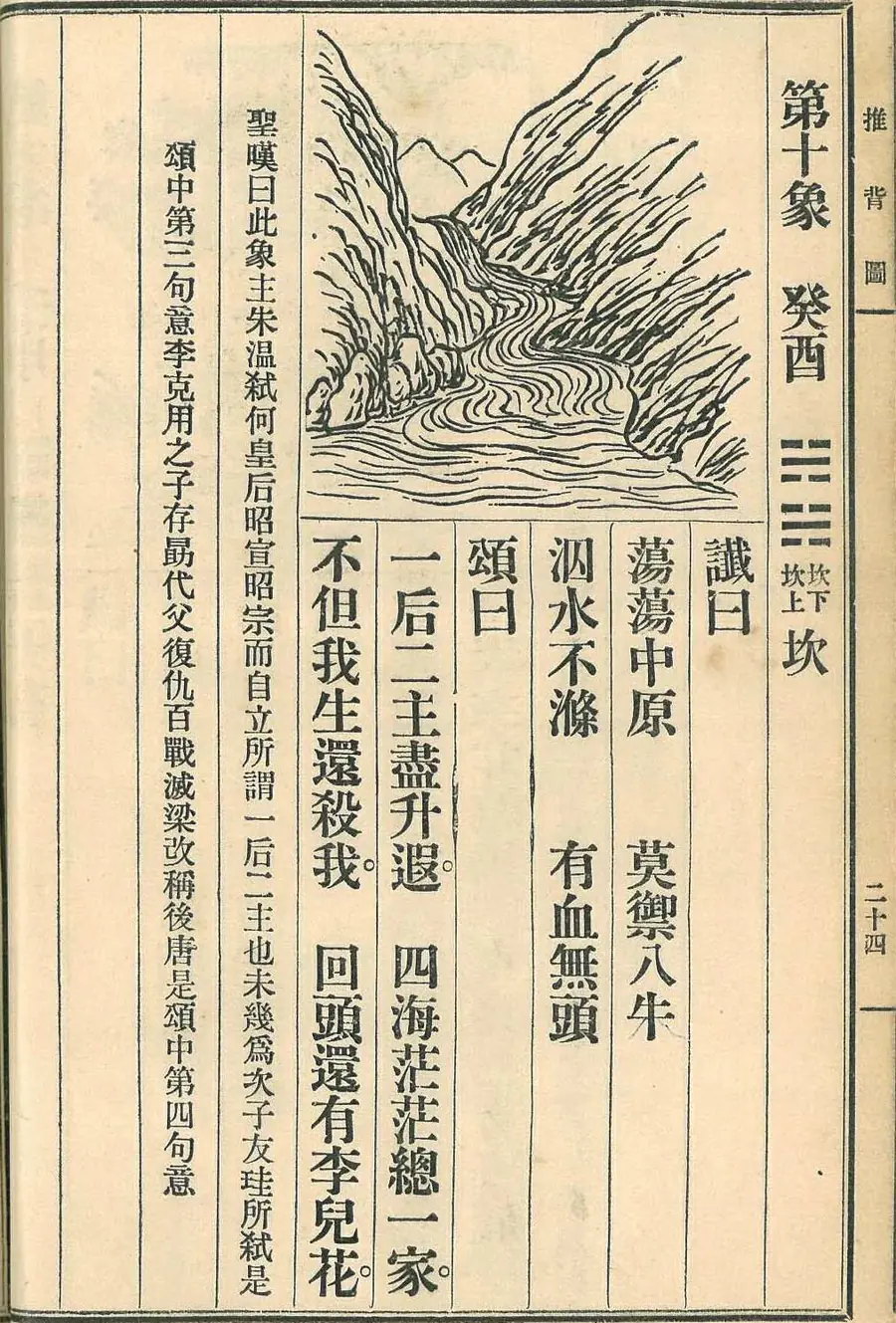
Prophecy
讖曰
蕩蕩中原 莫禦八牛 泗水不滌 有血無頭
Broad and open, the Central Plain. None can withstand the eight-ox. The waters of the Si do not wash it clean. There is blood, and no head.
Ode
頌曰
一后二主盡升遐 四海茫茫總一家 不但我生還殺我 回頭還有李兒花
One empress and two sovereigns all ascend and depart. The four seas, boundless, are one household at last. Not only did I father him — he kills me too. Turn your head: the Li child's blossom is there still.
Commentary
聖歎曰
聖嘆曰此象主朱温弑何皇后昭宣昭宗而自立所謂一后二主也未幾爲次子友珪所弑是
Shengtan says: this image concerns Zhu Wen murdering Empress He, and the sovereigns Zhaoxuan and Zhaozong, and setting himself up — what is meant by 'one empress and two sovereigns'. Before long he was murdered by his second son Yougui. This is
Commentary
聖歎曰
頌中第三句意李克用之子存勗代父復仇百戰滅梁改稱後唐是頌中第四句意
the sense of the ode's third line. Li Keyong's son Cunxu avenged his father, destroyed the Liang in a hundred battles, and renamed the dynasty Later Tang. This is the sense of the ode's fourth line.
Image 11 — Jiǎxū (printed 甲戊)
第十一象 甲戊
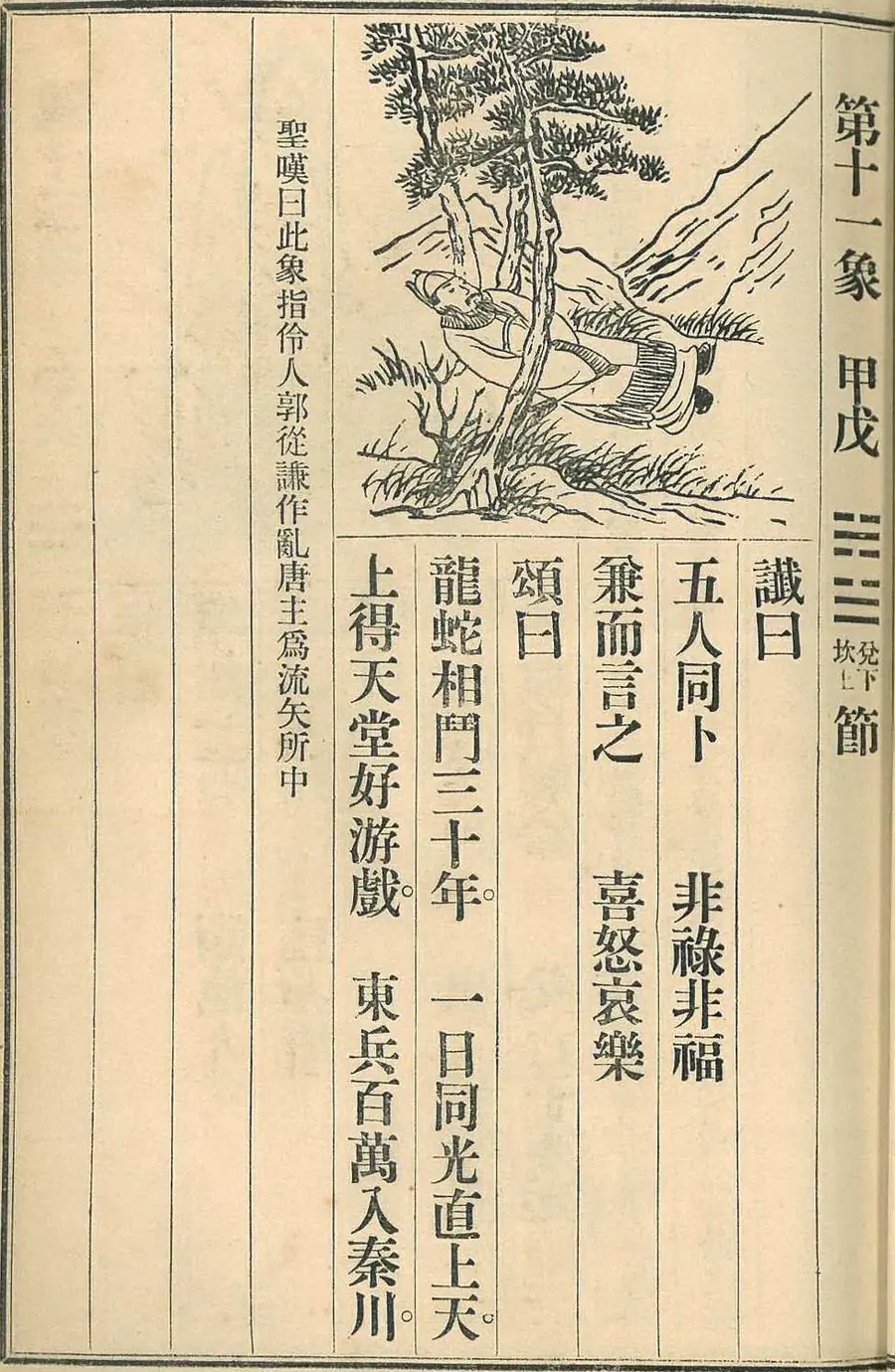
Prophecy
讖曰
五人同卜 非祿非福 兼而言之 喜怒哀樂
Five men divine together. It is neither emolument nor blessing. Take them together and speak of it: joy, anger, grief, delight.
Ode
頌曰
龍蛇相鬥三十年 一日同光直上天 上得天堂好游戲 東兵百萬入秦川
Dragon and snake fight for thirty years. One day Tongguang goes straight up to heaven. Having reached the hall of heaven, fine sport — and a million eastern troops enter the Qin plain.
Commentary
聖歎曰
聖嘆曰此象指伶人郭從謙作亂唐主爲流矢所中
Shengtan says: this image points to the actor Guo Congqian raising a mutiny, in which the Tang sovereign was struck by a stray arrow.
Image 12 — Yǐhài
第十二象 乙亥
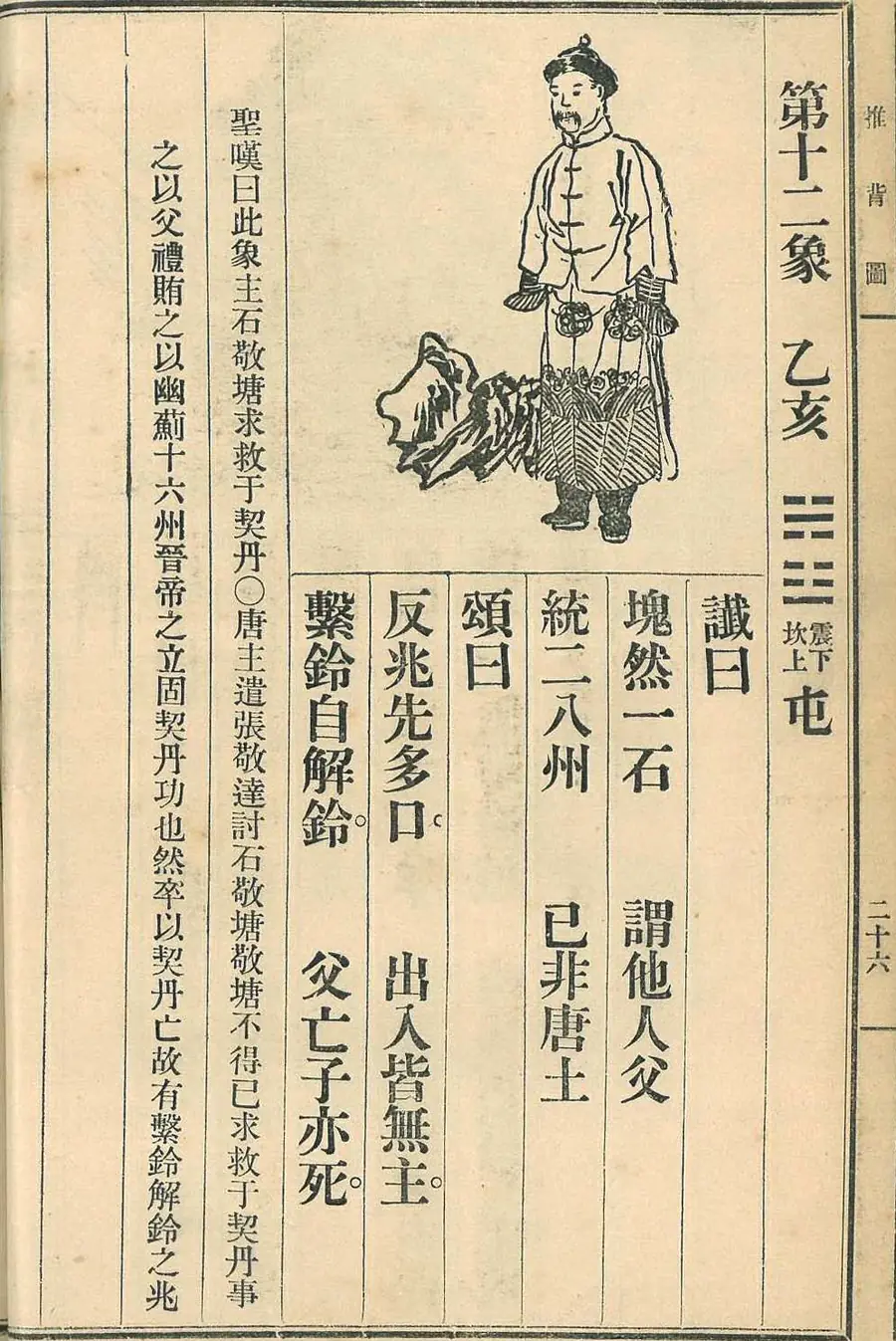
Prophecy
讖曰
塊然一石 謂他人父 統二八州 已非唐土
A lump — one stone. He calls another man father. He rules twice-eight prefectures, and they are no longer Tang soil.
Ode
頌曰
反兆先多口 出入皆無主 繫鈴自解鈴 父亡子亦死
The sign of revolt shows first in many mouths. Going out and coming in, there is no master. Whoever tied the bell must untie it himself. The father dies, and the son dies too.
Commentary
聖歎曰
聖嘆曰此象主石敬塘求救于契丹唐主遣張敬達討石敬塘敬塘不得已求救于契丹事
Shengtan says: this image concerns Shi Jingtang seeking rescue from the Khitan. The Tang sovereign sent Zhang Jingda to attack Shi Jingtang; Jingtang, having no other course, sought rescue from the Khitan, serving
Commentary
聖歎曰
之以父禮賄之以幽薊十六州晉帝之立固契丹功也然卒以契丹亡故有繫鈴解鈴之兆
them with the rites due to a father, and bribing them with the sixteen prefectures of You and Ji. The Jin emperor's enthronement was indeed the Khitan's doing — yet it was by the Khitan that he perished in the end, and so there is the omen of tying and untying the bell.
Image 13 — Bǐngzǐ
第十三象 丙子
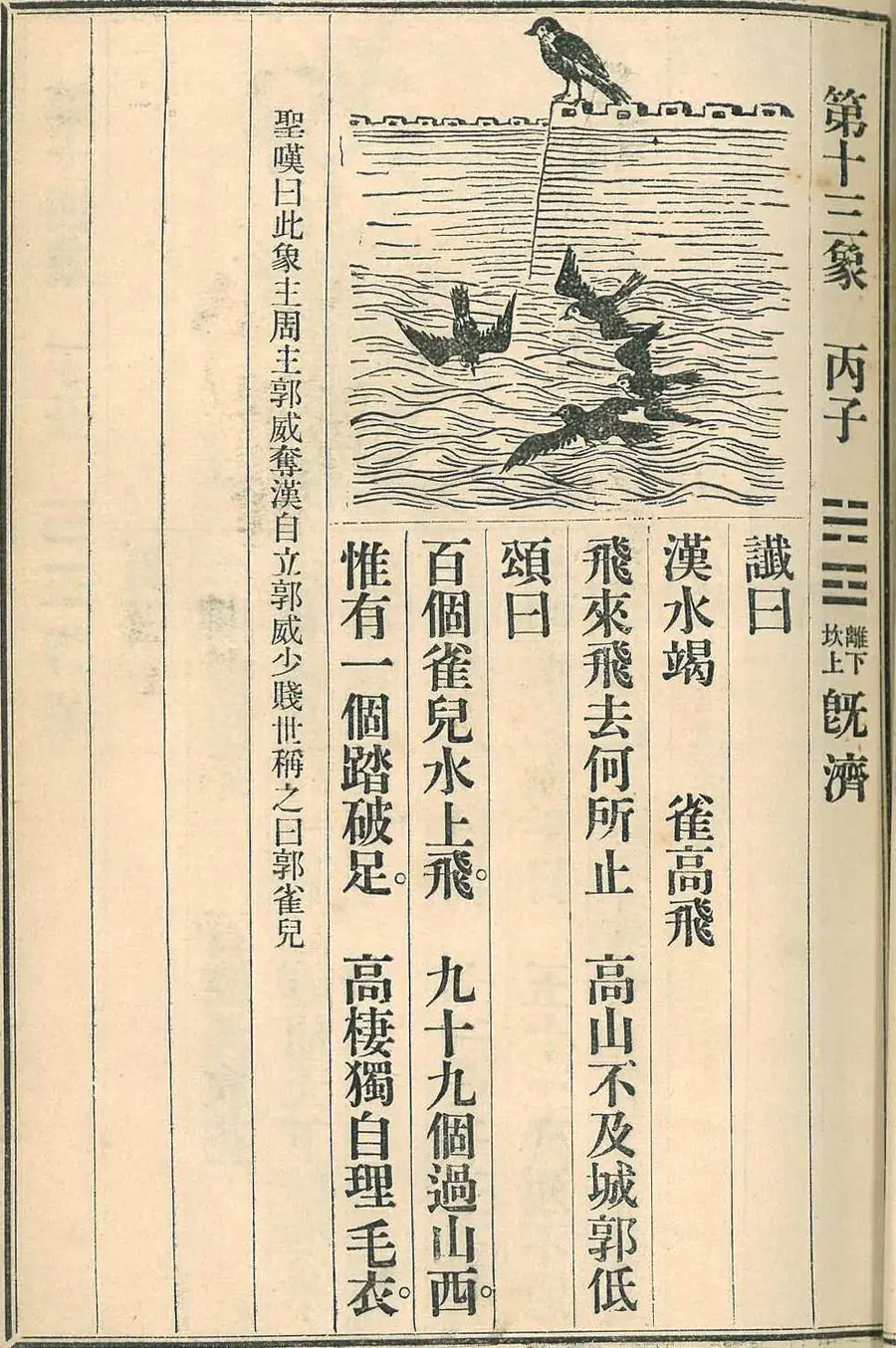
Prophecy
讖曰
漢水竭 雀高飛 飛來飛去何所止 高山不及城郭低
The Han waters run dry. The sparrow flies high. Flying to and fro — where does it stop? The high mountain is not so low as the city wall.
Ode
頌曰
百個雀兒水上飛 九十九個過山西 惟有一個踏破足 高棲獨自理毛衣
A hundred sparrows fly above the water. Ninety-nine pass over to Shanxi. Only one treads and breaks its foot, roosts high, and alone preens its feathers.
Commentary
聖歎曰
聖嘆曰此象主周主郭威奪漢自立郭威少賤世稱之曰郭雀兒
Shengtan says: this image concerns the Zhou sovereign Guo Wei seizing the Han and setting himself up. Guo Wei was of low birth in his youth, and the world called him Guo the Sparrow.
Image 14 — Dīngchǒu
第十四象 丁丑
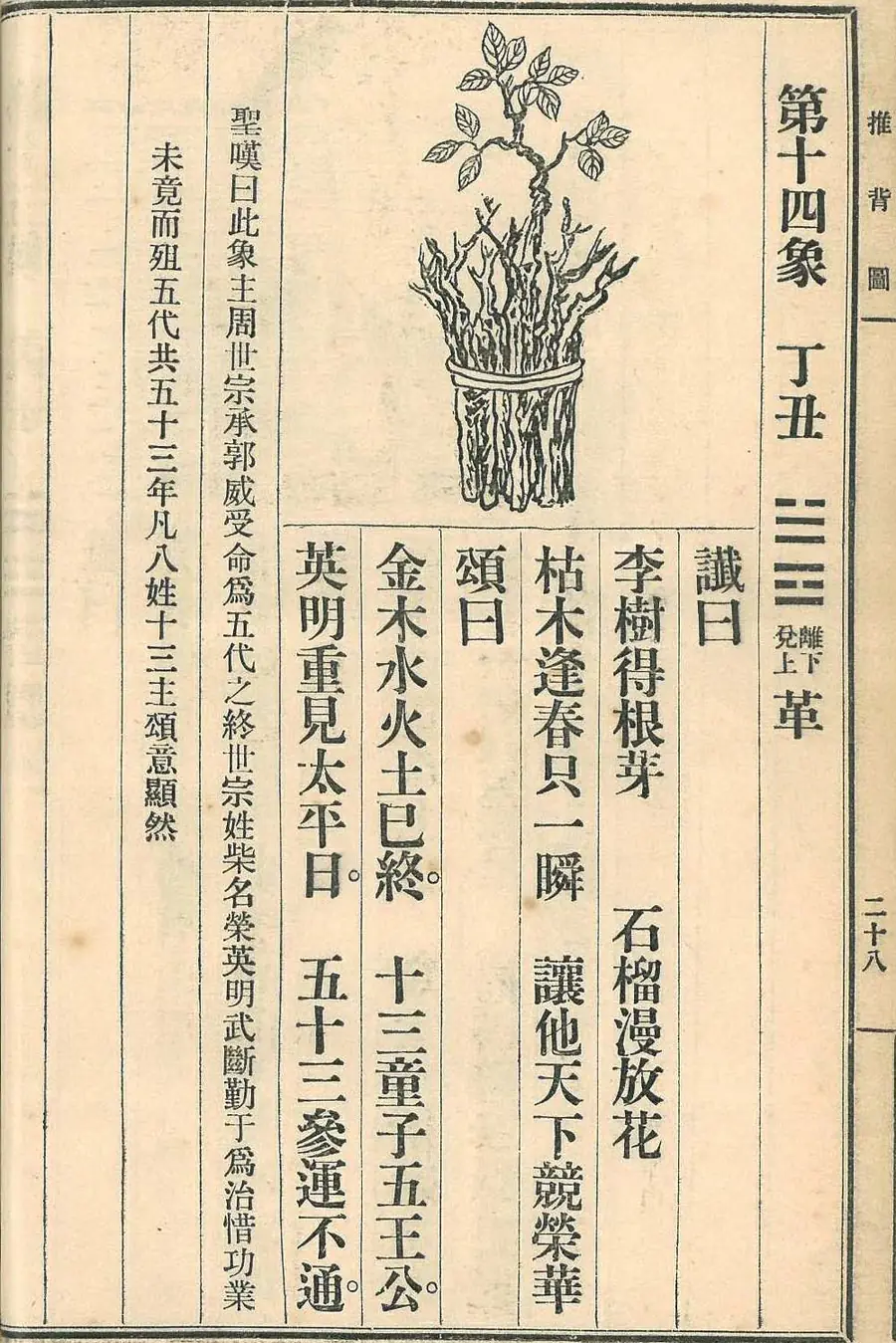
Prophecy
讖曰
李樹得根芽 石榴漫放花 枯木逢春只一瞬 讓他天下競榮華
The plum tree takes root and shoots. The pomegranate scatters its flowers wide. Dry wood meeting spring lasts only an instant, letting the world contend in glory.
Ode
頌曰
金木水火土巳終 十三童子五王公 英明重見太平日 五十三參運不通
Metal, wood, water, fire, earth — the round is finished. Thirteen children, five princely houses. Brilliance sees a day of great peace once more. At fifty-three the fortune does not pass.
Commentary
聖歎曰
聖嘆曰此象主周世宗承郭威受命爲五代之終世宗姓柴名榮英明武斷勤于爲治惜功業
Shengtan says: this image concerns Zhou Shizong, who received the mandate from Guo Wei and was the end of the Five Dynasties. Shizong's surname was Chai and his given name Rong. He was brilliant, decisive in war, and diligent in government. It is a pity that his work
Commentary
聖歎曰
未竟而殂五代共五十三年凡八姓十三主頌意顯然
was unfinished when he died. The Five Dynasties lasted fifty-three years in all, with eight surnames and thirteen sovereigns. The ode's meaning is plain.
Image 15 — Wùyín
第十五象 戊寅
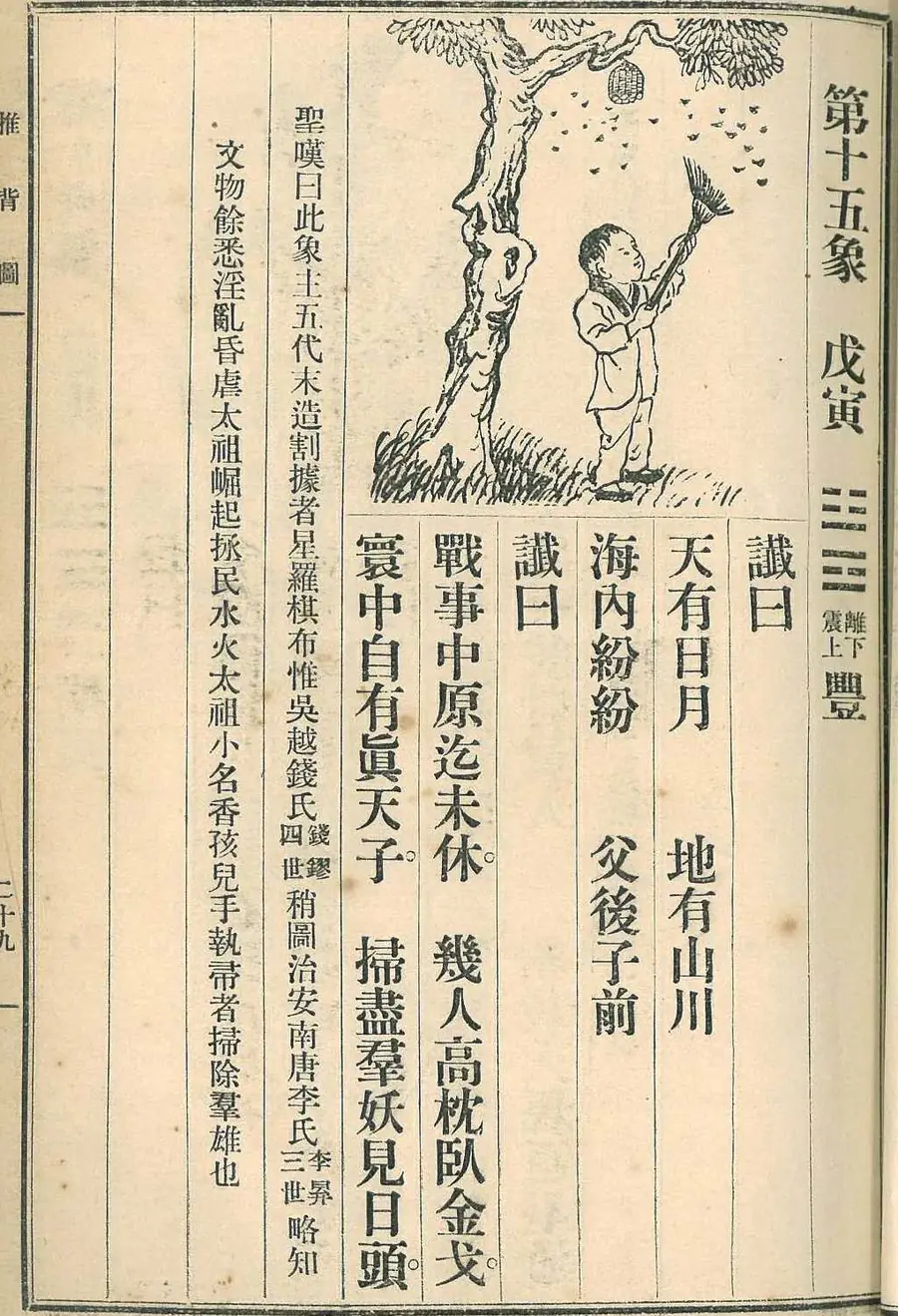
Prophecy
讖曰
天有日月 地有山川 海內紛紛 父後子前
Heaven has sun and moon. Earth has mountains and rivers. Within the seas, confusion. The father behind, the son in front.
Ode
頌曰
戰事中原迄未休 幾人高枕臥金戈 寰中自有眞天子 掃盡羣妖見日頭
Fighting in the Central Plain has not yet ceased. How many can sleep sound with weapons at hand? Within the realm there is a true Son of Heaven who sweeps the host of demons away, and the sun's face shows.
Commentary
聖歎曰
聖嘆曰此象主五代末造割據者星羅棋布惟吳越錢氏錢鏐四世稍圖治安南唐李氏李□三世略知
Shengtan says: this image concerns the last making of the Five Dynasties, when those who held territory were scattered like stars on a board. Only the Qian house of Wu-Yue — Qian Liu, four generations — made some attempt at order; and the Li house of Southern Tang — Li □, three generations — had some acquaintance with
Commentary
聖歎曰
文物餘悉淫亂昏虐太祖崛起拯民水火太祖小名香孩兒手執帚者掃除羣雄也
culture. All the rest were licentious, benighted and cruel. Taizu rose up and rescued the people from fire and flood. Taizu's childhood name was Fragrant Child, and the one holding a broom is the sweeping away of the host of contenders.