Images 16–30
推背圖 象十六至象三十
Image 16 — Jǐmǎo
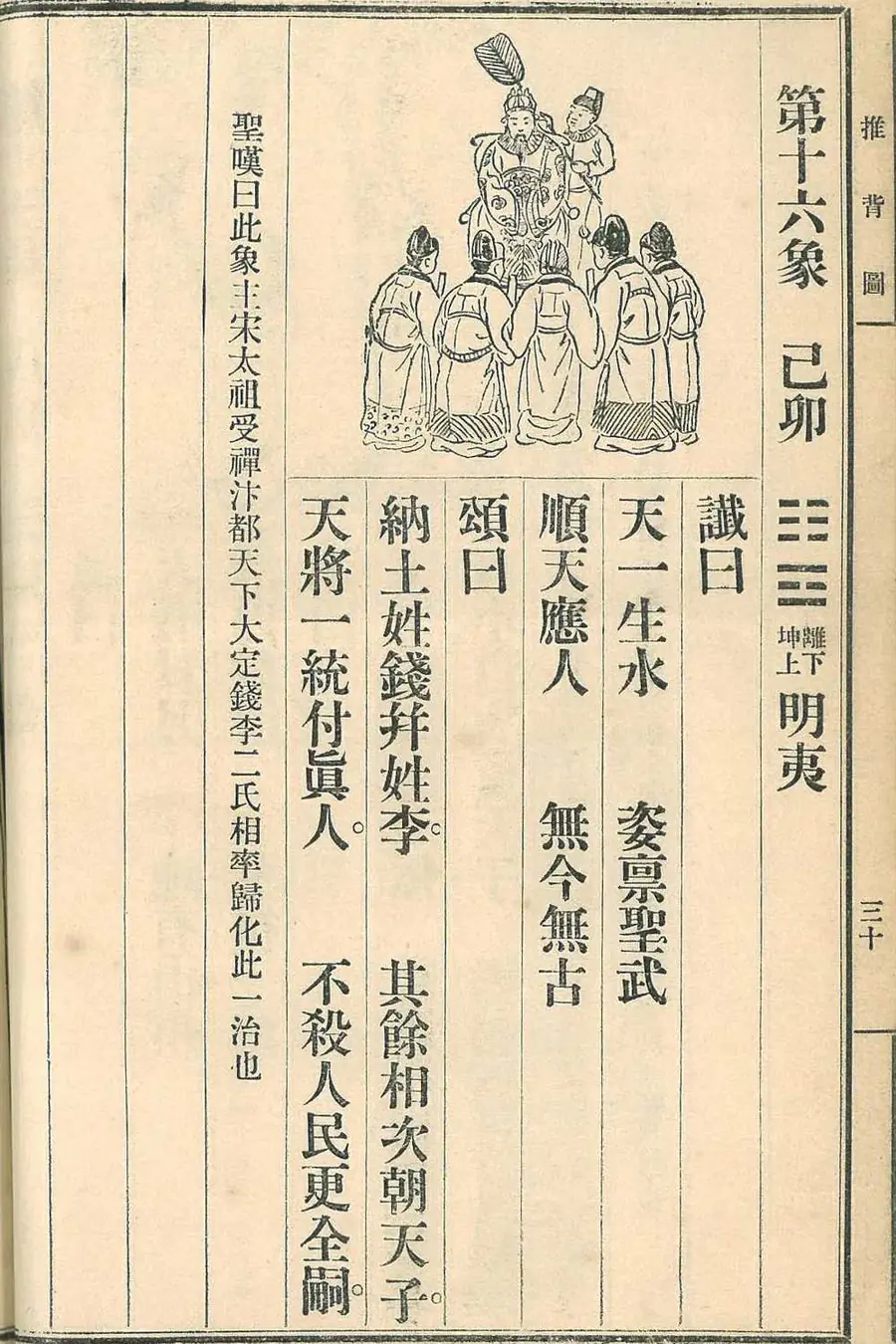
第十六象 己卯
Prophecy
讖曰
天一生水 姿禀聖武 順天應人 無今無古
Heaven-one gives birth to water. His bearing is endowed with sagely valour. He follows Heaven and answers men, without a now, without an antiquity.
Ode
頌曰
納土姓錢幷姓李 其餘相次朝天子 天將一統付眞人 不殺人民更全嗣
Surrendering their lands: the one surnamed Qian and the one surnamed Li. The rest in turn come to court the Son of Heaven. Heaven hands unification to the true man, who does not kill the people, and keeps their lines whole.
Commentary
聖歎曰
聖嘆曰此象主宋太祖受禪汴都天下大定錢李二氏相率歸化此一治也
Shengtan says: this image concerns Song Taizu receiving the abdication, with the capital at Bian, and the empire greatly settled. The two houses of Qian and Li led one another in submitting. This is one period of order.
Image 17 — Gēngchén
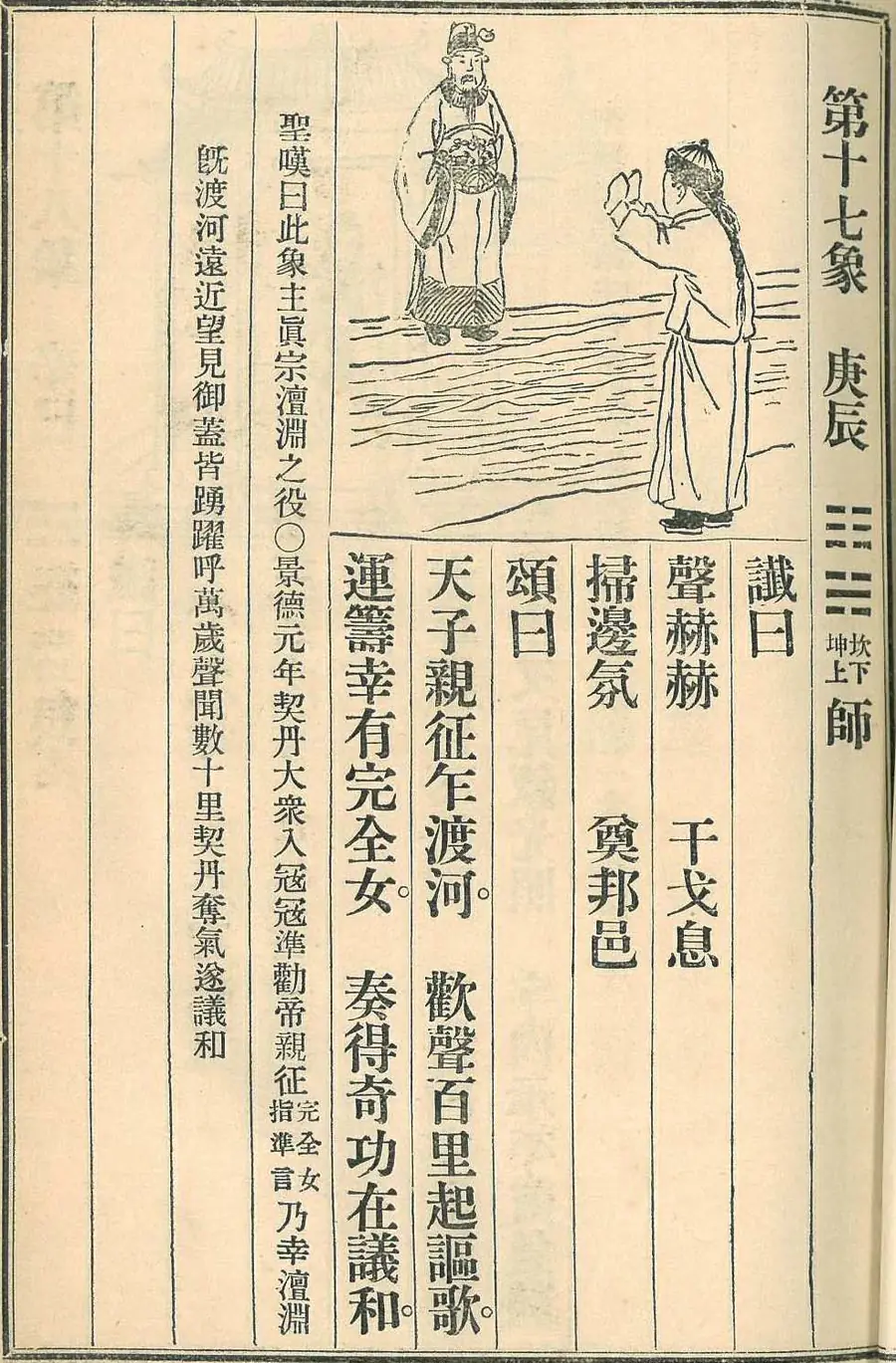
第十七象 庚辰
Prophecy
讖曰
聲赫赫 干戈息 掃邊氛 奠邦邑
The sound resounds. Shield and spear are laid down. The frontier miasma is swept. The realm and its towns are settled.
Ode
頌曰
天子親征乍渡河 歡聲百里起謳歌 運籌幸有完全女 奏得奇功在議和
The Son of Heaven leads the campaign himself and has just crossed the river. Cheering for a hundred li rises into song. In the planning, luckily, there is the Wholly-Complete Woman. And the extraordinary merit reported lies in making peace.
Commentary
聖歎曰
聖嘆曰此象主眞宗澶淵之役○景德元年契丹大衆入寇寇準勸帝親征完全女指準言乃幸澶淵
Shengtan says: this image concerns Zhenzong's campaign at Chanyuan. ○ In the first year of Jingde the Khitan invaded in force. Kou Zhun urged the emperor to lead the campaign in person — 'the Wholly-Complete Woman' refers to Zhun — and so he went to Chanyuan.
Commentary
聖歎曰
旣渡河遠近望見御蓋皆踴躍呼萬歲聲聞數十里契丹奪氣遂議和
Once he had crossed the river, near and far they caught sight of the imperial canopy and all leapt up crying 'Ten thousand years!' — the sound heard for dozens of li. The Khitan lost heart, and terms were then agreed.
Image 18 — Xīnsì
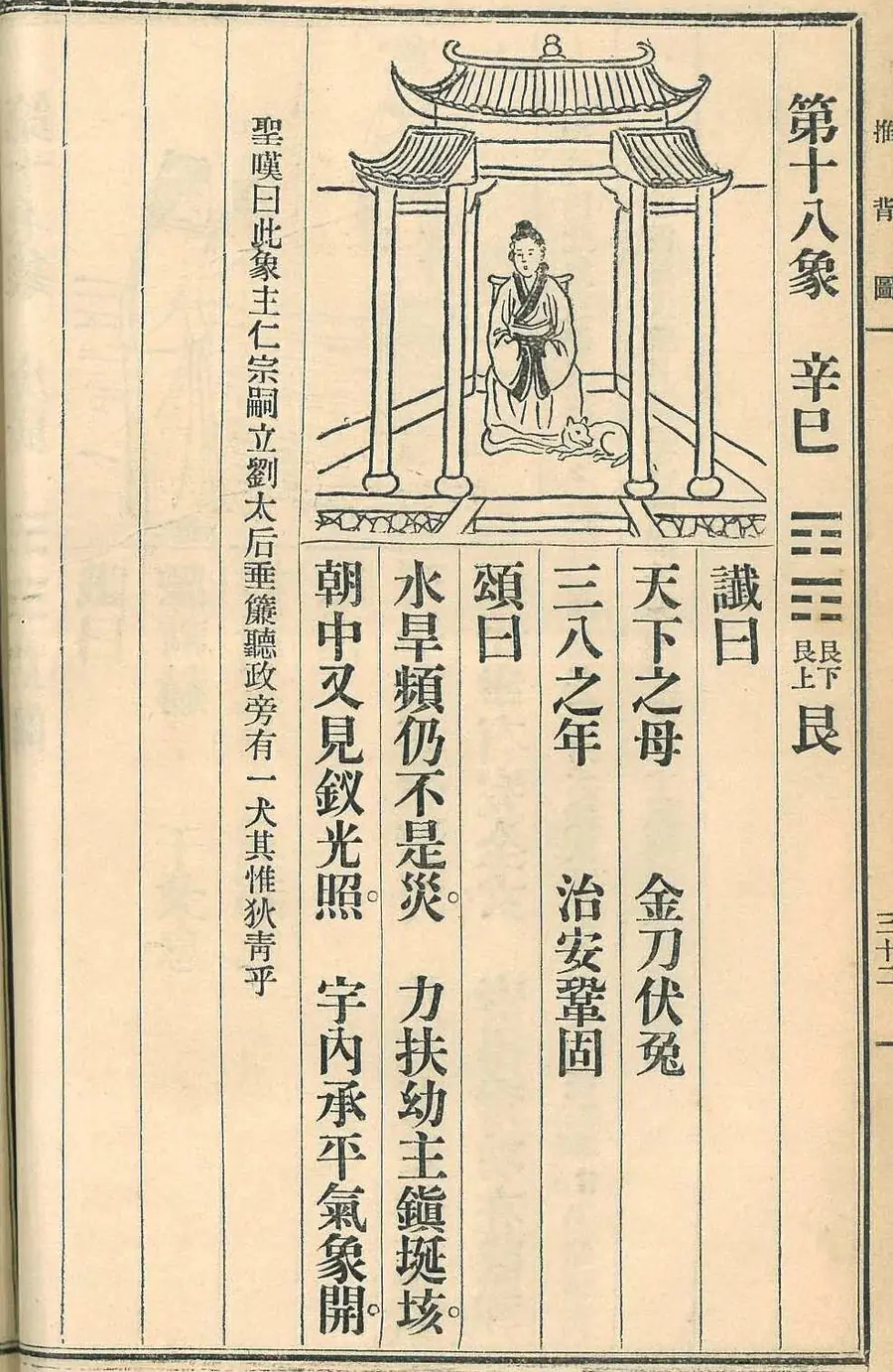
第十八象 辛巳
Prophecy
讖曰
天下之母 金刀伏兔 三八之年 治安鞏固
The mother of all under heaven. Gold blade, crouching hare. In the year of thrice-eight, order and peace are made firm.
Ode
頌曰
水旱頻仍不是災 力扶幼主鎭埏垓 朝中又見釵光照 宇內承平氣象開
Flood and drought come again and again, and are not the disaster. With her strength she upholds the boy sovereign and steadies the bounds of the earth. In the court a hairpin's light is seen once more. Within the realm an age of peace opens out.
Commentary
聖歎曰
聖嘆曰此象主仁宗嗣立劉太后垂簾聽政旁有一犬其惟狄靑乎
Shengtan says: this image concerns Renzong succeeding to the throne, with the Empress Dowager Liu governing from behind the screen. Beside her there is a dog — surely that is Di Qing?
Image 19 — Rénwǔ
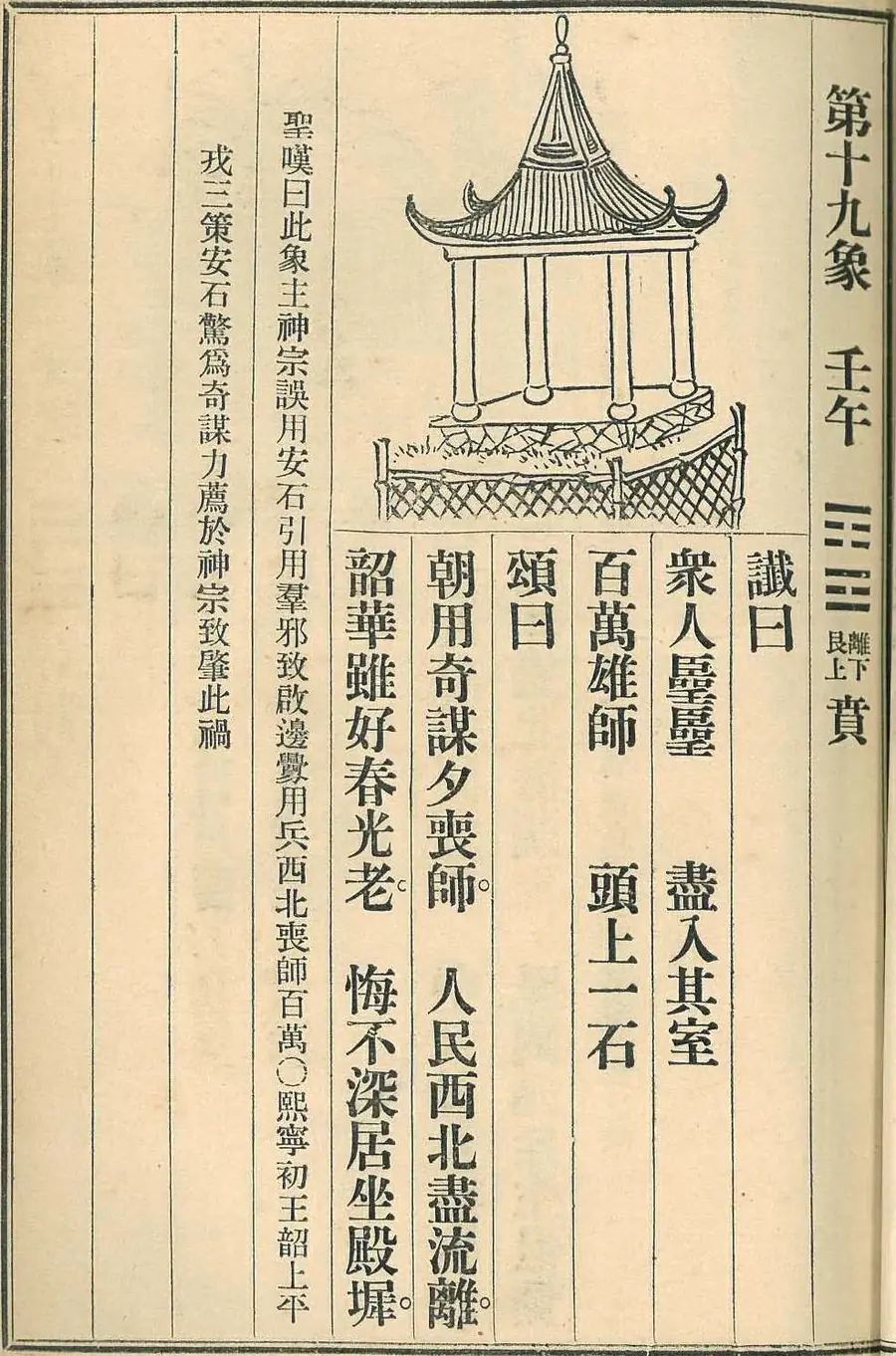
第十九象 壬午
Prophecy
讖曰
衆人壘壘 盡入其室 百萬雄師 頭上一石
The multitude heaped upon each other, all entering his chamber. A million valiant troops, and one stone above their heads.
Ode
頌曰
朝用奇謀夕喪師 人民西北盡流離 韶華雖好春光老 悔不深居坐殿墀
In the morning a marvellous stratagem is adopted; by evening the army is lost. The people of the northwest are scattered to the winds. Though the bright years were fine, the spring light grows old. He regrets not having stayed deep within, seated on the palace steps.
Commentary
聖歎曰
聖嘆曰此象主神宗誤用安石引用羣邪致啟邊釁用兵西北喪師百萬○熙寧初王韶上平
Shengtan says: this image concerns Shenzong wrongly employing Anshi, who brought in a crowd of corrupt men and so opened quarrels on the frontier; troops were committed in the northwest and a million men were lost. ○ Early in the Xining reign Wang Shao submitted his Three
Commentary
聖歎曰
戎三策安石驚爲奇謀力薦於神宗致肇此禍
Strategies for Pacifying the Rong. Anshi was struck by them, took them for a marvellous stratagem, and pressed them strongly on Shenzong — which brought on this disaster.
Image 20 — Guǐwèi
第二十象 癸未
Prophecy
讖曰
朝無光 日月盲 莫與京 終旁皇
The court is without light. Sun and moon are blind. None can match the Capital. And in the end, wandering bewildered.
Ode
頌曰
父子同心幷同道 中天日月手中物 奇雲翻過北海頭 鳳闕龍廷生怛惻
Father and son of one mind and one road. Sun and moon at heaven's centre are things held in their hands. Strange clouds roll over the head of the northern sea. And in the phoenix towers and dragon court, grief is born.
Commentary
聖歎曰
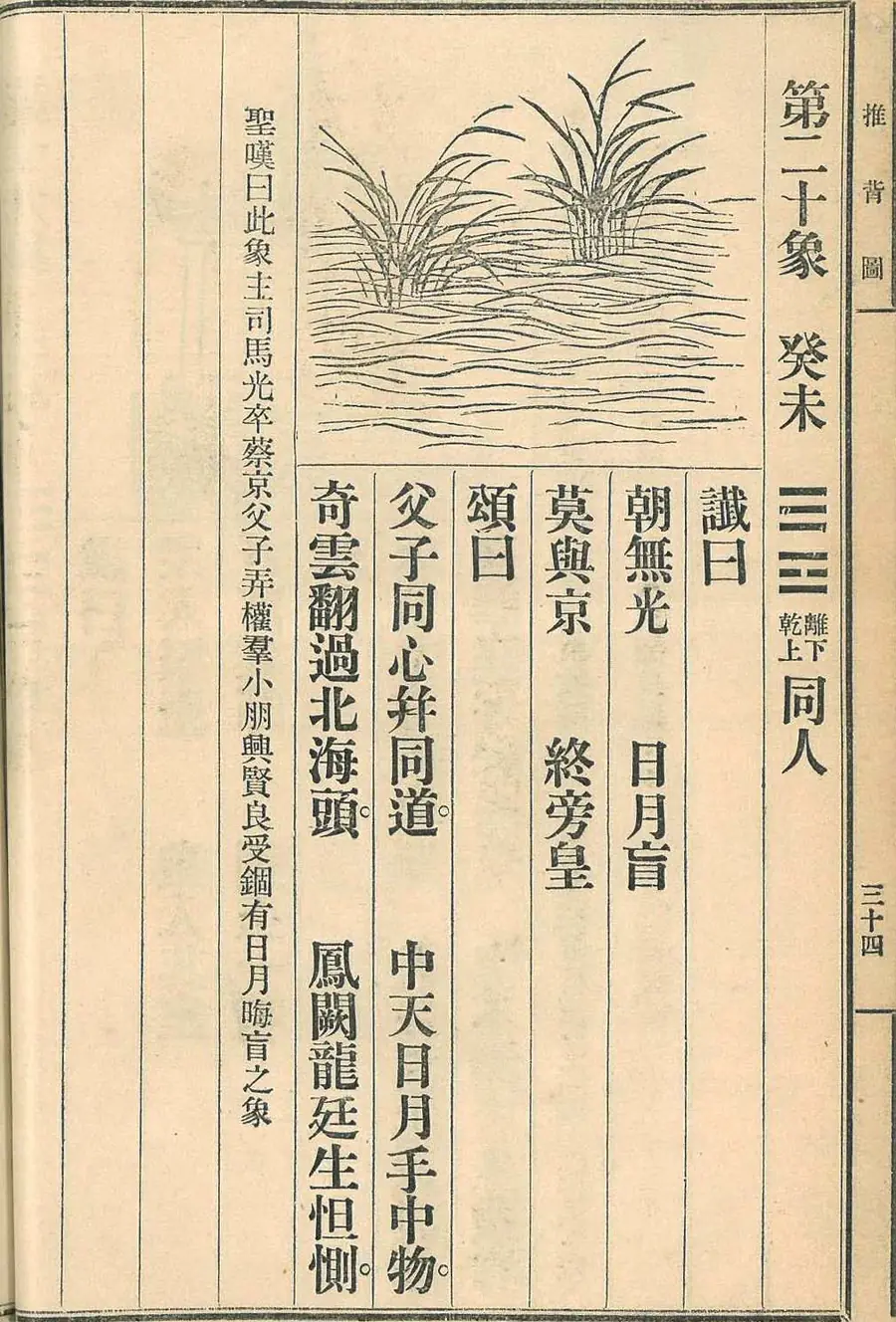
聖嘆曰此象主司馬光卒蔡京父子弄權羣小朋興賢良受錮有日月晦盲之象
Shengtan says: this image concerns the death of Sima Guang; Cai Jing and his son manipulating power; petty men rising in factions; the worthy proscribed. There is here the image of sun and moon darkened and blind.
Image 21 — Jiǎshēn
第二十一象 甲申
Prophecy
讖曰
空厥宮中 雪深三尺 吁嗟元□ 南轅北轍
Empty, the interior of his palace. The snow lies three feet deep. Alas — the primal □. The shaft points south, the wheel-ruts run north.
Ode
頌曰
妖氛未靖不康寧 北掃烽烟望帝京 異姓立朝終國位 卜世三六叉南行
The baleful vapour not yet quelled, there is no peace. From the north the beacon-smoke sweeps; they look toward the imperial capital. A house of another surname sets up its court and ends the state's standing. The divined generations, thrice six — and again a march to the south.
Image 22 — Yǐyǒu
第二十二象 乙酉
Prophecy
讖曰
天⿰易彡當空 否極見泰 鳳鳳淼淼 木冓大賴
Heaven's ⿰易彡 stands in the sky. When obstruction reaches its limit, peace appears. Phoenix, phoenix; waters wide and wide. Wood-Gou is the great reliance.
Ode
頌曰
神京王氣滿東南 禍水汪洋把策干 一木會支二八月 臨行馬色半平安
The royal aura of the sacred capital fills the southeast. Disaster's waters, vast, take up whip and shield. One wood meeting a branch, in the second and eighth month. At the moment of setting out, the horse's colour is half at peace.
Commentary
聖歎曰
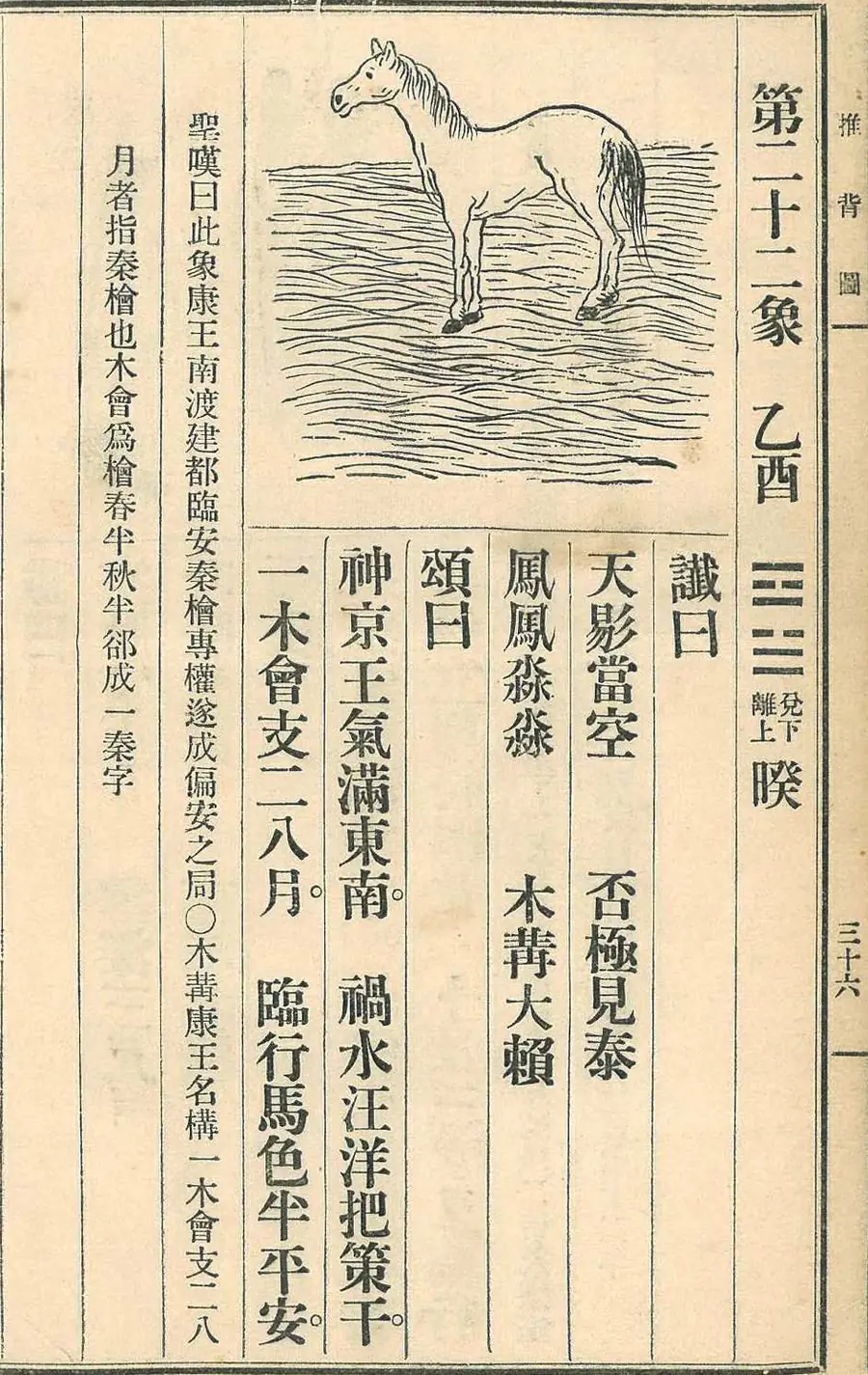
聖嘆曰此象康王南渡建都臨安秦檜專權遂成偏安之局○木冓康王名構一木會支二八
Shengtan says: this image is the Prince of Kang crossing to the south and fixing his capital at Lin'an, with Qin Hui monopolising power, so that a settlement of half the realm came about. ○ Wood-Gou: the Prince of Kang's given name is Gou. One-wood-meeting-branch, in the second and eighth
Commentary
聖歎曰
月者指秦檜也木會爲檜春半秋半郤成一秦字
months, points to Qin Hui. Wood plus meeting makes Hui. Half of spring and half of autumn together make the character Qin.
Image 23 — Bǐngxū
第二十三象 丙戌
Prophecy
讖曰
似道非道 乾沈坤驗 祥光宇內 一江斷楫
Seeming the Way, and not the Way. Qian sinks; Kun is borne out. Auspicious light within the realm. One river, and a broken oar.
Ode
頌曰
胡兒大張撻伐威 兩柱擎天力不支 如何兵火連天夜 猶自張燈作水嬉
The Hu lads make great display of the majesty of chastisement. Two pillars holding up heaven have not the strength. How is it that on nights when war-fire fills the sky he is still hanging lanterns and staging water-games?
Commentary
聖歎曰
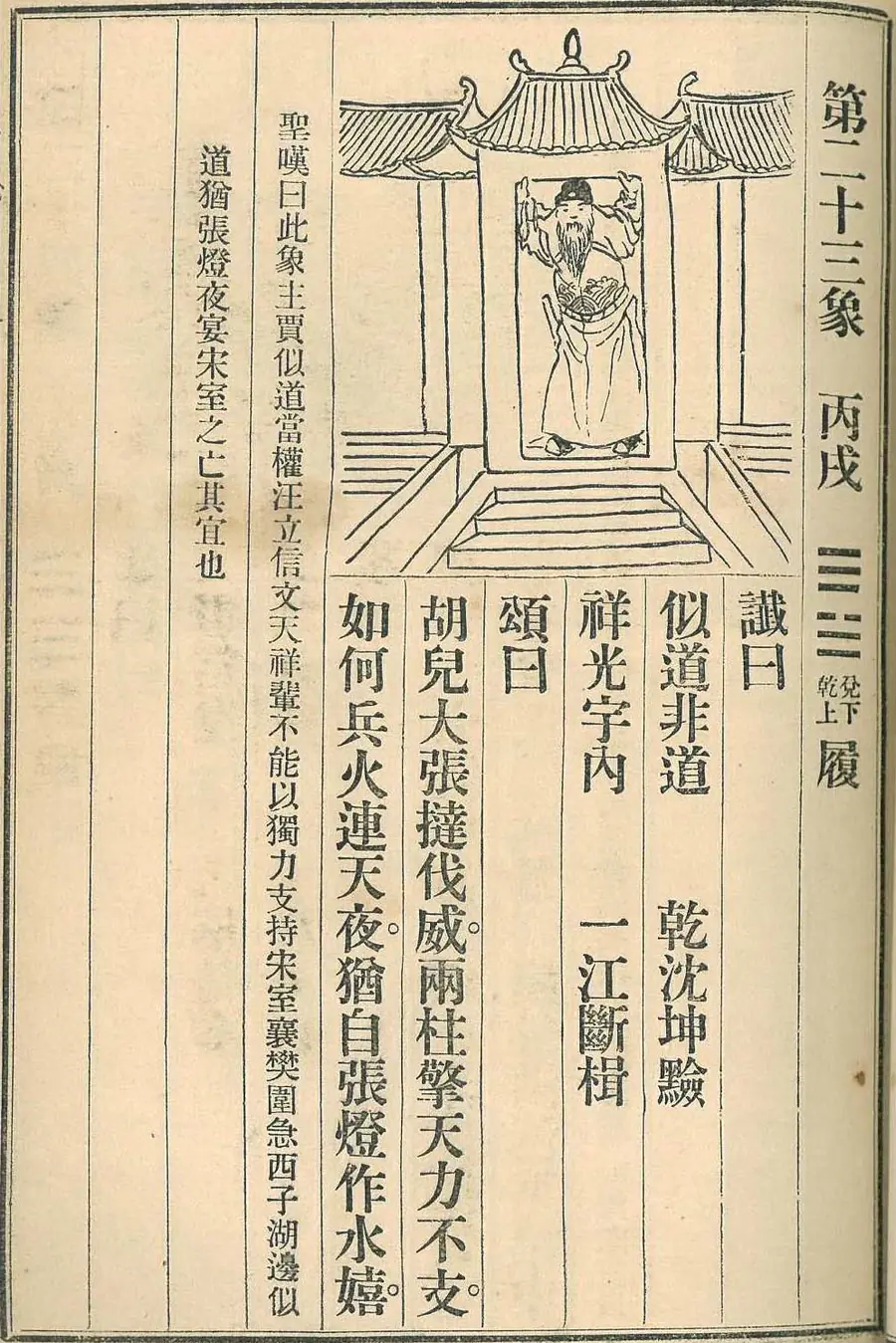
聖嘆曰此象主賈似道當權汪立信文天祥輩不能以獨力支持宋室襄樊圍急西子湖邊似
Shengtan says: this image concerns Jia Sidao holding power, while men of the stamp of Wang Lixin and Wen Tianxiang could not hold up the Song house by their own strength alone. With Xiangyang and Fancheng hard pressed by siege, on the shore of West Lake Si-
Commentary
聖歎曰
道猶張燈夜宴宋室之亡其宜也
dao was still hanging lanterns and feasting through the night. That the Song house perished was only fitting.
Image 24 — Dīnghài
第二十四象 丁亥
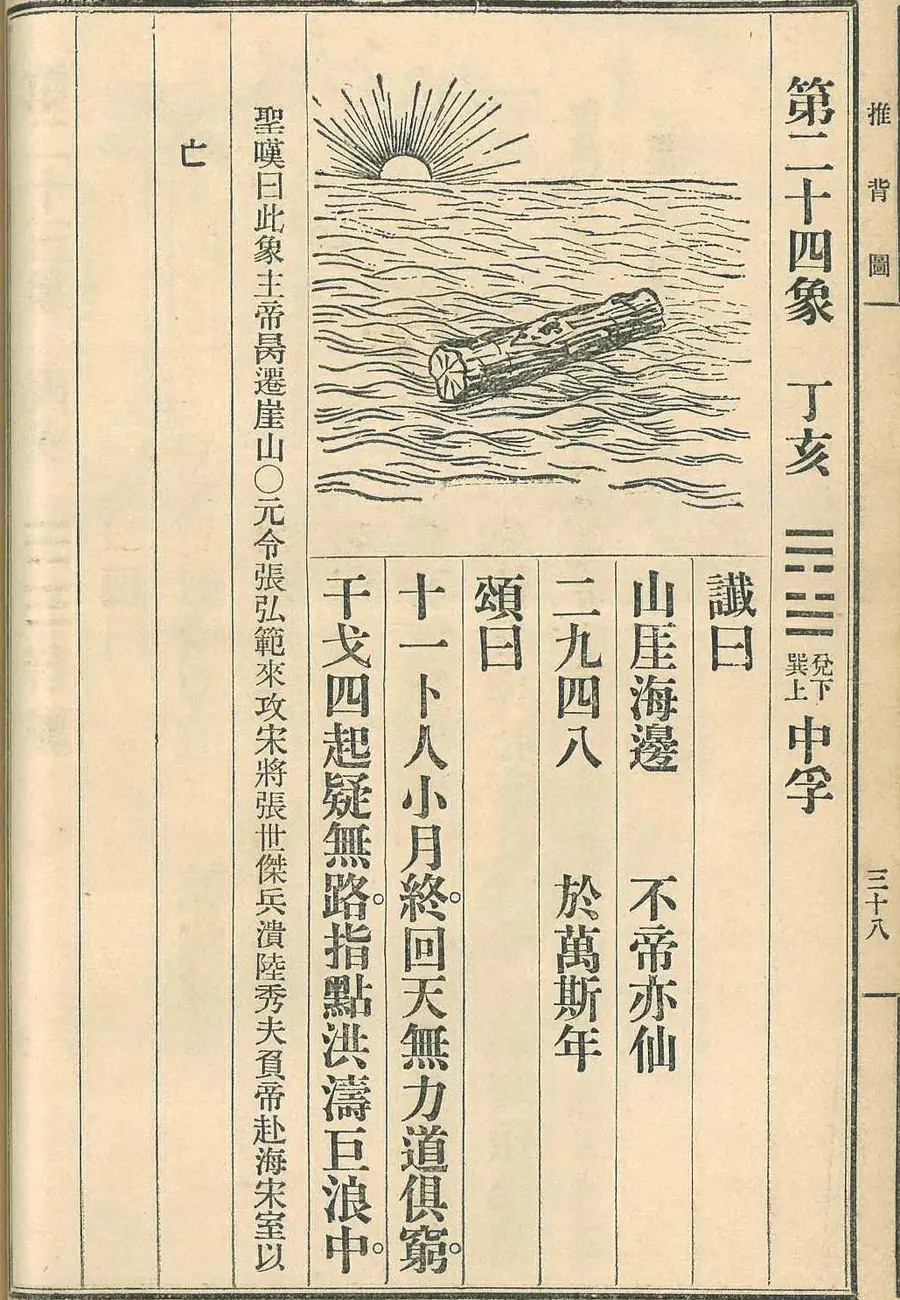
Prophecy
讖曰
山厓海邊 不帝亦仙 二九四八 於萬斯年
Mountain cliff, edge of the sea. Not an emperor, and yet an immortal. Twice nine, four eights, for ten thousand years.
Ode
頌曰
十一卜人小月終 回天無力道俱窮 干戈四起疑無路 指點洪濤巨浪中
Ten, one, divination, man — the small month ends. No strength to turn back heaven; the road is wholly spent. Weapons rise on four sides; there seems to be no way out. Pointing out into the vast breakers and the towering waves.
Commentary
聖歎曰
聖嘆曰此象主帝昺遷崖山○元令張弘範來攻宋將張世傑兵潰陸秀夫負帝赴海宋室以
Shengtan says: this image concerns Emperor Bing removing to Yashan. ○ The Yuan ordered Zhang Hongfan to attack; the Song general Zhang Shijie's troops were routed; Lu Xiufu took the emperor on his back and went into the sea, and with that the Song house
Commentary
聖歎曰
亡
perished.
Image 25 — Wùzǐ
第二十五象 戊子
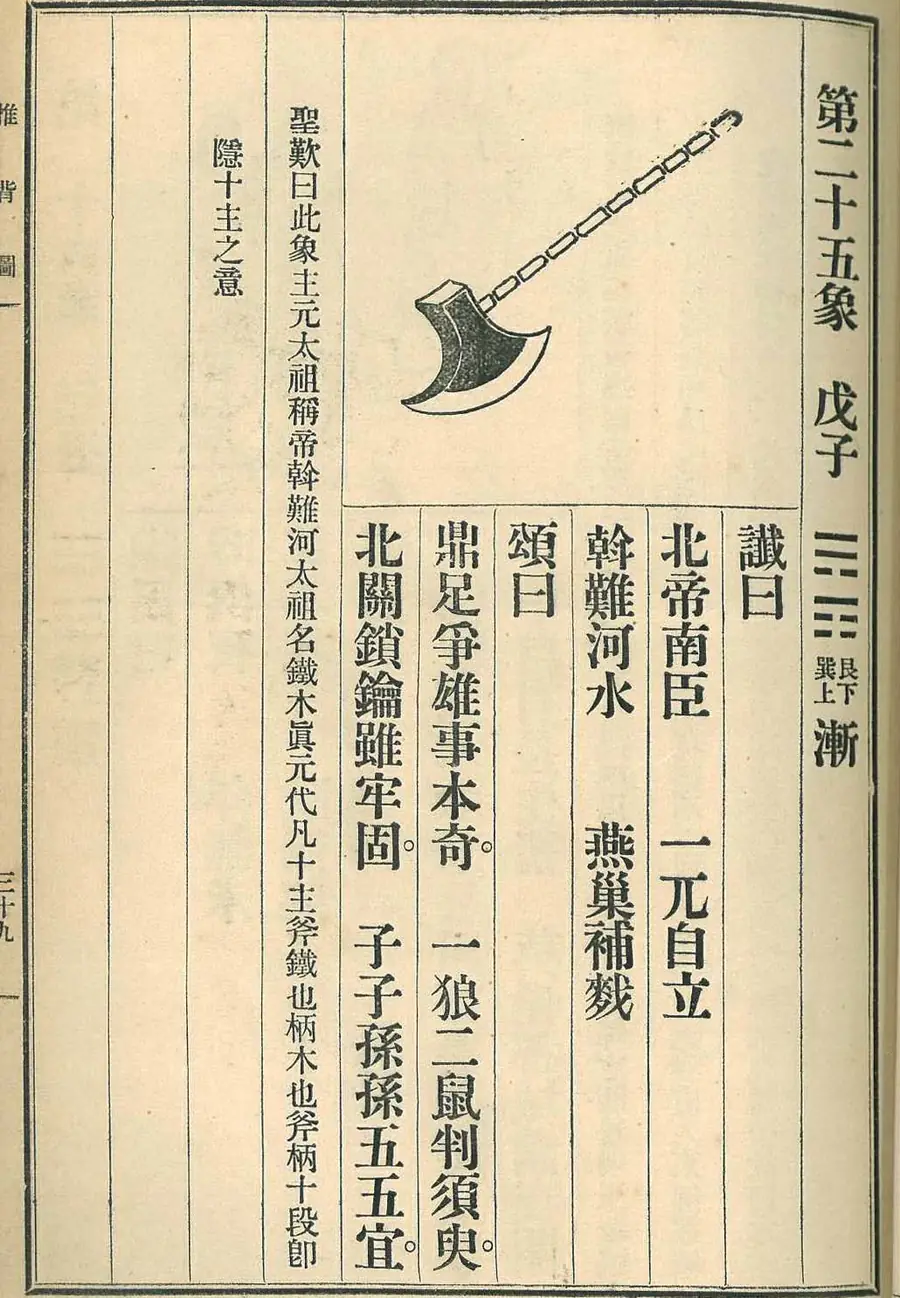
Prophecy
讖曰
北帝南臣 一元自立 斡難河水 燕巢補戮
A northern emperor, a southern subject. One Origin sets itself up. The waters of the Onon. The swallow's nest patched, and the slaughter.
Ode
頌曰
鼎足爭雄事本奇 一狼二鼠判須臾 北關鎖鑰雖牢固 子子孫孫五五宜
Three legs of the cauldron contending for mastery — the affair was strange from the first. One wolf and two rats were decided in a moment. Though the northern pass's lock and key were firm, sons and grandsons, five and five, as was fitting.
Commentary
聖歎曰
聖歎曰此象主元太祖稱帝斡難河太祖名鐵木眞元代凡十主斧鐵也柄木也斧柄十段卽
Shengtan says: this image concerns the Yuan Taizu proclaiming himself emperor at the Onon River. Taizu's name was Temüjin. The Yuan had ten sovereigns in all. An axe is iron; its handle is wood; and an axe-handle in ten sections is precisely
Commentary
聖歎曰
隱十主之意
the hidden sense of 'ten sovereigns'.
Image 26 — Jǐchǒu
第二十六象 己丑
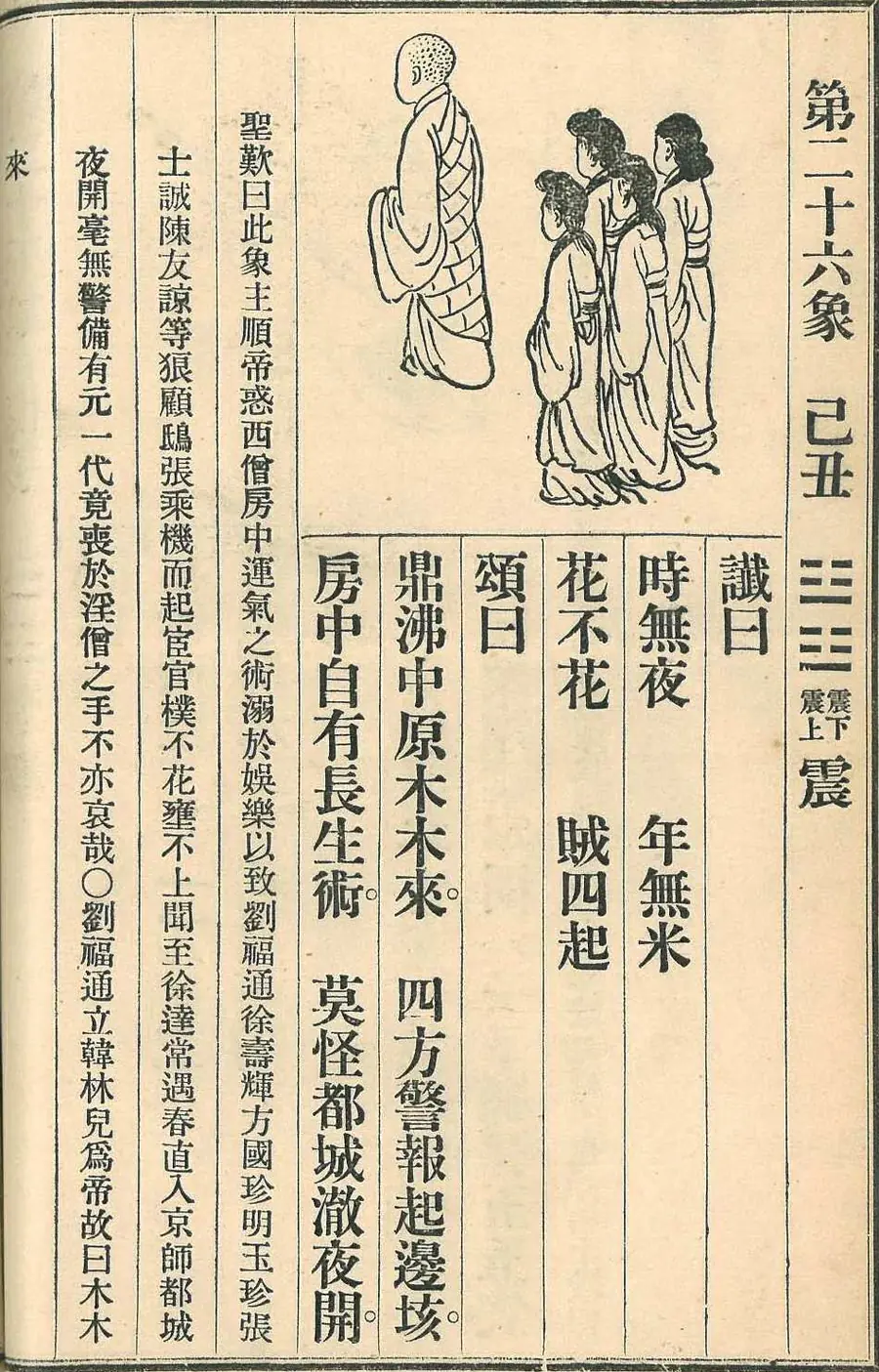
Prophecy
讖曰
時無夜 年無米 花不花 賊四起
The hour has no night. The year has no rice. The flower does not flower. Bandits rise on four sides.
Ode
頌曰
鼎沸中原木木來 四方警報起邊垓 房中自有長生術 莫怪都城澈夜開
The Central Plain boils like a cauldron; wood-wood comes. Alarms from the four quarters rise at the frontier. In the bedchamber there is an art of long life. No wonder the capital's gates stood open all night.
Commentary
聖歎曰
聖歎曰此象主順帝惑西僧房中運氣之術溺於娛樂以致劉福通徐壽輝方國珍明玉珍張
Shengtan says: this image concerns Shundi being deluded by the western monks' bedchamber arts of circulating the breath, and drowning himself in pleasures — so that Liu Futong, Xu Shouhui, Fang Guozhen, Ming Yuzhen, Zhang
Commentary
聖歎曰
士誠陳友諒等狼顧鴟張乘機而起宦官樸不花壅不上聞至徐達常遇春直入京師都城
Shicheng, Chen Youliang and the rest watched like wolves and spread like owls, seizing their moment to rise; and the eunuch Buqa blocked the reports from reaching him, until Xu Da and Chang Yuchun marched straight into the capital, and the city
Commentary
聖歎曰
夜開毫無警備有元一代竟喪於淫僧之手不亦哀哉○劉福通立韓林兒爲帝故曰木木
gates stood open at night with no guard at all. A whole dynasty of Yuan was lost in the end into the hands of a lecherous monk — is that not pitiful! ○ Liu Futong set up Han Lin'er as emperor, and so the text says 'wood-wood'.
Image 27 — Gēngyín
第二十七象 庚寅
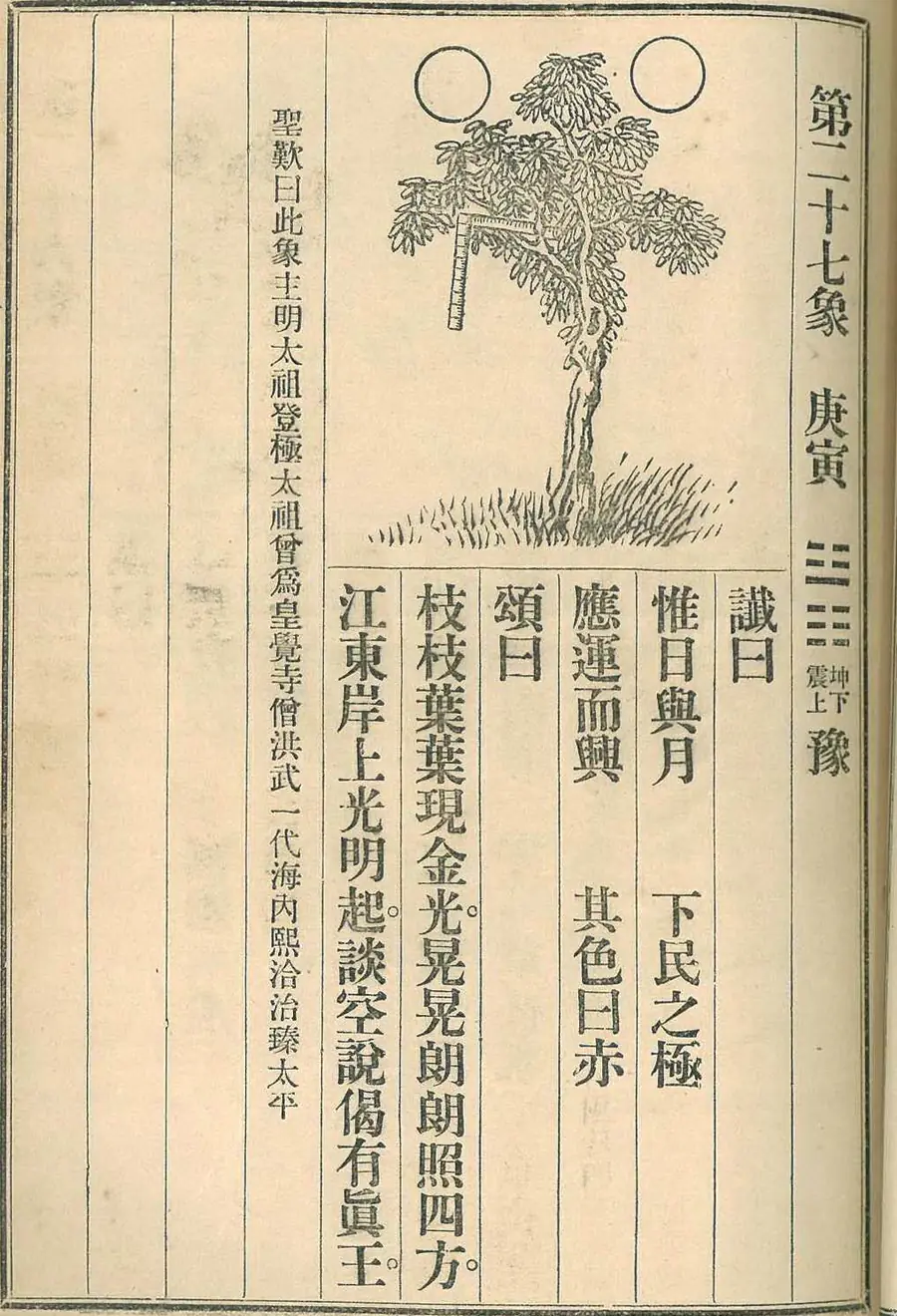
Prophecy
讖曰
惟日與月 下民之極 應運而興 其色曰赤
Only the sun and the moon. The utmost of the people below. Rising in answer to the turning, its colour is called red.
Ode
頌曰
枝枝葉葉現金光 晃晃朗朗照四方 江東岸上光明起 談空說偈有眞王
Branch upon branch, leaf upon leaf, a golden light appears, dazzling and clear, shining to the four quarters. On the eastern bank of the river a brightness rises: talking of emptiness and reciting gathas, there is a true king.
Commentary
聖歎曰
聖歎曰此象主明太祖登極太祖曾爲皇覺寺僧洪武一代海內熙洽治臻太平
Shengtan says: this image concerns Ming Taizu ascending the throne. Taizu had once been a monk at the Huangjue temple. Through the Hongwu reign the realm was harmonious, and its order reached great peace.
Image 28 — Xīnmǎo
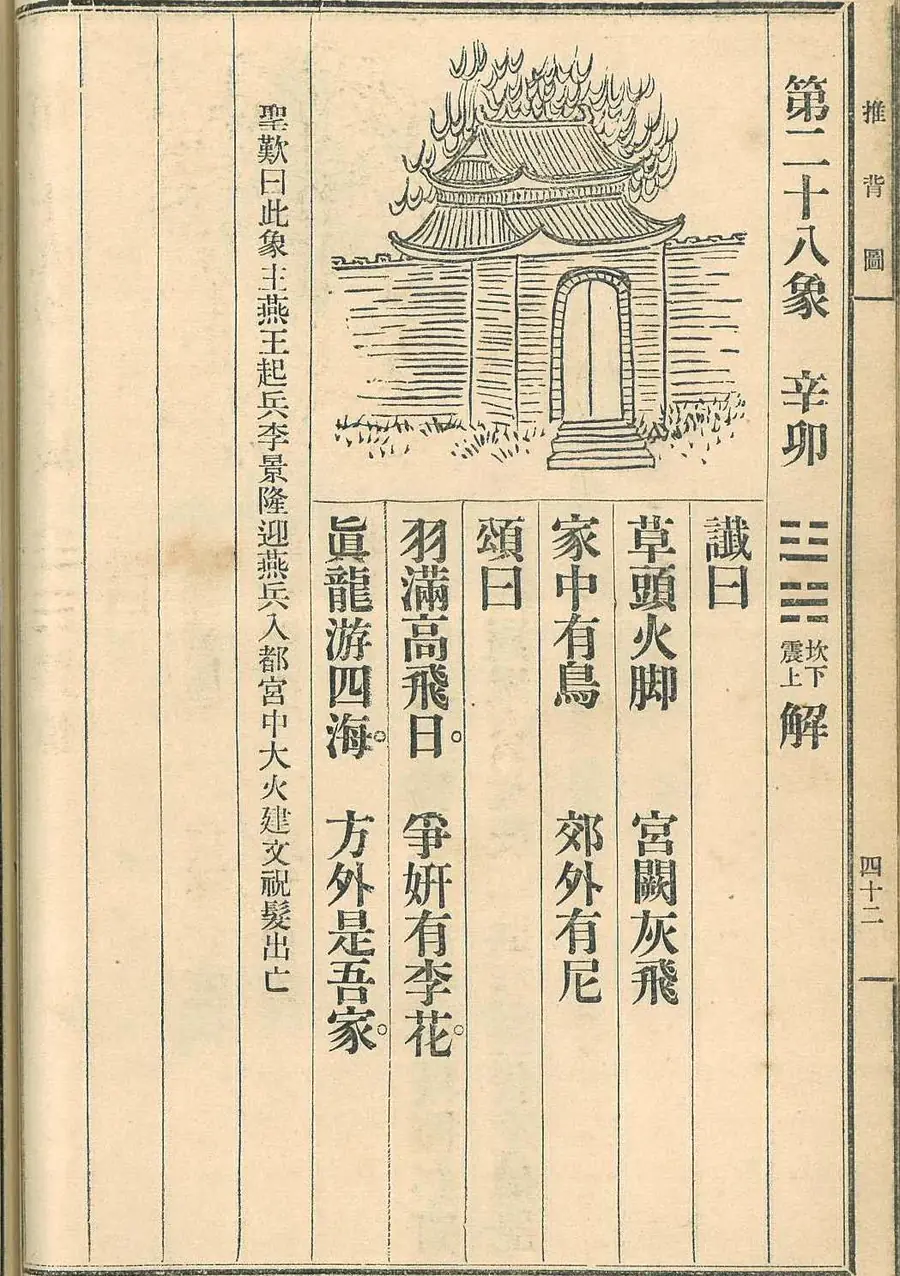
第二十八象 辛卯
Prophecy
讖曰
草頭火脚 宮闕灰飛 家中有鳥 郊外有尼
Grass for a head, fire for feet. The palace halls fly up as ash. In the house there is a bird. Beyond the walls there is a nun.
Ode
頌曰
羽滿高飛日 爭妍有李花 眞龍游四海 方外是吾家
When the feathers are full, the day of high flight. Vying in beauty, there is the plum blossom. The true dragon roams the four seas. Beyond the world is my home.
Commentary
聖歎曰
聖歎曰此象主燕王起兵李景隆迎燕兵入都宮中大火建文祝髮出亡
Shengtan says: this image concerns the Prince of Yan raising troops; Li Jinglong welcoming the Yan army into the capital; great fire in the palace; and Jianwen shaving his head and fleeing.
Image 29 — Rénchén
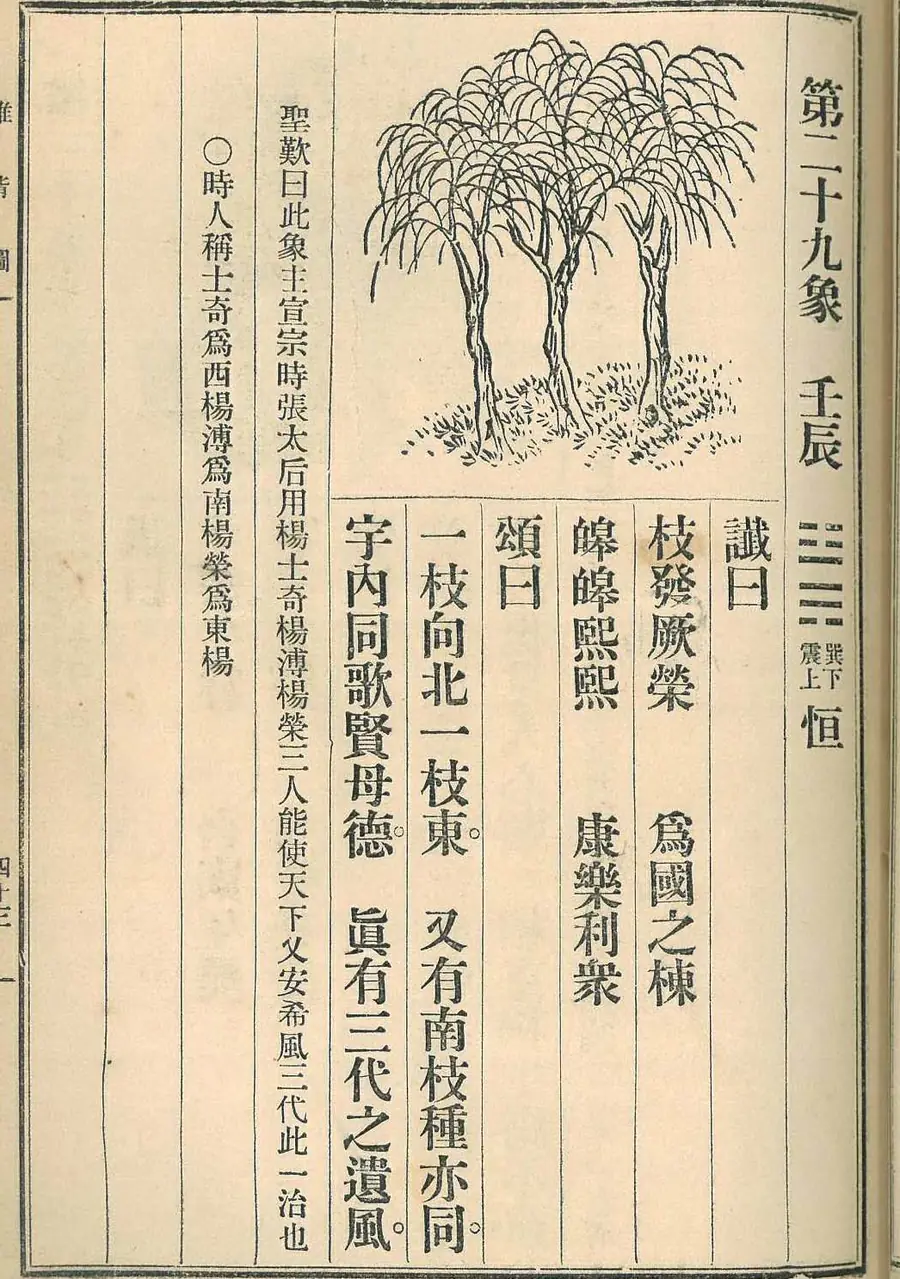
第二十九象 壬辰
Prophecy
讖曰
枝發厥榮 爲國之棟 皞皞熙熙 康樂利衆
The branch puts forth its glory. It becomes the ridgepole of the state. Broad and bright, glad and content: peace and joy profit the multitude.
Ode
頌曰
一枝向北一枝東 叉有南枝種亦同 宇內同歌賢母德 眞有三代之遺風
One branch toward the north, one branch east. There is a southern branch as well, of the same planting. Within the realm all sing the worthy mother's virtue. Here truly is the surviving air of the Three Dynasties.
Commentary
聖歎曰
聖歎曰此象主宣宗時張太后用楊士奇楊溥楊榮三人能使天下乂安希風三代此一治也
Shengtan says: this image concerns the time of Xuanzong, when the Empress Dowager Zhang employed Yang Shiqi, Yang Pu and Yang Rong — three men who were able to bring the realm to order and quiet, aspiring to the air of the Three Dynasties. This is one period of order.
Commentary
聖歎曰
○時人稱士奇爲西楊溥爲南楊榮爲東楊
○ People of the time called Shiqi the Western Yang, Pu the Southern Yang, and Rong the Eastern Yang.
Image 30 — Guǐsì
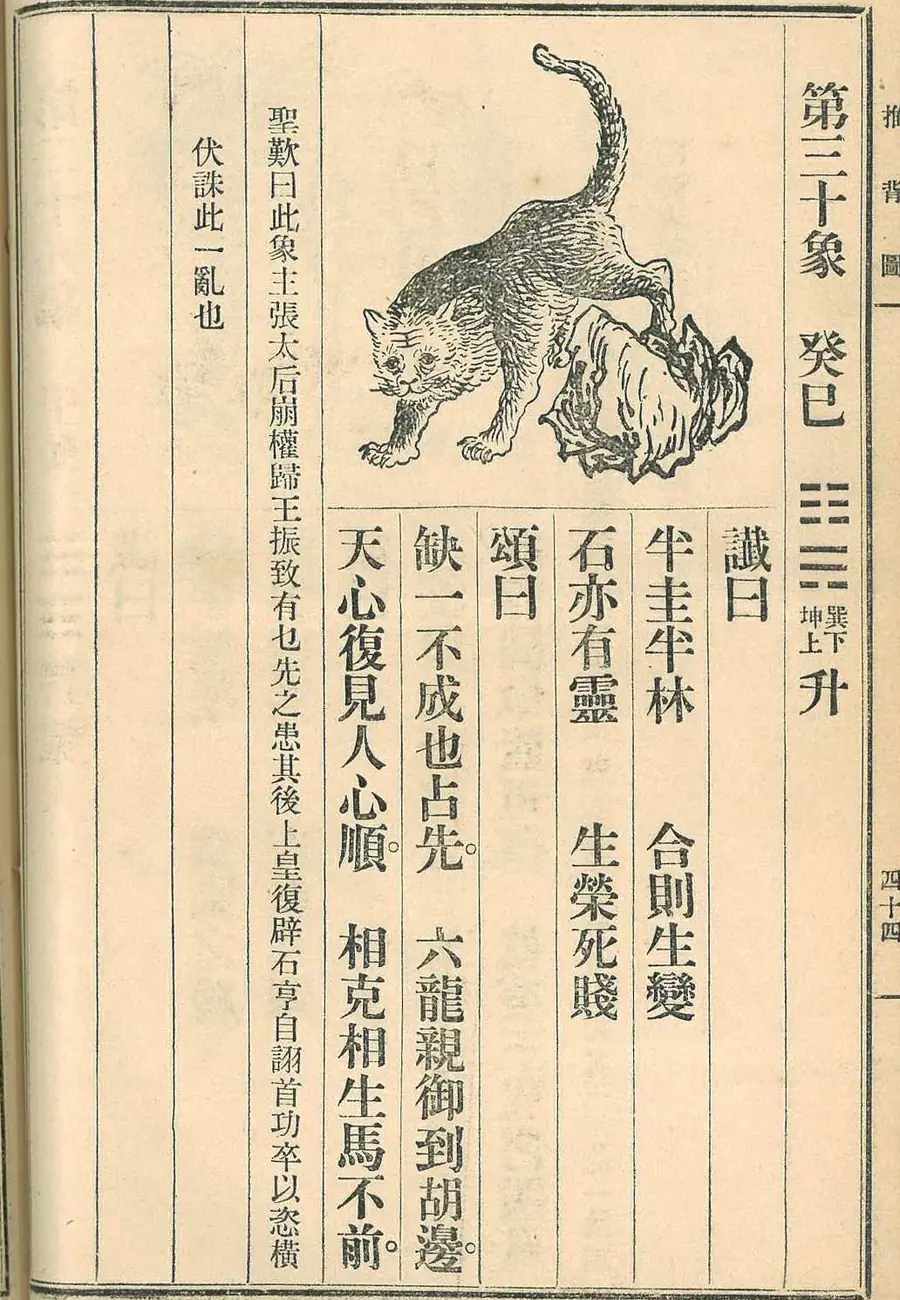
第三十象 癸巳
Prophecy
讖曰
半圭半林 合則生變 石亦有靈 生榮死賤
Half a jade tablet, half a grove. Joined, they breed upheaval. The stone too has a spirit: glorious in life, base in death.
Ode
頌曰
缺一不成也占先 六龍親御到胡邊 天心復見人心順 相克相生馬不前
Lacking one it cannot be whole; 'also' takes the lead. The six dragons drive in person to the barbarian border. Heaven's heart is seen again, and men's hearts comply. Mutual conquest, mutual generation — the horse does not advance.
Commentary
聖歎曰
聖歎曰此象主張太后崩權歸王振致有也先之患其後上皇復辟石亨自詡首功卒以恣橫
Shengtan says: this image concerns the death of Empress Dowager Zhang, power passing to Wang Zhen, and so the trouble of Esen; and afterwards the Retired Emperor's restoration, when Shi Heng, boasting the chief merit, ended by being executed for his arrogance.
Commentary
聖歎曰
伏誅此一亂也
This is one period of disorder.