噬嗑
Shì Kè — Biting Through
upper trigram
離Fire (Clinging)lower trigram
震Thunder (Movement)The Judgment
亨。利用獄。
Character-by-character gloss
Modern Interpretation
Success. It is favorable to administer justice. When unity is blocked, bite through the obstruction. The obstacle between the teeth must be eliminated. Legal proceedings, clear penalties—these restore order.
The Image
電雷,噬嗑。先王以明罰勅法。
Character-by-character gloss
Modern Interpretation
Thunder and lightning. Ancient kings made the laws firm through clearly defined penalties. Light and force together: clarity about consequences enables enforcement.
「電雷,噬嗑。先王以明罰勅法。」閃電讓人看清楚,雷聲讓人敬畏。刑罰是法律的具體應用。輕重分明,人們才知道界線在哪裡。執行不嚴,法律就沒有力量。但刑罰不是目的——是為了讓人不越界。
The Six Lines
First (Bottom) Line
初九 履校滅趾。无咎。
Modern Interpretation
Feet locked in stocks, toes gone. No blame. Punishment at the beginning stops wrong early. The small penalty prevents the greater crime. Better to lose toes than continue.
Second Line
六二 噬膚滅鼻。无咎。
Modern Interpretation
Biting through tender meat, nose disappearing. No blame. Easy to bite through, but the action still costs something. Enforcement has consequences even when successful.
Third Line
六三 噬腊肉。遇毒。小吝。无咎。
Modern Interpretation
Biting through old dried meat, encountering poison. Small humiliation, no blame. Harder material, hidden danger. The work is unpleasant, maybe shameful, but necessary.
Fourth Line
九四 噬乾胏。得金矢。利艱貞。吉。
Modern Interpretation
Biting through gristly meat, finding metal arrowheads. Persistence in difficulty brings good fortune. Very hard work, discovering the weapon within the problem. Persevere through the difficulty.
Fifth Line
六五 噬乾肉。得黃金。貞厲。无咎。
Modern Interpretation
Biting through dried meat, finding yellow gold. Perseverance with awareness of danger. No blame. Hard work yields treasure. Remain alert to the dangers that come with the prize.
Sixth (Top) Line
上九 何校滅耳。凶。
Modern Interpretation
Neck locked in a wooden collar, ears gone. Misfortune. Punishment at the end—you didn't learn from earlier warnings. Now hearing itself is lost. Too late for correction.
Yilin Verse
From the Forest of Changes (焦氏易林) — 噬嗑 Shì Kè (Biting Through)
麒麟鳳凰,善政德祥;陰陽和調,國無災殃。
Qilin and phoenix -- auspicious signs of benevolent rule. Yin and yang are harmonized and balanced; the kingdom suffers no calamity.
Full explanation
Fire and thunder return to themselves — Biting Through reflecting upon its own nature. The qilin and the phoenix appear, signs of sage governance and virtuous omens. Yin and yang are harmoniously balanced, and the state knows no calamity. These auspicious creatures emerge only under a sage's rule: the qilin treads on no living grass, the phoenix nests in paulownia. Their arrival signals that the legal order of hexagram 21 has achieved its ultimate purpose — not perpetual punishment but the creation of conditions so just that punishment becomes unnecessary. The doubled hexagram completes the circle: law perfectly administered makes itself obsolete.
Masterpiece
A work of art reflecting this hexagram's essence
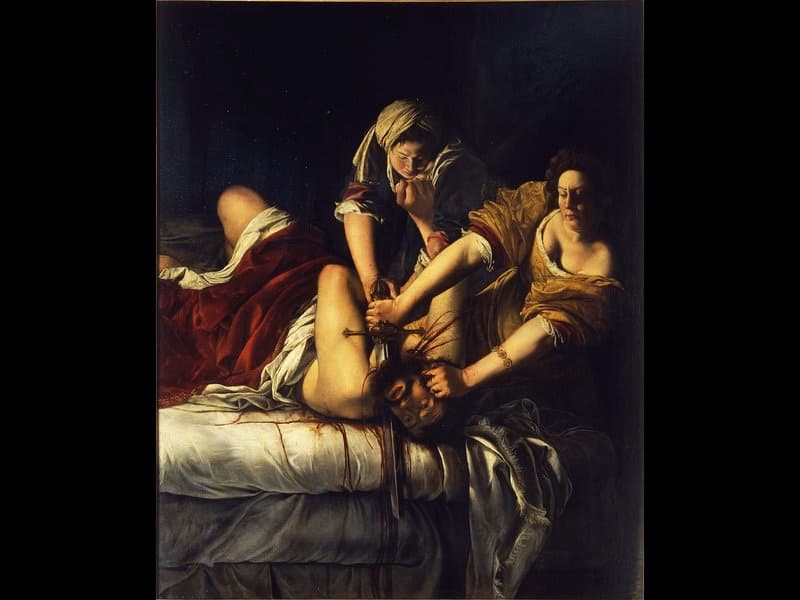
Judith Beheading Holofernes
Artemisia Gentileschi, 1620
Gentileschi painted this biblical scene showing the widow Judith decapitating the Assyrian general Holofernes, who had besieged her city. The Baroque painter rendered the violent act with dramatic realism, depicting Judith and her maidservant in the midst of the execution. The subject addresses the removal of an obstacle through decisive action.
Wilhelm Commentary
Richard Wilhelm's classic translation and interpretation
The Judgment
When an obstacle to union arises, energetic biting through brings success. This is true in all situations. Whenever unity cannot be established, the obstruction is due to a talebearer and traitor who is interfering and blocking the way. To prevent permanent injury, vigorous measures must be taken at once. Deliberate obstruction of this sort does not vanish of its own accord. Judgment and punishment are required to deter or obviate it. However, it is important to proceed in the right way. The hexagram combines Li, clarity, and Chên, excitement. Li is yielding, Chên is hard. Unqualified hardness and excitement would be too violent in meting out punishment; unqualified clarity and gentleness would be too weak. The two together create the just measure. It is of moment that the man who makes the decisions (represented by the fifth line) is gentle by nature, while he commands respect by his conduct in his position.
The Image
Penalties are the individual applications of the law. The laws specify the penalties. Clarity prevails when mild and severe penalties are differentiated, according to the nature of the crimes. This is symbolized by the clarity of lightning. The law is strengthened by a just application of penalties. This is symbolized by the terror of thunder. This clarity and severity have the effect of instilling respect; it is not that the penalties are ends in themselves. The obstructions in the social life of man increase when there is a lack of clarity in the penal codes and slackness in executing them. The only to strengthen the law is to make it clear and make penalties certain and swift.
First (Bottom) Line
If a sentence is imposed the first time a man attempts to do wrong, the penalty is a mild one. Only the toes are put in the stocks. This prevents him from sinning further and thus he becomes free of blame. It is a warning to halt in time on the path of evil.
Second Line
It is easy to discriminate between right and wrong in this case; it is like biting through tender meat. But one encounters a hardened sinner, and, aroused by anger, one goes a little too far. The disappearance of the nose in the course of the bite signifies that indignation blots out finer sensibility. However, there is no great harm in this, because the penalty as such is just.
Third Line
Punishment is to be carried out by someone who lacks the power and authority to do so. Therefore the culprits do not submit. The matter at issue is an old one–as symbolized by salted game–and in dealing with it difficulties arise. This old meat is spoiled: by taking up the problem the punisher arouses poisonous hatred against himself, and n this way is put in a somewhat humiliating position. But since punishment was required by the time, he remains free of blame.
Fourth Line
There are great obstacles to be overcome, powerful opponents are to be punished. Though this is arduous, the effort succeeds. But it is necessary to be hard as metal and straight as an arrow to surmount the difficulties. If one knows these difficulties and remains persevering, he attains good fortune. The difficult task is achieved in the end.
Fifth Line
The case to be decided is indeed not easy but perfectly clear. Since we naturally incline to leniency, we must make every effort to be like yellow gold–that is, as true as gold and as impartial as yellow, the color of the middle [the mean]. It is only by remaining conscious of the dangers growing out of the responsibility we have assumed that we can avoid making mistakes.
Sixth (Top) Line
In contrast to the first line, this line refers to a man who is incorrigible. His punishment is the wooden cangue, and his ears disappear under it–that is to say, he is deaf to warnings. This obstinacy leads to misfortune.