觀
Guān — Contemplation
upper trigram
巽Wind (Penetrating)lower trigram
坤Earth (Yielding)The Judgment
盥而不薦。有孚顒若。
Character-by-character gloss
Modern Interpretation
The ablution has been made, but not yet the offering. They look up with full trust. The ritual has begun—the sacred moment before the central act. Genuine inner preparation creates the reverence others feel.
The Image
風行地上,觀。先王以省方觀民設教。
Character-by-character gloss
Modern Interpretation
Wind blows over the earth, reaching everywhere. Ancient kings traveled through regions, contemplating the people, and providing instruction. Observation serves teaching; seeing clearly enables guiding rightly.
「風行地上,觀。先王以省方觀民設教。」風吹過大地,無處不到。古代的王會巡視各地,看看人民的生活,然後給予教導。觀察是為了理解,理解是為了指引。但這需要真的去看,不是走馬看花。
The Six Lines
First (Bottom) Line
初六 童觀。小人无咎。君子吝。
Modern Interpretation
Childish contemplation. For the small person, no blame. For the person of stature, humiliation. Surface seeing works for those who can't do better. For those who should see deeply, superficiality is shameful.
Second Line
六二 闚觀。利女貞。
Modern Interpretation
Peeping out through the door crack. Furthers the perseverance of a woman. Limited view from a protected position. Acceptable for those in restricted circumstances; inadequate for those who should see broadly.
Third Line
六三 觀我生進退。
Modern Interpretation
Contemplating my own life, deciding whether to advance or retreat. Self-examination to determine next action—watching yourself as the ground for choice.
Fourth Line
六四 觀國之光。利用賓于王。
Modern Interpretation
Contemplating the light of the kingdom. Furthers one to be a guest of the king. Seeing the order clearly enables participation at the highest level. Observation precedes contribution.
Fifth Line
九五 觀我生。君子无咎。
Modern Interpretation
Contemplating my own life. The person of moral stature remains without blame. Examining your own impact—your effect on others—the mature form of self-knowledge.
Sixth (Top) Line
上九 觀其生。君子无咎。
Modern Interpretation
Contemplating his life. The person of moral stature remains without blame. Observing life itself—existence as such—the sage's perspective. Beyond personal impact to universal pattern.
Yilin Verse
From the Forest of Changes (焦氏易林) — 觀 Guān (Contemplation)
歷山之下,虞舜所處,躬耕致孝,名聞四海。為堯所薦,纘位天子。
Below Mount Li, where Shun of Yu once dwelt; he plowed the land himself in filial devotion, and his name was heard across the four seas. Recommended by Yao, he succeeded to the throne of the Son of Heaven.
Full explanation
Wind over earth, doubled: Contemplation gazing upon itself. Beneath Mount Li, Shun the humble farmer tills the soil and practices supreme filial piety. His renown spreads across the four seas despite his lowly station. Emperor Yao hears of him, recommends him, and Shun ascends to the throne of the Son of Heaven. According to tradition, Shun's father Gu Sou was blind and cruel, his stepmother malicious, yet Shun served them without resentment until his virtue became impossible to conceal. From Contemplation to Contemplation, the pattern is self-referential: the observer becomes the observed. Shun's quiet cultivation at Li was itself a form of contemplation that drew heaven's gaze downward, transforming the watcher into the watched, the farmer into the sovereign.
Masterpiece
A work of art reflecting this hexagram's essence
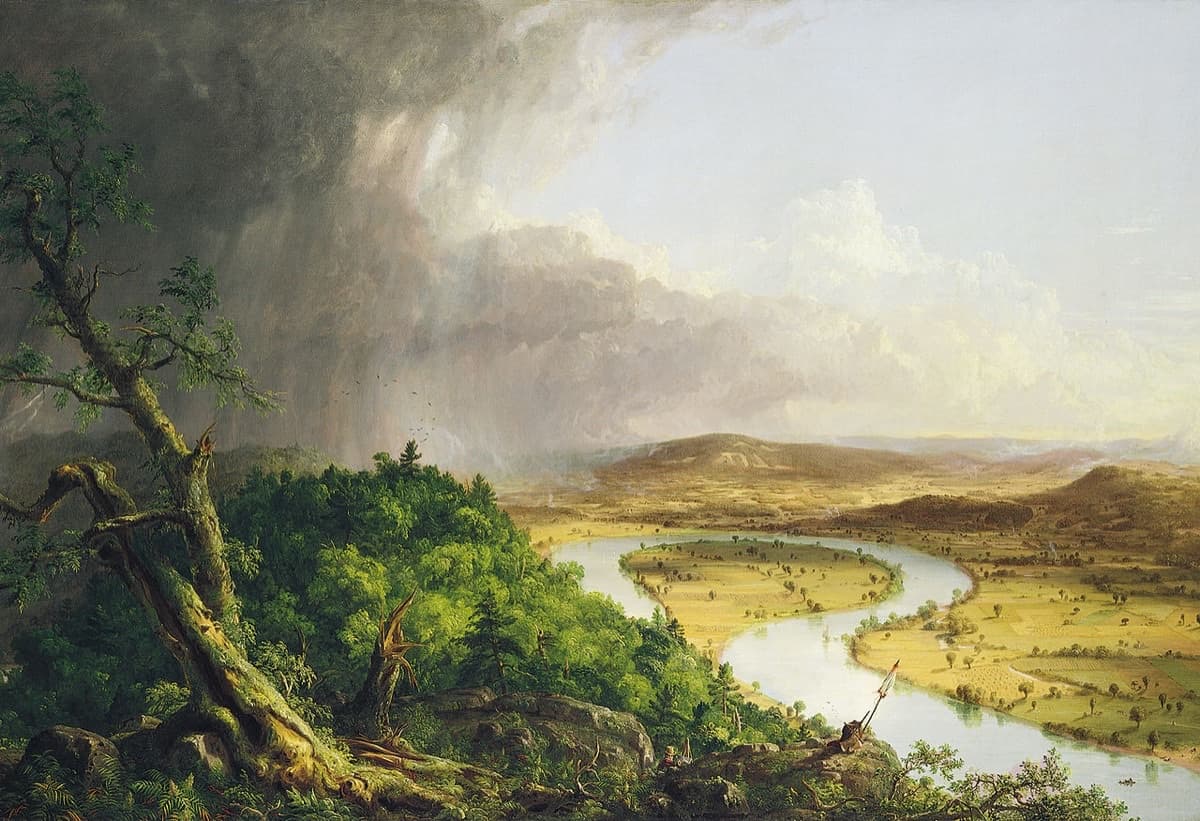
View from Mount Holyoke (The Oxbow)
Thomas Cole, 1836
Cole, founder of the Hudson River School, painted this panoramic view of the Connecticut River valley from an elevated vantage point. The composition contrasts wilderness and cultivated land, with the artist visible in the lower foreground observing the landscape. The elevated perspective allows contemplation of both natural forces and human settlement patterns.
Wilhelm Commentary
Richard Wilhelm's classic translation and interpretation
The Judgment
The sacrificial ritual in China began with an ablution and a libation by which the Deity was invoked, after which the sacrifice was offered. The moment of time between these two ceremonies is the most sacred of all, the moment of deepest inner concentration. If piety is sincere and expressive of real faith, the contemplation of it has a transforming and awe-spiring effect on those who witness it. Thus also in nature a holy seriousness is to be seen in the fact that natural occurrences are uniformly subject to law. Contemplation of the divine meaning underlying the workings of the universe gives to the man who is called upon to influence others the means of producing like effects. This requires that power of inner concentration which religious contemplation develops in great men strong in faith. It enables them to apprehend the mysterious and divine laws of life, and by means of profoundest inner concentration they give expression to these laws in their own persons. Thus a hidden spiritual power emanates from them, influencing and dominating others without their being aware of how it happens.
The Image
When the wind blows over the earth it goes far and wide, and the grass must bend to its power. These two occurrences find confirmation in the hexagram. The two images are used to symbolize a practice of the kings of old; in making regular journeys the ruler could, in the first place, survey his realm and make certain that none of the existing usages of the people escaped notice; in the second, he could exert influence through which such customs as were unsuitable could be changed. All of this points to the power possessed by a superior personality. On the one hand, such a man will have a view of the real sentiments of the great mass of humanity and therefore cannot be deceived; on the other, he will impress the people so profoundly, by his mere existence and by the impact of his personality, that they will be swayed by him as the grass by the wind.
First (Bottom) Line
This means contemplation from a distance, without comprehension. A man of influence is at hand, but his influence is not understood by the common people. This matters little in the case of the masses, for they benefit by the actions of the ruling sage whether they understand them or not. But for a superior man it is a disgrace. He must not content himself with a shallow, thoughtless view of prevailing forces; he must contemplate them as a connected whole and try to understand them.
Second Line
Through the crack of the door one has a limited outlook; one looks outward from within. Contemplation is subjectively limited. One tends to relate everything to oneself and cannot put oneself in another's place and understand his motives. This is appropriate for a good housewife. It is not necessary for her to be conversant with the affairs of the world. But for a man who must take active part in public life, such a narrow, egotistic way of contemplating things is of course harmful.
Third Line
This is the place of transition. We no longer look outward to receive pictures that are more or less limited and confused, but direct out contemplation upon ourselves in order to find a guideline for our decisions. This self-contemplation means the overcoming of naive egotism in the person who sees everything solely form his own standpoint. He begins to reflect and in this way acquires objectivity. However, self-knowledge does not mean preoccupation with one's own thoughts; rather, it means concern about the effects one creates. It is only the effects our lives produce that give us the right to judge whether what we have done means progress or regression.
Fourth Line
This describes a man who understands the secrets by which a kingdom can be made to flourish. Such a man must be given an authoritative position, in which he can exert influence. He should be, so to speak, a guest–that is, he should be honored and allowed to act independently, and should not be used as a tool.
Fifth Line
A man in an authoritative position to whom others look up must always be ready for self-examination. The right sort of self-examination, however, consists not in idle brooding over oneself but in examining the effects one produces. Only when these effects are good, and when one's influence on others is good, will the contemplation of one's own life bring the satisfaction of knowing oneself to be free of mistakes.
Sixth (Top) Line
While the preceding line represents a man who contemplates himself, here in the highest place everything that is personal, related to the ego, is excluded. The picture is that of a sage who stands outside the affairs of the world. Liberated from his ego, he contemplates the laws of life and so realizes that knowing how to become free of blame is the highest good.