賁
Bì — Grace
upper trigram
艮Mountain (Stillness)lower trigram
離Fire (Clinging)The Judgment
亨。小利有攸往。
Character-by-character gloss
Modern Interpretation
Success. In small matters, it is favorable to undertake something. Grace brings success, but ornament is not essence. Use beauty sparingly, for little things. Major decisions require more than elegance.
The Image
山下有火,賁。君子以明庶政,無敢折獄。
Character-by-character gloss
Modern Interpretation
Fire at the foot of the mountain, illuminating it. The person of character uses this light for clearing up current affairs, but does not dare decide controversial issues this way. Beauty clarifies the minor; it cannot resolve the fundamental.
「山下有火,賁。君子以明庶政,無敢折獄。」火在山腳下燃燒,把山照得好看。但光只到那麼遠。日常事務可以用美來處理,讓事情井然有序。但牽涉到是非對錯的大事,不能只靠漂亮——那需要更深的東西。
The Six Lines
First (Bottom) Line
初九 賁其趾。舍車而徒。
Modern Interpretation
Adorning the toes. Leaving the carriage to walk. When even the lowest parts receive attention, you might abandon the vehicle of ease for direct contact with earth. Grace that returns to simplicity.
Second Line
六二 賁其須。
Modern Interpretation
Adorning the beard. The beard follows the chin—ornament depends on what it adorns. Decoration has no independent existence; it serves what it attaches to.
Third Line
九三 賁如濡如。永貞吉。
Modern Interpretation
Graceful and moist. Constant perseverance brings good fortune. Beauty maintained, soft and living. If this is sustained, fortune follows. Freshness preserved.
Fourth Line
六四 賁如皤如。白馬翰如。匪寇婚媾。
Modern Interpretation
Grace or plainness? A white horse, flying. Not robbers—suitors. Initial doubt about whether the approach is threat or invitation. Uncertainty resolves into connection.
Fifth Line
六五 賁于丘園。束帛戔戔。吝。終吉。
Modern Interpretation
Grace in the hill gardens. The bolt of silk is meager. Humiliation, but good fortune in the end. Simple offering, almost inadequate—yet sincere. The humble gift ultimately succeeds.
Sixth (Top) Line
上九 白賁。无咎。
Modern Interpretation
Simple white grace. No blame. At the height, ornament becomes simplicity again. Pure white needs nothing added. The return to unadorned truth.
Yilin Verse
From the Forest of Changes (焦氏易林) — 賁 Bì (Grace)
政不暴虐,鳳凰來舍;四時順節,民安其居。
Governance neither cruel nor oppressive; the phoenix comes to dwell. The four seasons follow their proper order; the people rest secure in their homes.
Full explanation
Fire beneath the mountain mirrors itself — Grace transforms into Grace, the hexagram unchanged. When governance is not tyrannical, the phoenix comes to dwell. The four seasons follow their proper rhythm, and the people rest secure in their homes. The phoenix appears only under a sage ruler whose virtue radiates without coercion. This self-referential verse captures Grace's highest potential: adornment as the natural expression of good order, not artifice imposed upon chaos. When the source and target are identical, the message is: this pattern, fully realized, needs no transformation. Civilized beauty at its best is not decoration but the visible form of virtue — the phoenix choosing to settle where it senses authentic grace.
Masterpiece
A work of art reflecting this hexagram's essence
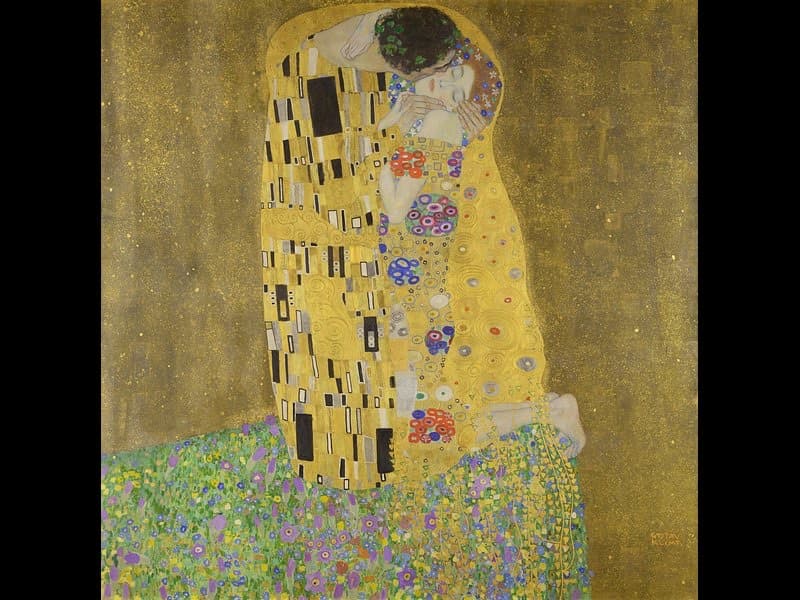
The Kiss
Klimt, Unknown
Klimt created this Symbolist work during his 'Golden Period', using gold leaf and decorative patterns inspired by Byzantine mosaics. The painting depicts an embracing couple on a flower-filled meadow, their bodies adorned with elaborate geometric and organic ornamentation. The decorative surface treatment transforms the intimate scene into a highly stylized composition.
Wilhelm Commentary
Richard Wilhelm's classic translation and interpretation
The Judgment
Grace brings success. However, it is not the essential or fundamental thing; it is only the ornament and must therefore be used sparingly and only in little things. In the lower trigram of fire a yielding line comes between two strong lines and makes them beautiful, but the strong lines are the essential content and the weak line is the beautifying form. In the upper trigram of the mountain, the strong line takes the lead, so that here again the strong element must be regarded as the decisive factor. In nature we see in the sky the strong light of the sun; the life of the world depends on it. But this strong, essential thing is changed and given pleasing variety by the moon and the stars. In human affairs, aesthetic form comes into being when traditions exist that, strong and abiding like mountains, are made pleasing by a lucid beauty. By contemplating the forms existing in the heavens we come to understand time and its changing demands. Through contemplation of the forms existing in human society it becomes possible to shape the world.
The Image
The fire, whose light illuminates the mountain and makes it pleasing, does not shine far; in the same way, beautiful form suffices to brighten and to throw light upon matters of lesser moment, but important questions cannot be decided in this way. They require greater earnestness.
First (Bottom) Line
A beginner in a subordinate place must take upon himself the labor of advancing. There might be an opportunity of surreptitiously easing the way–symbolized by the carriage–but a self-contained man scorns help gained in a dubious fashion. He thinks it more graceful to go on foot than to drive in a carriage under false pretenses.
Second Line
The beard is not an independent thing; it moves only with the chin. The image therefore means that form is to be considered only as a result and attribute of content. The beard is a superfluous ornament. To devote care to it for its own sake, without regard for the inner content of which it is an ornament, would bespeak a certain vanity.
Third Line
This represents a very charming life situation. One is under the spell of grace and the mellow mood induced by wine. This grace can adorn, but it can also swamp us. Hence the warning not to sink into convivial indolence but to remain constant in perseverance. Good fortune depends on this.
Fourth Line
An individual is in a situation in which doubts arise as to which is better–to pursue the grace of external brilliance, or to return to simplicity. The doubt itself implies the answer. Confirmation comes from the outside; it comes like a white winged horse. The white color indicates simplicity. At first it may be disappointing to renounce the comforts that might have been obtained, yet one finds peace of mind in a true relationship with the friend who courts him. The winged horse is the symbol of the thoughts that transcend all limits of space and time.
Fifth Line
A man withdraws from contact with people of the lowlands, who seek nothing but magnificence and luxury, into the solitude of the heights. There he finds an individual to look up to, whom he would like to have as a friend. But the gifts he has to offer are poor and few, so that he feels ashamed. However, it is not the material gifts that count, but sincerity of feeling, and so all goes well in the end.
Sixth (Top) Line
Here at the highest stage of development all ornament is discarded. Form no longer conceals content but brings out its value to the full. Perfect grace consists not in exterior ornamentation of the substance, but in the simple fitness of its form.