剝
Bō — Splitting Apart
upper trigram
艮Mountain (Stillness)lower trigram
坤Earth (Yielding)The Judgment
不利有攸往。
Character-by-character gloss
Modern Interpretation
It does not further one to go anywhere. Inferior forces push forward, crowding out the remaining strong. The time favors dissolution, not action. Wait. Give generously to those below to stabilize what remains.
The Image
山附於地,剝。上以厚下安宅。
Character-by-character gloss
Modern Interpretation
The mountain rests on earth. Those above secure their position only by giving to those below. Without a broad base, the steep mountain topples. Generosity is structural, not optional.
「山附於地,剝。上以厚下安宅。」山依附在大地上。山如果又陡又窄,沒有寬闊的底座,就會倒塌。同樣的道理:在上面的人,必須厚待下面的人,才能穩固。慷慨不是選擇,是結構——沒有根基,什麼都站不住。
The Six Lines
First (Bottom) Line
初六 剝牀以足。蔑貞凶。
Modern Interpretation
The bed is split at the legs. Perseverance destroyed. Misfortune. The foundation breaks first. What rests on it cannot survive. Collapse begins below.
Second Line
六二 剝牀以辨。蔑貞凶。
Modern Interpretation
The bed is split at the frame. Perseverance destroyed. Misfortune. The support structure fails. The splitting continues upward, unstoppable now.
Third Line
六三 剝之无咎。
Modern Interpretation
Splitting among them. No blame. You can split from the decaying situation without incurring blame. Sometimes separation is the only right action.
Fourth Line
六四 剝牀以膚。凶。
Modern Interpretation
The bed is split to the skin. Misfortune. Now the person themselves is affected. The collapse has reached living flesh. Very bad.
Fifth Line
六五 貫魚。以宮人寵。无不利。
Modern Interpretation
A string of fishes. Favor through the palace ladies. Nothing that does not further. Even in collapse, order can be restored through right sequence, like fish strung together, like court ladies in rank.
Sixth (Top) Line
上九 碩果不食。君子得輿。小人剝廬。
Modern Interpretation
The large fruit is not eaten. The person of character gains a carriage. Small people split apart their huts. The seed remains—the great fruit that isn't consumed becomes the next cycle. The worthy survive; the petty destroy even their own shelter.
Yilin Verse
From the Forest of Changes (焦氏易林) — 剝 Bō (Splitting Apart)
行觸大忌,與司命牾。執囚束縛,拘制於吏。幽人有喜。
Actions transgress a great taboo, offending the Lord of Fate. Seized and bound as a prisoner, restrained in an official's custody. The secluded one finds cause for joy.
Full explanation
Mountain upon earth doubled — Splitting Apart meets itself. One's actions collide with the greatest taboo, offending the Lord of Fate himself. Bound and fettered, one is detained under an official's control. Yet the verse closes with a paradox drawn from the hexagram's own sixth line: 'The secluded person has joy.' To transgress against cosmic authority and be imprisoned by mortal authority is the worst of Splitting Apart's imagery. But confinement, in the Yi's logic, can also be protection. The 'secluded person' who finds joy in captivity has discovered that being stripped of everything external reveals an irreducible inner freedom. From Splitting Apart to itself, the lesson is recursive: at the nadir of dissolution, the single remaining fruit contains the seed of renewal.
Masterpiece
A work of art reflecting this hexagram's essence
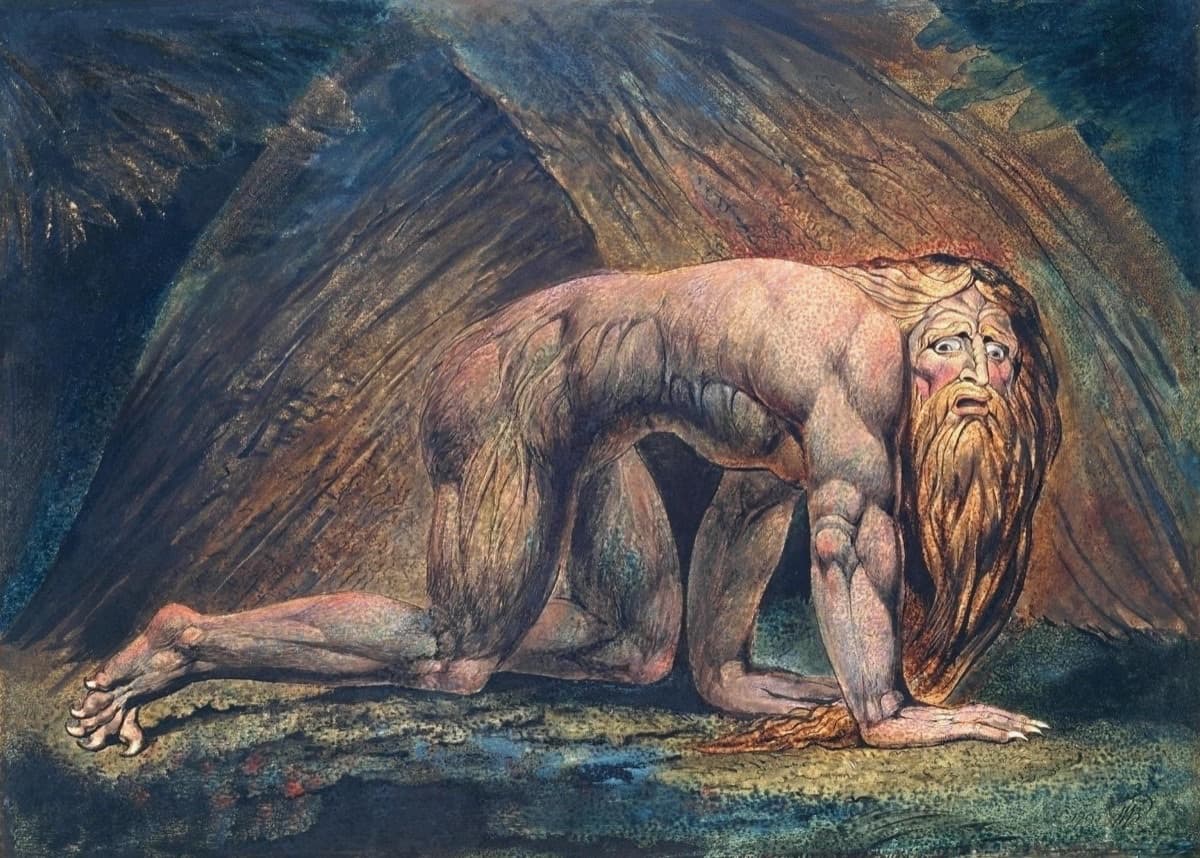
Nebuchadnezzar
William Blake, 1795
Blake illustrated the Biblical story of King Nebuchadnezzar, who was driven from his throne and lived as a beast in the wilderness as punishment for pride. The color print shows the fallen king on all fours with wild hair and long fingernails, crawling on the ground. Blake's depiction portrays a figure experiencing psychological and spiritual disintegration.
Wilhelm Commentary
Richard Wilhelm's classic translation and interpretation
The Judgment
This pictures a time when inferior people are pushing forward and are about to crowd out the few remaining strong and superior men. Under these circumstances, which are due to the time, it is not favorable for the superior man to undertake anything. The right behavior in such adverse times is to be deduced from the images and their attributes. The lower trigram stands for the earth, whose attributes are docility and devotion. The upper trigram stands for the mountain, whose attribute is stillness. This suggests that one should submit to the bad time and remain quiet. For it is a question not of man's doing but of time conditions, which, according to the laws of heaven, show an alternation of increase and decrease, fullness and emptiness. It is impossible to counteract these conditions of the time. Hence it is not cowardice but wisdom to submit and avoid action.
The Image
The mountain rests on the earth. When it is steep and narrow, lacking a broad base, it must topple over. Its position is strong only when it rises out of the earth broad and great, not proud and steep. So likewise those who rule rest on the broad foundation of the people. They too should be generous and benevolent, like the earth that carries all. Then they will make their position as secure as a mountain is in its tranquillity.
First (Bottom) Line
Inferior people are on the rise and stealthily begin their destructive burrowing from below in order to undermine the place where the superior man rests. Those followers of the ruler who remain loyal are destroyed by slander and intrigue. The situation bodes disaster, yet there is nothing to do but wait.
Second Line
The power of the inferior people is growing. The danger draws close to one's person; already there are clear indications, and rest is disturbed. Moreover, in this dangerous situation one is as yet without help or friendly advances from above or below. Extreme caution is necessary in this isolation. One must adjust to the time and promptly avoid the danger. Stubborn perseverance in maintaining one's standpoint would lead to downfall.
Third Line
An individual finds himself in an evil environment to which he is committed by external ties. But he has an inner relationship with a superior man, and through this he attains the stability to free himself from the way of the inferior people around him. This brings him into opposition to them of course, but that is not wrong.
Fourth Line
Here the disaster affects not only the resting place but even the occupant. No warning or other comment is added. Misfortune has reached its peak: it can no longer be warded off.
Fifth Line
Here, in immediate proximity to the strong, light-giving principle at the top, the nature of the dark force undergoes a change. It no longer opposes the strong principle by means of intrigues but submits to its guidance. Indeed, as the head of the other weak lines, it leads all of these to the strong line, just as a princess leads her maids-in-waiting like a shoal of fishes to her husband and thus gains his favor. Inasmuch as the lower element thus voluntarily places itself under the higher, it attains happiness and the higher also receives its due. Therefore all goes well.
Sixth (Top) Line
Here the splitting apart reaches its end. When misfortune has spent itself, better times return. The seed of the good remains, and it is just when the fruit falls to the ground that food sprouts anew from its seed. The superior man again attains influence and effectiveness. He is supported by public opinion as if in a carriage. But the inferior man's wickedness is visited upon himself. His house is split apart. A law of nature is at work here. Evil is not destructive to the good alone but inevitably destroys itself as well. For evil, which lives solely by negation, cannot continue to exist on its own strength alone. The inferior man himself fares best when held under control by a superior man.