復
Fù — Return
upper trigram
坤Earth (Yielding)lower trigram
震Thunder (Movement)The Judgment
亨。出入无疾。朋來无咎。反復其道。七日來復。利有攸往。
Character-by-character gloss
Modern Interpretation
Success. Going out and coming in without error. Friends come without blame. To and fro goes the way. On the seventh day comes return. It furthers one to have somewhere to go. After decay, the turning point. The light returns.
The Image
雷在地中,復。先王以至日閉關,商旅不行,后不省方。
Character-by-character gloss
Modern Interpretation
Thunder within the earth. Ancient kings closed the passes at solstice—merchants and strangers did not travel, the ruler did not tour. The turning point requires stillness, not action. Let the return establish itself.
「雷在地中,復。先王以至日閉關,商旅不行,后不省方。」雷還在地底下,生命的能量剛剛開始萌動。這時候要讓它休息,用安靜來滋養它,不要太早用掉。冬至那天,古人會關閉關隘,商人和旅客都不走動,君王也不巡視。這是轉折的智慧:剛開始的東西要溫柔對待,才能開花。
The Six Lines
First (Bottom) Line
初九 不遠復。无祗悔。元吉。
Modern Interpretation
Return from not far. No need for remorse. Supreme good fortune. You haven't strayed far; the return is easy. Catching the error early enables the best outcome.
Second Line
六二 休復。吉。
Modern Interpretation
Quiet return. Good fortune. Coming back in stillness and humility—this is the right way. No drama, just correction.
Third Line
六三 頻復。厲。无咎。
Modern Interpretation
Repeated return. Danger, but no blame. Returning again and again—you keep straying and correcting. The pattern is unstable, but the effort itself is not blameworthy.
Fourth Line
六四 中行獨復。
Modern Interpretation
Walking in the middle, returning alone. You return to the right path while others continue wrongly. Solitary correction, no companions in the turn.
Fifth Line
六五 敦復。无悔。
Modern Interpretation
Generous return. No remorse. Returning with nobility, magnanimously acknowledging the need to change. Nothing to regret in this.
Sixth (Top) Line
上六 迷復。凶。有災眚。用行師。終有大敗。以其國君凶。至于十年不克征。
Modern Interpretation
Confused return. Misfortune. Disaster and blunder. Using armies leads to great defeat in the end—the ruler's misfortune. Even after ten years, unable to attack. Lost on the way back, you make everything worse. The return that fails is catastrophic.
Yilin Verse
From the Forest of Changes (焦氏易林) — 復 Fù (Return)
周師伐紂,剋於牧野。甲子平旦,天下悅喜。
The armies of Zhou campaign against Zhou; vanquishing him at Muye. At dawn on the jiazi day; all under heaven rejoice.
Full explanation
Thunder returns beneath the earth and returns again — Return doubled upon itself. King Wu of Zhou leads his armies against the tyrant Zhou of Shang and triumphs at the Battle of Muye. On the jiazi dawn, under the first light, the world rejoices. This is the definitive return in Chinese history: the restoration of moral order after tyranny, the mandate of heaven transferring to the virtuous. The doubled hexagram intensifies the image — what returns is not merely a single yang line but an entire civilizational renewal. The Muye victory is return incarnate: righteous force restoring what cruelty had destroyed, timed to the cosmic daybreak.
Masterpiece
A work of art reflecting this hexagram's essence
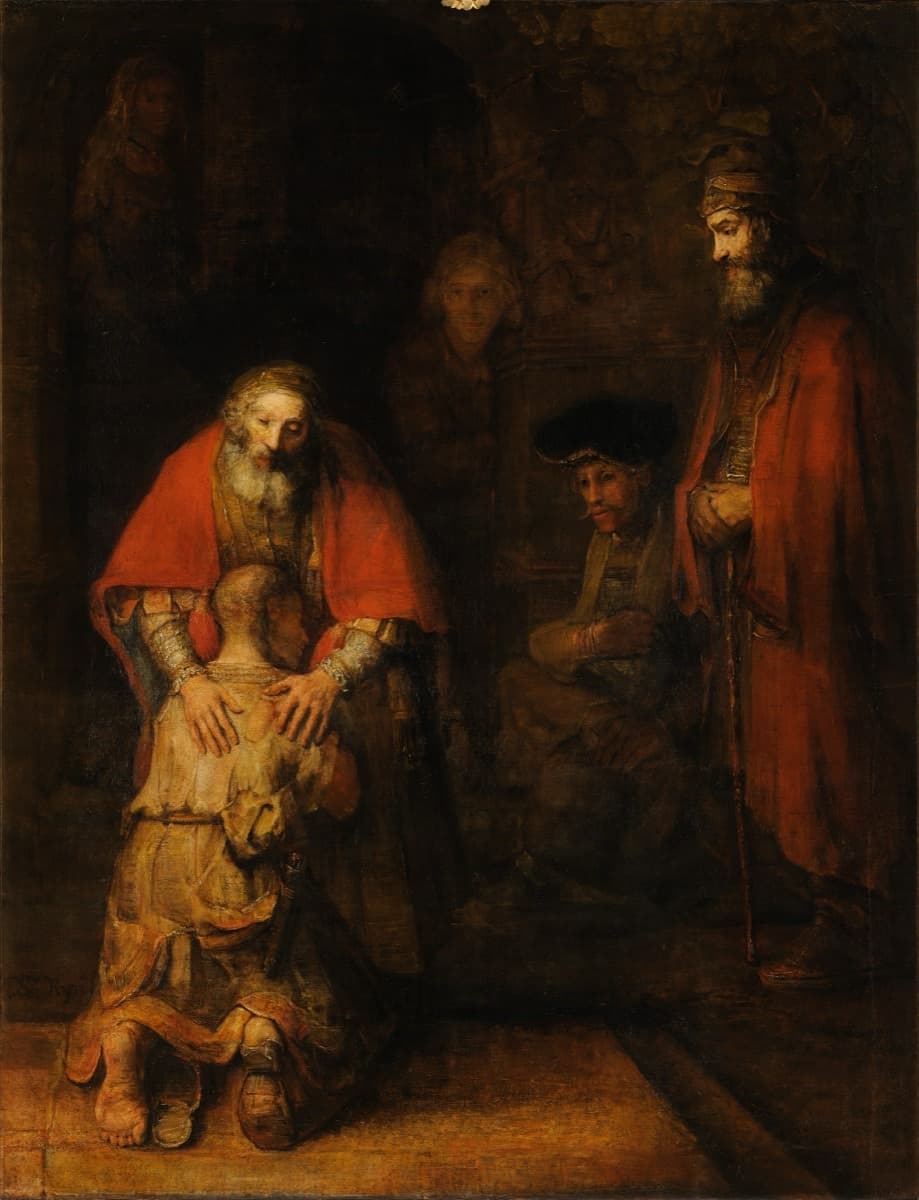
The Return of the Prodigal Son
Rembrandt, 1660s
Rembrandt painted this biblical parable late in life, showing the moment when a wayward son returns home after squandering his inheritance. The father embraces his kneeling son, who wears tattered clothing and worn shoes. The composition depicts reconciliation and the restoration of a broken relationship.
Wilhelm Commentary
Richard Wilhelm's classic translation and interpretation
The Judgment
After a time of decay comes the turning point. The powerful light that has been banished returns. There is movement, but it is not brought about by force. The upper trigram K'un is characterized by devotion; thus the movement is natural, arising spontaneously. For this reason the transformation of the old becomes easy. The old is discarded and the new is introduced. Both measures accord with the time; therefore no harm results. Societies of people sharing the same views are formed. But since these groups come together in full public knowledge and are in harmony with the time, all selfish separatist tendencies are excluded, and no mistake is made. The idea of RETURN is based on the course of nature. The movement is cyclic, and the course completes itself. Therefore it is not necessary to hasten anything artificially. Everything comes of itself at the appointed time. This is the meaning of heaven and earth. All movements are accomplished in six stages, and the seventh brings return. Thus the winter solstice, with which the decline of the year begins, comes in the seventh month after the summer solstice; so too sunrise comes in the seventh double hour after sunset. Therefore seven is the number of the young light, and it arises when six, the number of the great darkness, is increased by one. In this way the state of rest gives place to movement.
The Image
The winter solstice has always been celebrated in China as the resting time of the year–a custom that survives in the time of rest observed at the new year. In winter the life energy, symbolized by thunder, the Arousing, is still underground. Movement is just at its beginning; therefore it must be strengthened by rest so that it will not be dissipated by being used prematurely. This principle, i. e. , of allowing energy that is renewing itself to be reinforced by rest, applies to all similar situations. The return of health after illness, the return of understanding after an estrangement: everything must be treated tenderly and with care at the beginning, so that the return may lead to a flowering.
First (Bottom) Line
Slight digressions from the good cannot be avoided, but one must turn back in time, before going too far. This is especially important in the development of character; every faintly evil thought must be put aside immediately, before it goes too far and takes root in the mind. Then there is no cause for remorse, and all goes well.
Second Line
Return always calls for a decision and is an act of self-mastery. It is made easier if a man is in good company. If he can bring himself to put aside pride and follow the example of good men, good fortune results.
Third Line
There are people of a certain inner instability who feel a constant urge to reverse themselves. There is danger in continually deserting the good because of uncontrolled desires, then turning back to it again because of a better resolution. However, since this does not lead to habituation in evil, a general inclination to overcome the defect is not wholly excluded.
Fourth Line
A man is in a society composed of inferior people, but is connected spiritually with a strong and good friend, and this makes him turn back alone. Although nothing is said of reward and punishment, this return is certainly favorable, for such a resolve to choose the good brings its own reward.
Fifth Line
When the time for return has come, a man should not take shelter in trivial excuses, but should look within and examine himself. And if he has done something wrong he should make a noblehearted resolve to confess his fault. No one will regret having taken this road.
Sixth (Top) Line
If a man misses the right time for return, he meets with misfortune. The misfortune has its inner cause in a wrong attitude toward the world. The misfortune coming upon him from without results from this wrong attitude. What is pictured here is blind obstinacy and the judgment that is visited upon it.