大畜
Dà Chù — Great Accumulation
upper trigram
艮Mountain (Stillness)lower trigram
乾Heaven (Strong)The Judgment
利貞。不家食。吉。利涉大川。
Character-by-character gloss
Modern Interpretation
Staying the course is beneficial. Not eating at home brings good fortune—take public responsibility rather than private comfort. Major undertakings can succeed. This is a time of gathering strength, storing energy, and building reserves for the work ahead.
The Image
天在山中,大畜。君子以多識前言往行,以畜其德。
Character-by-character gloss
Modern Interpretation
Heaven within the mountain—vast power contained. Study the words and deeds of the past to strengthen your character. History isn't academic; it's practical. The patterns repeat. Learning them makes you effective.
「天在山中」——天被山包住,巨大的能量在裡面。君子因此「多識前言往行,以畜其德」。讀古人的話,看前人的事。這不是懷舊,是實用。模式會重複。認得出來,就省很多力氣。
The Six Lines
First (Bottom) Line
初九 有厲。利已。
Modern Interpretation
Danger ahead. Better to stop here. You want to advance but the situation blocks you. Forcing through leads to misfortune. Patience now; energy builds for later.
Second Line
九二 輿說輹。
Modern Interpretation
The axles are removed from the wagon. Forward movement stops entirely. This isn't defeat—it's strategic pause. Accumulated energy serves you when release finally comes.
Third Line
九三 良馬逐。利艱貞。曰閑輿衛。利有攸往。
Modern Interpretation
A good horse follows another good horse. Danger remains, but the path opens. Practice what advances you and what protects you. Have a destination in mind. Movement with purpose, not aimless galloping.
Fourth Line
六四 童牛之牿。元吉。
Modern Interpretation
The young bull's headboard. Attach the restraint before the horns grow. Preventing problems is easier than fixing them. Great success comes from this kind of foresight.
Fifth Line
六五 豶豕之牙。吉。
Modern Interpretation
The gelded boar's tusk. The danger is neutralized at its source. Don't fight wild force directly; change the nature that produces it. Good fortune.
Sixth (Top) Line
上九 何天之衢。亨。
Modern Interpretation
The way of heaven is attained. The obstruction ends. Energy stored through discipline now flows freely. Your principles shape the world because you earned that authority through restraint.
Yilin Verse
From the Forest of Changes (焦氏易林) — 大畜 Dà Chù (Great Taming)
朝鮮之地,箕伯所保。宜人宜家,業處子孫,求事大喜。
The land of Joseon, kept safe by Lord Jizi. Fit for people, fit for families; the enterprise is passed to sons and grandsons. In all undertakings, great joy.
Full explanation
Great Taming doubled upon itself — heaven stored within the mountain, undiluted and self-referencing. The land of Joseon, which the Viscount of Ji protected and preserved. Suitable for person and family alike, a legacy handed down through the generations; all undertakings bring great joy. The Viscount of Ji (Jizi), uncle of the Shang tyrant, feigned madness to survive the court's depravity. After Shang fell, he was enfeoffed at Joseon, where he established a civilized state. This is Great Taming at its purest: the sage who stored virtue within himself during a period of darkness, then carried that accumulated wisdom to a new land and built something lasting. The static hexagram shows accumulation fulfilled across generations.
Masterpiece
A work of art reflecting this hexagram's essence
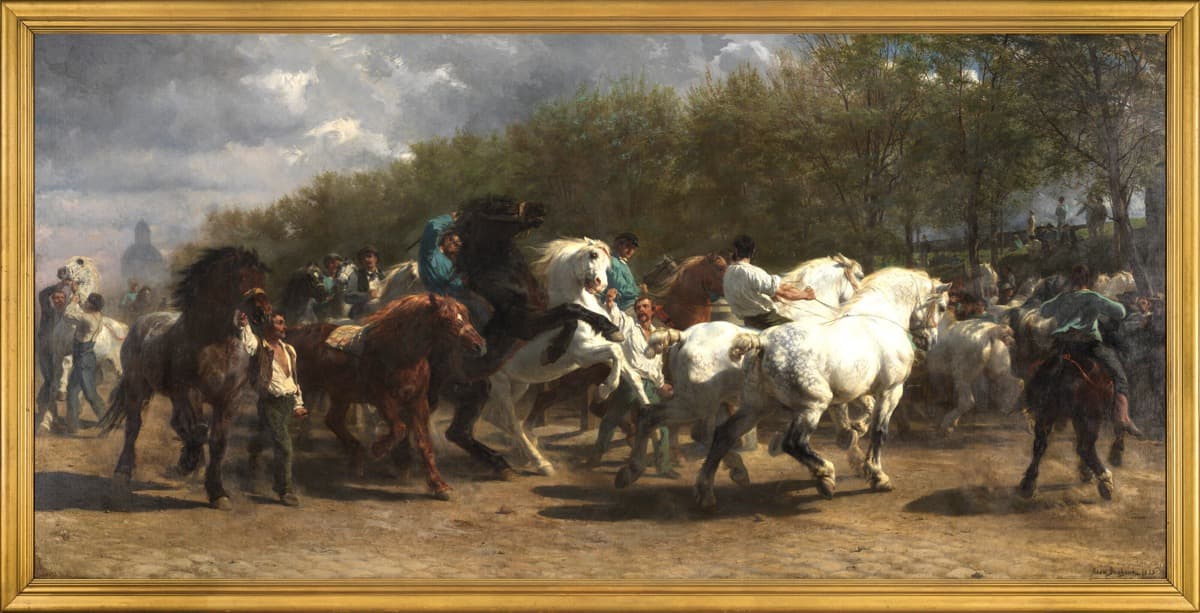
The Horse Fair
Rosa Bonheur, 1852–55
Bonheur's monumental painting depicts powerful horses restrained by handlers at the Paris horse market on Boulevard de l'Hôpital. The dynamic composition shows great force held in check—wild energy tamed through skill and persistence. She sketched at the market for eighteen months, studying how accumulated strength is channeled and controlled.
Wilhelm Commentary
Richard Wilhelm's classic translation and interpretation
The Judgment
To hold firmly to great creative powers and store them up, as set forth in this hexagram, there is need of a strong, clear-headed man who is honored by the ruler. The trigram Ch'ein points to strong creative power; Kên indicates firmness and truth. Both point to light and clarity and to the daily renewal of character. Only through such daily self-renewal can a man continue at the height of his powers. Force of habit helps to keep order in quiet times; but in periods when there is a great storing up of energy, everything depends on the power of the personality. However, since the worthy are honored, as in the case of the strong personality entrusted with leadership by the ruler, it is an advantage not to eat at home but rather to earn one's bread by entering upon public office. Such a man is in harmony with heaven; therefore even great and difficult undertakings, such as crossing the great water, succeed.
The Image
Heaven within the mountain points to hidden treasures. In the words and deeds of the past there lies hidden a treasure that men may use to strengthen and elevate their own characters. The way to study the past is not to confine oneself to mere knowledge of history but, through application of this knowledge, to give actuality to the past.
First (Bottom) Line
A man wishes to make vigorous advance, but circumstances present an obstacle. He sees himself held back firmly. If he should attempt to force an advance, it would lead him into misfortune. Therefore it is better for him to compose himself and to wait until an outlet is offered for release of his stored-up energies.
Second Line
Here advance is checked just as in the third line of THE TAMING POWER OF THE SMALL (9 ). However, in the later the restraining force is slight; thus a conflict arises between the propulsive and the restraining movement, as a result of which the spokes fall out of the wagon wheels, while here the restraining force is absolutely superior; hence no struggle takes place. One submits and removes the axletrees from the wagon–in other words, contents himself with waiting. In this way energy accumulates for a vigorous advance later on.
Third Line
The way opens; the hindrance has been cleared away. A man is in contact with a strong will acting in the same direction as his own, and goes forward like one good horse following another. But danger still threatens, and he must remain aware of it, or he will be robbed of his firmness. Thus he must acquire skill on the one hand in what will take him forward, and on the other in what will protect him against unforeseen attacks. It is good in such a pass to have a goal toward which to strive.
Fourth Line
This line and the one following it are the two that tame the forward-pushing lower lines. Before a bull's horns grow out, a headboard is fastened to its forehead, so that later when the horns appear they cannot do harm. A good way to restrain wild force is to forestall it. By so doing one achieves an easy and great success.
Fifth Line
Here the restraining of the impetuous forward drive is achieved in an indirect way. A boar's tusk is in itself dangerous, but if the boar's nature is altered, the tusk is no longer a menace. Thus also where men are concerned, wild force should not be combated directly; instead, its roots should be eradicated.
Sixth (Top) Line
The time of obstruction is past. The energy long dammed up by inhibition forces its way out and achieves great success. This refers to a man who is honored by the ruler and whose principles now prevail and shape the world.