頤
Yí — Nourishment
upper trigram
艮Mountain (Stillness)lower trigram
震Thunder (Movement)The Judgment
貞吉。觀頤。自求口實。
Character-by-character gloss
Modern Interpretation
Steady attention to what you feed yourself—body and mind—brings good fortune. Watch what a person takes in and what they put out. That tells you everything about their character. The mouth works both ways: what you consume and what you speak.
The Image
山下有雷,頤。君子以慎言語,節飲食。
Character-by-character gloss
Modern Interpretation
Thunder beneath the mountain. The wise person speaks carefully and eats moderately. Both words and food are movements—one outward, one inward. Both require discipline. Character forms through controlling these basic exchanges.
山下有雷。君子因此「慎言語,節飲食」。說話是向外的動,吃喝是向內的動。兩樣都要節制。古人很實際——修養品性,就從管住嘴開始。其他的,往往是空談。
The Six Lines
First (Bottom) Line
初九 舍爾靈龜。觀我朶頤。凶。
Modern Interpretation
You abandon your own resources to gaze enviously at others. The tortoise that lives on air needs nothing, yet you drop it to stare at someone's feast. This brings misfortune. You had independence; you traded it for longing.
Second Line
六二 顛頤。拂經于丘。頤征凶。
Modern Interpretation
Looking upward for nourishment, turning from your own path for sustenance. If you can't support yourself and depend on favors from above, something is wrong. This pattern leads to shame if continued.
Third Line
六三 拂頤。貞凶。十年勿用。无攸利。
Modern Interpretation
Turning away from real nourishment toward what doesn't satisfy. From desire to gratification to desire again—the cycle of craving. Ten years of this leads nowhere. Complete waste.
Fourth Line
六四 顛頤。吉。虎視眈眈。其欲逐逐。无咎。
Modern Interpretation
Looking upward for provision—but from this position, this serves the greater good. Tiger-like intensity in seeking capable people. When you work for everyone rather than yourself, the hunger serves a purpose.
Fifth Line
六五 拂經。居貞吉。不可涉大川。
Modern Interpretation
Aware of your own insufficiency. You should be providing but lack the strength. Turn from the usual path to seek help from someone wiser but less visible. Stay in place; don't attempt the great crossing.
Sixth (Top) Line
上九 由頤。厲吉。利涉大川。
Modern Interpretation
The source of nourishment for others. Great responsibility comes with this position. Stay aware of the danger, and you can undertake even the most difficult ventures. Success and general benefit follow.
Yilin Verse
From the Forest of Changes (焦氏易林) — 頤 Yí (Nourishment)
家給人足,頌聲並作。四夷賓服,干戈卷閣。
Every household provided, every person content; songs of praise arise in chorus. The four frontiers submit as guests; weapons of war are rolled up and shelved.
Full explanation
Mountain over thunder remains mountain over thunder — Nourishment unchanged, its essence distilled. Every household is well provisioned and every person satisfied; hymns of praise arise in chorus. The four barbarian peoples submit as guests, and weapons of war are rolled up and stored in the pavilion. This is the golden age vision of nourishment perfected: when the mouth is governed wisely, material abundance cascades into cultural harmony and diplomatic peace. Spears sheathed and songs composed — the realm needs no army because it is properly fed. Nourishment turning upon itself amplifies its own virtue, proving that careful governance of what enters and exits the mouth underlies all civilization.
Masterpiece
A work of art reflecting this hexagram's essence
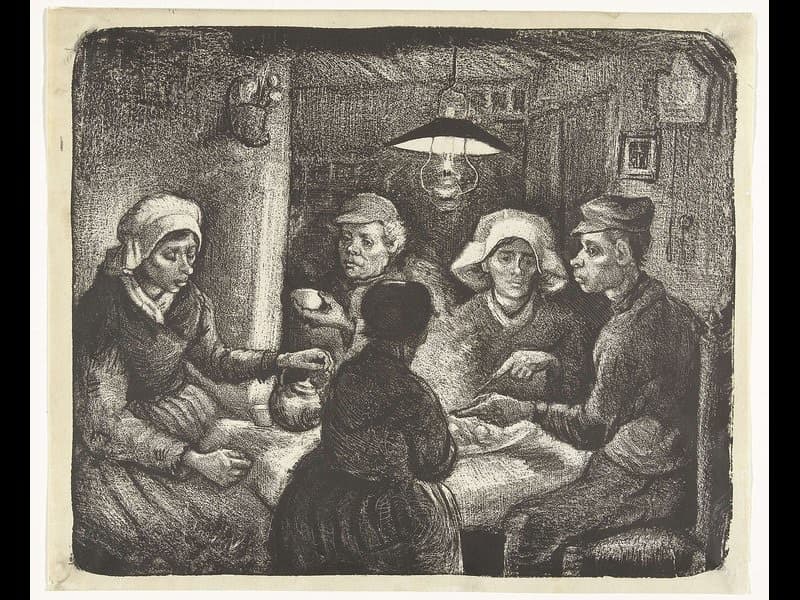
The Potato Eaters
Vincent van Gogh, 1885
Van Gogh's early work depicts Dutch peasants gathered around a simple meal they have earned through hard labor. The dark palette and rough faces emphasize the basic sustenance that nourishes life, connecting to the hexagram's theme of proper nourishment and what truly sustains us.
Wilhelm Commentary
Richard Wilhelm's classic translation and interpretation
The Judgment
In bestowing care and nourishment, it is important that the right people should be taken care of and that we should attend to our own nourishment in the right way. If we wish to know what anyone is like, we have only to observe on whom he bestows his care and what sides of his own nature he cultivates and nourishes. Nature nourishes all creatures. The great man fosters and takes care of superior men, in order to take care of all men through them. Mencius says about this: If we wish to know whether anyone is superior or not, we need only observe what part of his being he regards as especially important. The body has superior and inferior, important and unimportant parts. We must not injure important parts for the sake of the unimportant, nor must we injure the superior parts for the sake of the inferior. He who cultivates the inferior parts of his nature is an inferior man. He who cultivates the superior parts of his nature is a superior man.
The Image
"God comes forth in the sign of the Arousing": when in the spring the life forces stir again, all things come into being anew. "He brings to perfection in the sign of Keeping Still": thus in the early spring, when the seeds fall to earth, all things are made ready. This is an image of providing nourishment through movement and tranquillity. The superior man takes it as a pattern for the nourishment and cultivation of his character. Words are a movement going from within outward. Eating and drinking are movements from without inward. Both kinds of movement can be modified by tranquillity. For tranquillity keeps the words that come out of the mouth from exceeding proper measure, and keeps the food that goes into the mouth from exceeding its proper measure. Thus character is cultivated.
First (Bottom) Line
The magic tortoise is a creature possessed of such supernatural powers that it lives on air and needs no earthly nourishment. The image means that a man fitted by nature and position to live freely and independently renounces this self-reliance and instead looks with envy and discontent at others who are outwardly in better circumstances. But such base envy only arouses derision and contempt in those others. This has bad results.
Second Line
Normally a person either provides his own means of nourishment or is supported in a proper way by those whose duty and privilege it is to provide for him. If, owing to weakness of spirit, a man cannot support himself, a feeling of uneasiness comes over him; this is because in shirking the proper way of obtaining a living, he accepts support as a favor from those in higher place. This is unworthy, for he is deviating from his true nature. Kept up indefinitely, this course leads to misfortune.
Third Line
He who seeks nourishment that does not nourish reels from desire to gratification and in gratification craves desire. Mad pursuit of pleasure for the satisfaction of the senses never brings one to the goal. One should never (ten years is a complete cycle of time) follow this path, for nothing good can come of it.
Fourth Line
In contrast to the six in the second place, which refers to a man bent exclusively on his own advantage, this line refers to one occupying a high position and striving to let his light shine forth. To do this he needs helpers, because he cannot attain his lofty aim alone. With the greed of a hungry tiger he is on the lookout for the right people. Since he is not working for himself but for the good of all, there is no wrong in such zeal.
Fifth Line
A man may be conscious of a deficiency in himself. He should be undertaking the nourishment of the people, but he has not the strength to do it. Thus he must turn from his accustomed path and beg counsel and help from a man who is spiritually his superior but undistinguished outwardly. If he maintains this attitude of mind perseveringly, success and good fortune are his. But he must remain aware of his dependence. He must not put his own person forward nor attempt great labors, such as crossing the great water.
Sixth (Top) Line
This describes a sage of the highest order, from whom emanate all influences that provide nourishment for others. Such a position brings with it heavy responsibility. If he remains conscious of this fact, he has good fortune and may confidently undertake even great and difficult labors, such as crossing the great water. These undertakings bring general happiness for him and for all others.