離
Lí — Clinging Fire
upper trigram
離Fire (Clinging)lower trigram
離Fire (Clinging)The Judgment
利貞。亨。畜牝牛。吉。
Character-by-character gloss
Modern Interpretation
Success through persistence. Care of the cow brings good fortune. Fire depends on what it burns—without fuel, no flame. Consciousness depends on what it attaches to. Accept this dependence and cultivate docility. Clarity without harshness; brilliance sustained through what nourishes it.
The Image
明兩作,離。大人以繼明照於四方。
Character-by-character gloss
Modern Interpretation
Fire doubled—the sun's course repeated. The great person perpetuates this brightness to illuminate the four directions. Light spreading continuously, penetrating deeply into human nature. The work of clarity never finishes.
「明兩作」——光明重複升起,太陽一日的軌跡。大人因此「繼明照於四方」。光不斷地傳遞,深入人心。這種照亮的工作,沒有結束的時候。
The Six Lines
First (Bottom) Line
初九 履錯然。敬之。无咎。
Modern Interpretation
Waking—impressions crisscross, activity begins. Preserve composure now. Don't be swept along by the bustle. Seriousness at the start matters because the beginning contains the seed of everything that follows.
Second Line
六二 黃離。元吉。
Modern Interpretation
Yellow light. Supreme good fortune. Midday, the sun at zenith, the perfect mean. Yellow is the color of measure. This is culture at its height—complete harmony through holding to the center.
Third Line
九三 日昃之離。不鼓缶而歌。則大耋之嗟。凶。
Modern Interpretation
The light of the setting sun. Some beat pots and sing; others lament old age. Both responses are wrong. Transitoriness is the condition—neither denial nor despair serves. Cultivate yourself and await your allotted time.
Fourth Line
九四 突如其來如。焚如。死如。棄如。
Modern Interpretation
It comes suddenly—flames up, dies down, is discarded. The meteor, the straw fire. Brilliant but consuming itself. Excitability and restlessness may bring quick prominence but produce nothing lasting. Spent too fast.
Fifth Line
六五 出涕沱若。戚嗟若。吉。
Modern Interpretation
Tears flowing, sighing and lamenting. Good fortune. At the peak, understanding vanity brings genuine change of heart. This isn't passing mood but real transformation. Grief that preserves clarity.
Sixth (Top) Line
上九 王用出征。有嘉。折首。獲匪其醜。无咎。
Modern Interpretation
The king campaigns to discipline. Kill the leaders, spare the followers. Punishment's purpose is discipline, not revenge. Root out the source of the problem; tolerate what's harmless. Excessive severity defeats itself.
Yilin Verse
From the Forest of Changes (焦氏易林) — 離 Lí (Clinging Fire)
時乘六龍,為帝使東,達命宣旨,無所不通。
Riding the six dragons in season; serving as the emperor's envoy to the east. Proclaiming the mandate, declaring the edict; nothing that does not reach through.
Full explanation
Doubled fire meets itself: pure brilliance sustained. Riding the six dragons in season, one serves as the emperor's envoy to the east, proclaiming mandates and conveying edicts with nothing beyond reach. 'Riding the six dragons in season' quotes directly from the I-Ching's Qian hexagram commentary (Wenyan): the sage rides the six dragons to traverse the heavens. Here the envoy carries imperial light in all directions. From The Clinging to The Clinging, fire renews fire in perpetual succession. The great person 'continues brightness to illuminate the four quarters' — this is the hexagram's own image text made flesh. There is no transformation to manage, only the challenge of sustaining radiance without burnout, which the verse resolves through service: light that travels outward on behalf of another never exhausts itself.
Masterpiece
A work of art reflecting this hexagram's essence
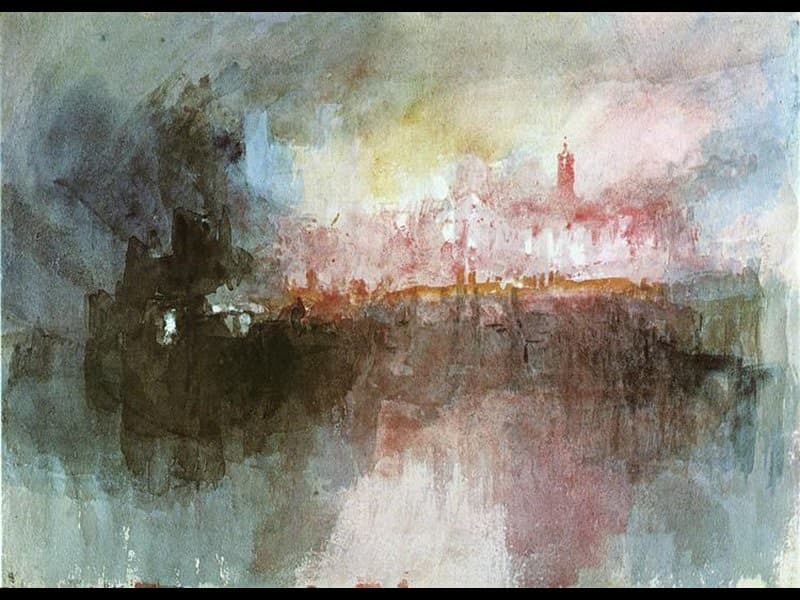
The Burning of the Houses of Parliament
J.M.W. Turner, 1834
Turner witnessed the 1834 fire that destroyed much of the Palace of Westminster and painted multiple versions of the event. The paintings show intense flames reflected in the Thames, with crowds gathered on the riverbank. The imagery of fire and its reflections connects to the hexagram's doubled fire trigram, representing clinging and illumination—the way light both reveals and depends on what it attaches to.
Wilhelm Commentary
Richard Wilhelm's classic translation and interpretation
The Judgment
What is dark clings to what is light and so enhances the brightness of the latter. A luminous thing giving out light must have within itself something that perseveres; otherwise it will in time burn itself out. Everything that gives light is dependent on something to which it clings, in order that it may continue to shine. Thus the sun and moon cling to heaven, and grain, grass, and trees cling to the earth. So too the twofold clarity of the dedicated man clings to what is right and thereby can shape the world. Human life on earth is conditioned and unfree, and when man recognizes this limitation and makes himself dependent upon the harmonious and beneficent forces of the cosmos, he achieves success. The cow is the symbol of extreme docility. By cultivating in himself an attitude of compliance and voluntary dependence, man acquires clarity without sharpness and finds his place in the world.
The Image
Each of the two trigrams represents the sun in the course of a day. The two together represent the repeated movement of the sun, the function of light with respect to time. The great man continues the work of nature in the human world. Through the clarity of his nature he causes the light to spread farther and farther and to penetrate the nature of man ever more deeply.
First (Bottom) Line
It is early morning and work begins. The mind has been closed to the outside world in sleep; now its connections with the world begin again. The traces of one's impressions run crisscross. Activity and haste prevail. It is important then to preserve inner composure and not to allow oneself to be swept along by the bustle of life. If one is serious and composed, he can acquire the clarity of mind needed for coming to terms with the innumerable impressions that pour in. It is precisely at the beginning that serious concentration is important, because the beginning holds the seed of all that is to follow.
Second Line
Midday has come; the sun shines with a yellow light. Yellow is the color of measure and mean. Yellow light is therefore a symbol of the highest culture and art, whose consummate harmony consists in holding to the mean.
Third Line
Here the end of the day has come. The light of the setting sun calls to mind the fact that life is transitory and conditional. Caught in this external bondage, men are usually robbed of their inner freedom as well. The sense of the transitoriness of life impels them to uninhibited revelry in order to enjoy life while it lasts, or else they yield to melancholy and spoil the precious time by lamenting the approach of old age. Both attitudes are wrong. To the superior man it makes no difference whether death comes early or late. He cultivates himself, awaits his allotted time, and in this way secures his fate.
Fourth Line
Clarity of mind has the same relation to life that fire has to wood. Fire clings to wood, but also consumes it. Clarity of mind is rooted in life but can also consume it. Everything depends upon how the clarity functions. Here the image used is that of a meteor or a straw fire. A man who is excitable and restless may rise quickly to prominence but produces no lasting effects. Thus matters end badly when a man spends himself too rapidly and consumes himself like a meteor.
Fifth Line
Here the zenith of life has been reached. Were there no warning, one would at this point consume oneself like a flame. Instead, understanding the vanity of all things, one may put aside both hope and fear, and sigh and lament: if one is intent on retaining his clarity of mind, good fortune will come from this grief. For here we are dealing not with a passing mood, as in the nine in the third place, but with a real change of heart.
Sixth (Top) Line
It is not the purpose of chastisement to impose punishment blindly but to create discipline. Evil must be cured at its roots. To eradicate evil in political life, it is best to kill the ringleaders and spare the followers. In educating oneself it is best to root out bad habits and tolerate those that are harmless. For asceticism that is too strict, like sentences of undue severity, fails in its purpose.