晉
Jìn — Progress
upper trigram
離Fire (Clinging)lower trigram
坤Earth (Yielding)The Judgment
康侯用錫馬蕃庶。晝日三接。
Character-by-character gloss
Modern Interpretation
The powerful lord is honored with horses in great numbers. In a single day he is granted audience three times. The sun rises over the earth—rapid, easy progress with widening expansion and clarity. A twofold condition: the leader has clarity not to abuse influence but uses it for the benefit of the ruler. The ruler is free of jealousy and showers rewards. Enlightened ruler, obedient servant—this is how great progress happens.
The Image
明出地上,晉。君子以自昭明德。
Character-by-character gloss
Modern Interpretation
The sun rises over the earth, emerging from dark mists into pristine clarity. Brighten your own virtue. Human nature is originally good but becomes clouded by earthly things. Purification allows the native clarity to shine forth.
「明出地上,晉。君子以自昭明德。」太陽升起,穿過濃霧,越升越高,光芒越發清澈。人的本性大概也是這樣——原本明亮,被塵世遮蔽了,需要淨化才能再次發光。這話說來容易。
The Six Lines
First (Bottom) Line
初六 晉如摧如。貞吉。罔孚。裕无咎。
Modern Interpretation
Progressing but turned back. If met with no confidence, remain calm. Persistence in what's right brings good fortune. Don't try to force trust. Refuse to be roused to anger. Freedom from mistakes comes through steady composure.
Second Line
六二 晉如愁如。貞吉。受茲介福。于其王母。
Modern Interpretation
Progressing but in sorrow. Blocked from the authority you're connected to. Remain persistent through the grief; with maternal gentleness, happiness will come. Mutual attraction based on correct principles, not selfish motives.
Third Line
六三 眾允悔亡。
Modern Interpretation
All are in accord. Remorse disappears. Moving forward with others whose support encourages you. No regret about lacking independence—collective progress works.
Fourth Line
九四 晉如鼫鼠。貞厲。
Modern Interpretation
Progress like a hamster. Persistence brings danger. In times of progress, it's easy to amass possessions through dubious means. But such conduct shuns light. Times of progress are also when shady dealings get exposed.
Fifth Line
六五 悔亡。失得勿恤。往吉无不利。
Modern Interpretation
Remorse disappears. Don't take gain or loss to heart. Gentle and reserved in an influential position, you might reproach yourself for not maximizing advantage. Let that regret go—what matters is securing opportunities for beneficial influence.
Sixth (Top) Line
上九 晉其角。維用伐邑。厲吉无咎。貞吝。
Modern Interpretation
Advancing with horns—permissible only when disciplining your own people. Offensive action is always dangerous. Avoid the mistakes that threaten; succeed in what you set out to do. Persistence in aggressive behavior toward outsiders brings humiliation.
Yilin Verse
From the Forest of Changes (焦氏易林) — 晉 Jìn (Progress)
銷鋒鑄耜,休牛放馬,甲兵解散,夫婦相保。
Weapons melted, plowshares cast; oxen rested, horses set free. Armor and soldiers disbanded; husband and wife keep each other safe.
Full explanation
Fire rises above the earth, and the land returns to peace. Weapon points are melted down and recast as plowshares; oxen are rested and horses set free to pasture. Armor and troops are disbanded, and husbands and wives keep each other safe. This verse directly echoes the Shangshu chapter 'Wu Cheng,' describing King Wu of Zhou's demobilization after defeating the Shang: he released war-oxen in the Peach Forest and pastured war-horses on the southern slopes of Mount Hua. From Progress to Progress (the hexagram returning to itself), the transformation embodies fulfillment at rest. The brightest advance is the one that knows when to stop advancing — when the fire that rose above the earth settles into sustained warmth rather than consuming flame.
Masterpiece
A work of art reflecting this hexagram's essence
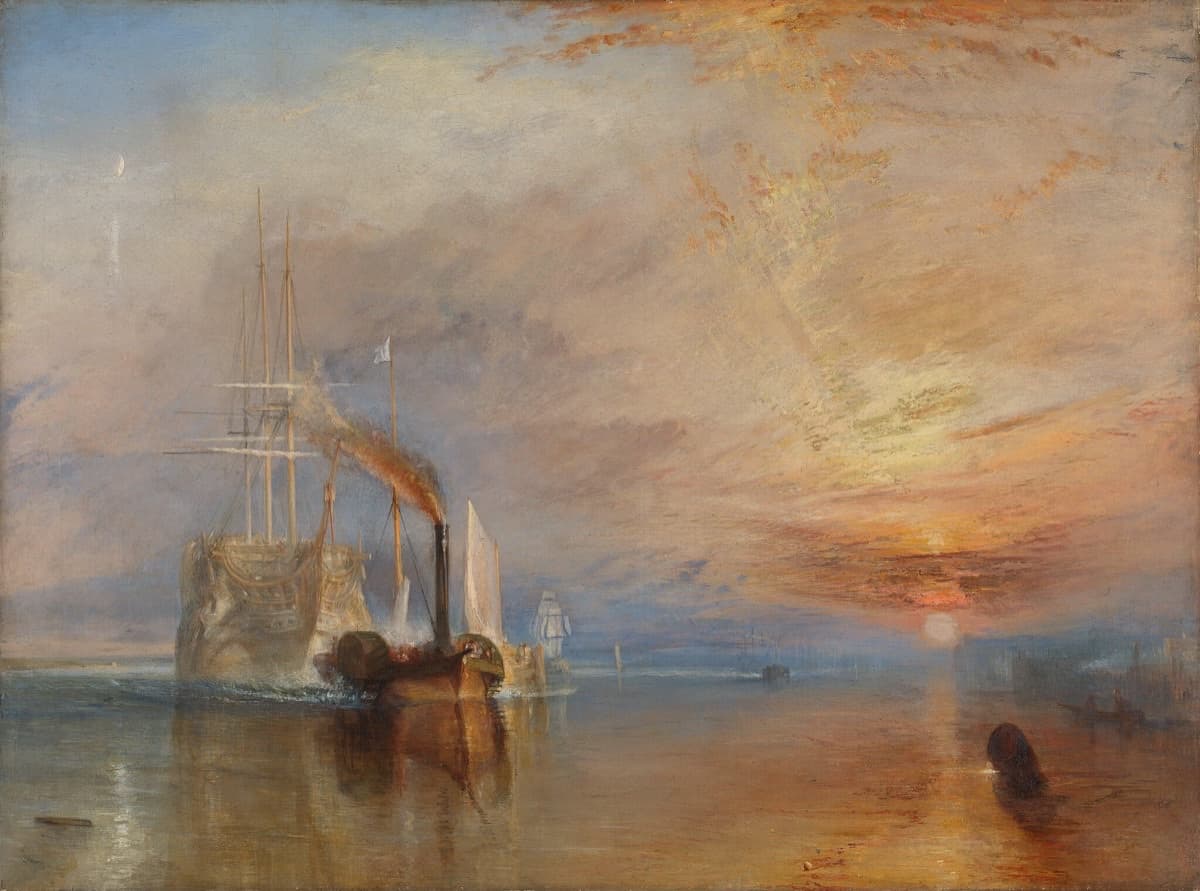
The Fighting Temeraire
J.M.W. Turner, 1839
Turner painted this in 1839 depicting the HMS Temeraire, a warship from the Battle of Trafalgar, being towed by a steam tugboat to be scrapped. The old sailing ship gives way to new steamship technology, showing progress through generational transition.
Wilhelm Commentary
Richard Wilhelm's classic translation and interpretation
The Judgment
As an example of progress, this pictures a time when a powerful feudal lord rallies the other lords around the sovereign and pledges fealty and peace. The sovereign rewards him richly and invites him to a closer intimacy. A twofold idea is set forth here. The actual effect of the progress emanates from a man who is in a dependent position and whom the others regard as their equal and are therefore willing to follow. This leader has enough clarity of vision not to abuse his great influence but to use it rather for the benefit of his ruler. His ruler in turn is free of all jealousy, showers presents on the great man, and invites him continually to his court. An enlightened ruler and an obedient servant–this is the condition on which great progress depends.
The Image
The light of the sun rises over the earth is by nature clear. The higher the sun rises, the more it emerges from the dark mists, spreading the pristine purity of its rays over an ever widening area. The real nature of man is likewise originally good, but it becomes clouded by contact with earthly things and therefore needs purification before it can shine forth in its native clarity.
First (Bottom) Line
At a time when all elements are pressing for progress, we are still uncertain whether in the course of advance we may not meet with a rebuff. Then the thing to do is simply continue in what is right; in the end this will bring good fortune. It may be that we meet with no confidence. In this case we ought not to try to win confidence regardless of the situation, but should remain calm and cheerful and refuse to be roused to anger. Thus we remain free of mistakes.
Second Line
Progress is halted; an individual is kept from getting in touch with the man in authority with whom he has a connection. When this happens, he must remain persevering, although he is grieved; then with a maternal gentleness the man in question will bestow great happiness upon him. This happiness comes to him–and is well deserved–because in this case mutual attraction does not rest on selfish or partisan motives but on firm and correct principles.
Third Line
A man strives onward, in association with others whose backing encourages him. This dispels any cause for regret over the fact that he does not have enough independence to triumph unaided over every hostile turn of fate.
Fourth Line
In times of progress it is easy for strong men in the wrong places to amass great possessions. But such conduct shuns the light. And since times of progress are also times in which dubious procedures are inevitably brought to the light, perseverance in such action always leads to danger.
Fifth Line
The situation described here is that of one who, finding himself in an influential position in a time of progress, remains gentle and reserved. He might reproach himself for lack of energy in making the most of the propitiousness of the time and obtaining all possible advantage. However, this regret passes away. He must not take either loss or gain to heart; they are minor considerations. What matters much more is the fact that in this way he has assured himself of opportunities for successful and beneficent influence.
Sixth (Top) Line
Making progress with lowered horns–i. e. , acting on the offensive–is permissible, in times like those referred to here, only in dealing with the mistakes of one's own people. Even then we must bear in mind that proceeding on the offensive may always be dangerous. In this way we avoid the mistakes that otherwise threaten, and succeed in what we set out to do. On the other hand, perseverance in such overenergetic behavior, especially toward persons with whom there is no close connection, will lead to humiliation.