蒙
Méng — Youthful Folly
upper trigram
艮Mountain (Stillness)lower trigram
坎Water (Danger)The Judgment
亨。匪我求童蒙。童蒙求我。初筮告。再三瀆。瀆則不告。利貞。
Character-by-character gloss
Modern Interpretation
The student seeks the teacher, not the other way around. Ask once and receive an answer. Ask repeatedly out of anxiety and you'll get nothing—that's not inquiry, it's neediness. Success comes through staying the course.
The Image
山下出泉,蒙。君子以果行育德。
Character-by-character gloss
Modern Interpretation
A spring emerges at the mountain's base—it doesn't know where it's going yet, just that it must flow. Fill each hollow completely before moving forward. Character develops the same way: thoroughness in small things before attempting large ones.
「山下出泉,蒙。」泉水從山腳湧出,還不知道自己要去哪裡,只知道要流。把每個低窪處填滿,才能繼續往前。人的性格好像也是這樣——小事做得徹底,大事才有根基。
The Six Lines
First (Bottom) Line
初六 發蒙。利用刑人。用說桎梏。以往吝。
Modern Interpretation
Discipline awakens the fool—but only enough to start. Remove the fetters once the lesson takes hold. Continuing to punish after understanding arrives creates resentment, not growth.
Second Line
九二 包蒙吉。納婦吉。子克家。
Modern Interpretation
You can work with fools if you're patient. You can work with the inexperienced if you don't condescend. The capable child can run the household—competence isn't about age.
Third Line
六三 勿用取女。見金夫。不有躬。无攸利。
Modern Interpretation
Don't pursue someone who abandons themselves at the sight of wealth or status. When a person loses their center that easily, nothing good can come from the connection.
Fourth Line
六四 困蒙。吝。
Modern Interpretation
Isolated in fantasy, cut off from reality—this is the most hopeless form of ignorance. The cure requires contact with the actual world, not more thinking.
Fifth Line
六五 童蒙。吉。
Modern Interpretation
Childlike openness brings good fortune. The key word is childlike, not childish. No arrogance, genuine curiosity, willingness to not-know. This is the right attitude.
Sixth (Top) Line
上九 擊蒙。不利為寇。利禦寇。
Modern Interpretation
Sometimes a fool must be stopped, not taught. But the punishment should prevent future harm, not avenge past wrongs. Defense, not attack.
Yilin Verse
From the Forest of Changes (焦氏易林) — 蒙 Méng (Youthful Folly)
何草不黃,至未盡玄。室家分離,悲愁於心。
What grass is not yellowed? Reaching its end, all turns dark. House and home are parted; grief and sorrow fill the heart.
Full explanation
A spring beneath the mountain returns to the mountain — folly encountering itself. The verse opens by quoting the Shijing soldiers' lament 'He Cao Bu Huang': 'What grass is not yellowed?' — an image of universal exhaustion under endless campaigning. But the withering has not yet reached its darkest extreme. Families are torn apart, grief filling the heart. When the source hexagram meets its own reflection, there is no transformation, only intensification: the naivety that might have been educated instead compounds into deeper confusion. Separation from home and kin is the cruelest form of bewilderment — not ignorance of facts, but loss of the relationships that give knowledge its meaning.
Masterpiece
A work of art reflecting this hexagram's essence
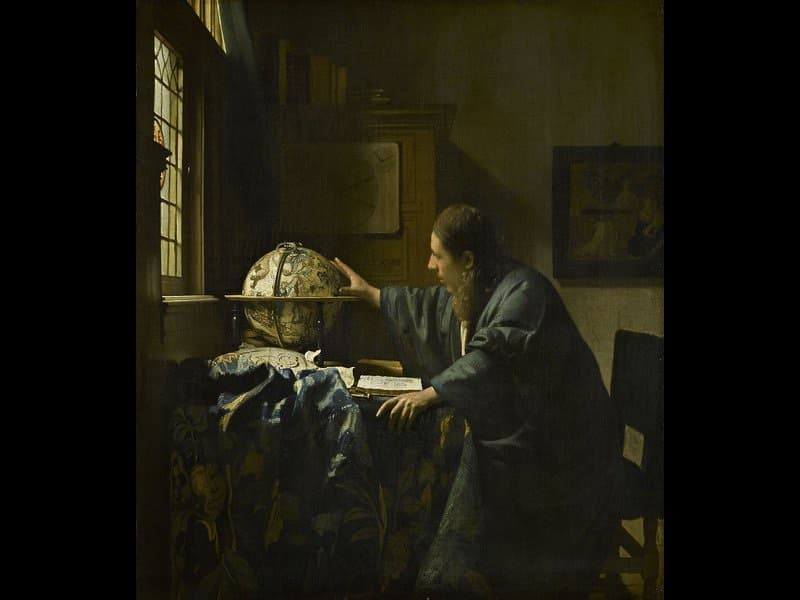
The Astronomer
Vermeer, Unknown
Vermeer painted this scholar studying a celestial globe, surrounded by instruments and books. The astronomer seeks knowledge of the heavens, representing youthful inexperience seeking instruction from a teacher or master.
Wilhelm Commentary
Richard Wilhelm's classic translation and interpretation
The Judgment
In the time of youth, folly is not an evil. One may succeed in spite of it, provided one finds an experienced teacher and has the right attitude toward him. This means, first of all, that the youth himself must be conscious of his lack of experience and must seek out the teacher. Without this modesty and this interest there is no guarantee that he has the necessary receptivity, which should express itself in respectful acceptance of the teacher. This is the reason why the teacher must wait to be sought out instead of offering himself. Only thus can the instruction take place at the right time and in the right way. A teacher's answer to the question of a pupil ought to be clear and definite like that expected from an oracle; thereupon it ought to be accepted as a key for resolution of doubts and a basis for decision. If mistrustful or unintelligent questioning is kept up, it serves only to annoy the teacher. He does well to ignore it in silence, just as the oracle gives one answer only and refuses to be tempted by questions implying doubt. Given addition a perseverance that never slackens until the points are mastered one by one, real success is sure to follow. Thus the hexagram counsels the teacher as well as the pupil.
The Image
A spring succeeds in flowing on and escapes stagnation by filling up all the hollow places in its path. In the same way character is developed by thoroughness that skips nothing but, like water, gradually and steadily fills up all gaps and so flows onward.
First (Bottom) Line
Law is the beginning of education. Youth in its inexperience is inclined at first to take everything carelessly and playfully. It must be shown the seriousness of life. A certain measure of taking oneself in hand, brought about by strict discipline, is a good thing. He who plays with life never amounts to anything. However, discipline should not degenerate into drill. Continuous drill has a humiliating effect and cripples a man's powers.
Second Line
These lines picture a man who has no external power, but who has enough strength of mind to bear his burden of responsibility. He has the inner superiority and that enable him to tolerate with kindliness the shortcomings of human folly. The same attitude is owed to women as the weaker sex. One must understand them and give them recognition in a spirit of chivalrous consideration. Only this combination of inner strength with outer reserve enables one to take on the responsibility of directing a larger social body with real success.
Third Line
A weak, inexperienced man, struggling to rise, easily loses his own individuality when he slavishly imitates a strong personality of higher station. He is like a girl throwing herself away when she meets a strong man. Such a servile approach should not be encouraged, because it is bad both for the youth and the teacher. A girl owes it to her dignity to wait until she is wooed. In both cases it is undignified to offer oneself, and no good comes of accepting such an offer.
Fourth Line
For youthful folly it is the most hopeless thing to entangle itself in empty imaginings. The more obstinately it clings to such unreal fantasies, the more certainly will humiliation overtake it. Often the teacher, when confronted with such entangled folly, has no other course but to leave the fool to himself for a time, not sparing him the humiliation that results. This is frequently the only means of rescue.
Fifth Line
An inexperienced person who seeks instruction in a childlike and unassuming way is on the right path, for the man devoid of arrogance who subordinated himself to his teacher will certainly be helped.
Sixth (Top) Line
Sometimes an incorrigible fool must be punished. He who will not heed will be made to feel. This punishment is quite different from a preliminary shaking up. But the penalty should not be imposed in anger; it must be restricted to an objective guarding against unjustified excesses. Punishment is never an end in itself but serves merely to restore order. This applies not only in regard to education but also in regard to the measures taken by a government against a populace guilty of transgressions. Governmental interference should always be merely preventive and should have as its sole aim the establishment of public security and peace.