屯
Zhūn — Difficulty at the Beginning
upper trigram
坎Water (Danger)lower trigram
震Thunder (Movement)The Judgment
元亨利貞。勿用有攸往。利建侯。
Character-by-character gloss
Modern Interpretation
You're at the start of something—chaos precedes order. Everything is trying to take form at once. Don't force it. Premature action wastes what's emerging. Find helpers; you can't organize this alone.
The Image
雲雷,屯。君子以經綸。
Character-by-character gloss
Modern Interpretation
Thunder beneath water—energy trapped below the surface, rain about to break. The work now is sorting: which threads belong together, which must be separated. Impose order before you advance.
「雲雷,屯。君子以經綸。」雷在水下,能量困在裡面,雨快來但還沒來。現在的工作是整理:哪些線可以放在一起,哪些要分開。亂中大概已經藏著秩序,只是還看不清。
The Six Lines
First (Bottom) Line
初九 磐桓。利居貞。利建侯。
Modern Interpretation
Stuck at the threshold. This isn't the moment to push through—it's the moment to establish your base. Find allies who share your aim. Humility attracts the right help; arrogance repels it.
Second Line
六二 屯如邅如。乘馬班如。匪寇婚媾。女子貞不字。十年乃字。
Modern Interpretation
Help appears from an unexpected direction. It looks like rescue, but the timing is wrong—this isn't your ally yet. Wait. The right connection comes when conditions mature, not when desperation accepts any offer.
Third Line
六三 即鹿無虞。惟入于林中。君子幾不如舍。往吝。
Modern Interpretation
You're hunting without a guide. The territory is unfamiliar and you'll get lost. The person of moral stature recognizes this and stops. Better to abandon the chase than stumble into humiliation.
Fourth Line
六四 乘馬班如。求婚媾。往吉。无不利。
Modern Interpretation
Now's the time to reach out. You lack power but opportunity presents itself. False pride will cost you. Taking the first step—even if it feels like lowering yourself—is clarity, not weakness.
Fifth Line
九五 屯其膏。小貞吉。大貞凶。
Modern Interpretation
Your good intentions can't take visible form yet—others distort everything you do. Small steps succeed; grand gestures backfire. Work quietly until trust accumulates. Force nothing.
Sixth (Top) Line
上六 乘馬班如。泣血漣如。
Modern Interpretation
Some people never emerge from the initial chaos. They surrender to difficulty, fold their hands, stop trying. This is the saddest outcome—not failure through action, but abandonment of the struggle itself.
Yilin Verse
From the Forest of Changes (焦氏易林) — 屯 Zhūn (Difficulty)
兵征大宛,北出玉關。與胡寇戰,平城道西,七日絕糧,身幾不全。
The army campaigns against Dayuan, going north out through Jade Gate. Battling the Xiongnu raiders west of Pingcheng; seven days without grain, the body nearly lost.
Full explanation
Difficulty doubles upon itself when the hexagram transforms into its own image. Troops march against Dayuan and venture north through the Jade Gate, only to clash with nomad raiders west of Pingcheng, cut off from supplies for seven days, their lives hanging by a thread. This references the Siege of Baideng in 200 BC, when Emperor Gaozu of Han rashly pursued the Xiongnu and was encircled by Modu Chanyu's forty thousand cavalry on Baideng Mountain for seven full days without provisions. Only Chen Ping's secret stratagem, bribing the Chanyu's consort, secured the emperor's escape. Zhun unchanging intensifies its own nature: the initial difficulty is not merely encountered but compounded, and reckless advance into hostile terrain magnifies every vulnerability.
Masterpiece
A work of art reflecting this hexagram's essence
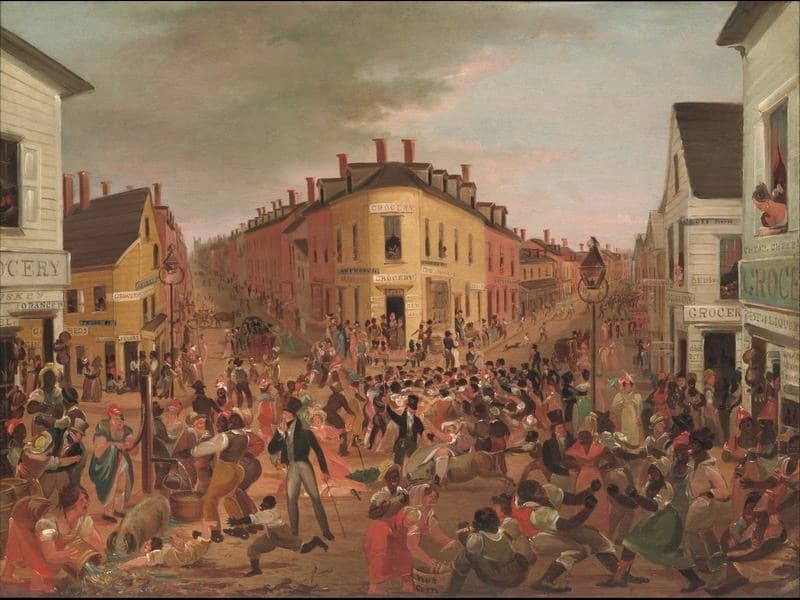
The Five Points
Unknown Artist, ca. 1827
This watercolor depicts the Five Points, a notorious New York slum district in the 1820s. The chaotic street scene shows the difficult conditions and social disorder that characterize the early stages of breakthrough.
Wilhelm Commentary
Richard Wilhelm's classic translation and interpretation
The Judgment
Times of growth are beset with difficulties. They resemble a first birth. But these difficulties arise from the very profusion of all that is struggling to attain form. Everything is in motion: therefore if one perseveres there is a prospect of great success, in spite of the existing danger. When it is a man's fate to undertake such new beginnings, everything is still unformed, dark. Hence he must hold back, because any premature move might bring disaster. Likewise, it is very important not to remain alone; in order to overcome the chaos he needs helpers. This is not to say, however, that he himself should look on passively at what is happening. He must lend his hand and participate with inspiration and guidance.
The Image
Clouds and thunder are represented by definite decorative lines; this means that in the chaos of difficulty at the beginning, order is already implicit. So too the superior man has to arrange and organize the inchoate profusion of such times of beginning, just as one sorts out silk threads from a knotted tangle and binds them into skeins. In order to find one's place in the infinity of being, one must be able both to separate and to unite.
First (Bottom) Line
If a person encounters a hindrance at the beginning of an enterprise, he must not try to force advance but must pause and take thought. However, nothing should put him off his course; he must persevere and constantly keep the goal in sight. It is important to seek out the right assistants, but he can find them only if he avoids arrogance and associated with his fellows in a spirit of humility. Only then will he attract those with whose help he can combat the difficulties.
Second Line
We find ourselves beset by difficulties and hindrances. Suddenly there is a turn of affairs, as if someone were coming up with a horse and wagon and unhitching them. This event comes so unexpectedly that we assume the newcomer to be a robber. Gradually it becomes clear that he has no evil intentions but seeks to be friendly and to offer help. But this offer is not to be accepted, because it does not come from the right quarter. We must wait until the time is fulfilled; ten years is a fulfilled cycle of time. Then normal conditions return of themselves, and we can join forces with the friend intended for us. Using the image of a betrothed girl who remains true to her lover in face of grave conflicts, the hexagram gives counsel for a special situation. When in times of difficulty a hindrance is encountered and unexpected relief is offered from a source unrelated to us, we must be careful and not take upon ourselves any obligations entailed by such help; otherwise our freedom of decision is impaired. If we bide our time, things will quiet down again, and we shall attain what we have hoped for.
Third Line
If a man tries to hunt in a strange forest and has no guide, he loses his way. When he finds himself in difficulties he must not try to steal out of them unthinkingly and without guidance. Fate cannot be duped; premature effort, without the necessary guidance, ends in failure and disgrace. Therefore the superior man, discerning the seeds of coming events, prefers to renounce a wish rather than to provoke failure and humiliation by trying to force its fulfillment.
Fourth Line
We are in a situation in which it is our duty to act, but we lack sufficient power. However, an opportunity to make connections offers itself. It must be seized. Neither false pride nor false reserve should deter us. Bringing oneself to take the first step, even when it involves a certain degree of self- abnegation, is a sign of inner clarity. To accept help in a difficult situation is not a disgrace. If the right helper is found, all goes well.
Fifth Line
An individual is in a position in which he cannot so express his good intentions that they will actually take shape and be understood. Other people interpose and distort everything he does. He should then be cautious and proceed step by step. He must not try to force the consummation of a great undertaking, because success is possible only when general confidence already prevails. It is only through faithful and conscientious work, unobtrusively carried on, that the situation gradually clears up and the hindrance disappears.
Sixth (Top) Line
The difficulties at the beginning are too great for some persons. They get stuck and never find their way out; they fold their hands and give up the struggle. Such resignation is the saddest of all things. Therefore Confucius says of this line: "Bloody tears flow: one should not persist in this. "