艮
Gèn — Keeping Still
upper trigram
艮Mountain (Stillness)lower trigram
艮Mountain (Stillness)The Judgment
其背。不獲其身。行其庭。不見其人。无咎。
Character-by-character gloss
Modern Interpretation
Keeping his back still so that he no longer feels his body. He goes into his courtyard and does not see his people. No blame. True quiet means keeping still when the time has come to keep still, and going forward when the time has come to go forward. Rest and movement in agreement with the demands of the time—thus there is light in life. When the movement of the spinal nerves is brought to a standstill, the ego with its restlessness disappears. When calm, you may turn to the outside world. You no longer see struggle and tumult but have that peace of mind needed for understanding the great laws of the universe.
The Image
兼山,艮。君子以思不出其位。
Character-by-character gloss
Modern Interpretation
Mountains standing close together. Do not permit your thoughts to go beyond your situation. The heart thinks constantly. This cannot be changed, but thoughts should restrict themselves to the immediate situation. All thinking that goes beyond this only makes the heart sore.
「兼山,艮。」兩座山並排而立。象辭說君子「思不出其位」——不讓思想超出自己的處境。心總是在想,這改變不了。但思緒應該限制在眼前的情況。想太遠的事,只會讓心痛苦。這話聽起來消極,但往往是真的。
The Six Lines
First (Bottom) Line
初六 艮其趾。无咎。利永貞。
Modern Interpretation
Keeping his toes still. No blame. Continued persistence furthers. Halting before you have even begun to move. The beginning is the time of few mistakes—still in harmony with primal innocence. Not yet influenced by obscuring interests and desires, you see things intuitively as they really are. Halt at the beginning, and you find the right way. But persisting firmness is needed to keep from drifting irresolutely.
Second Line
六二 艮其腓。不拯其隨。其心不快。
Modern Interpretation
Keeping his calves still. He cannot rescue the one he follows. His heart is not glad. The leg cannot move independently; it depends on the body's movement. If a leg is suddenly stopped while the whole body moves vigorously, the continuing motion will cause a fall. The same is true of serving a master stronger than yourself. You are swept along; even though you halt on the path of wrongdoing, you can no longer check the other in their powerful movement.
Third Line
九三 艮其限。列其夤。厲熏心。
Modern Interpretation
Keeping his hips still. Making his sacrum stiff. Dangerous. The heart suffocates. Enforced quiet. The restless heart is subdued by forcible means. But fire smothered changes into acrid smoke that suffocates. In meditation and concentration, don't try to force results. Calmness must develop naturally out of inner composure. Artificial rigidity leads to unwholesome results.
Fourth Line
六四 艮其身。无咎。
Modern Interpretation
Keeping his trunk still. No blame. Though able to keep the ego with its thoughts and impulses at rest, you are not yet quite liberated from its dominance. Nonetheless, keeping the heart at rest is an important function, leading in the end to complete elimination of egotistic drives. Though not yet free from dangers of doubt and unrest, this frame of mind is not a mistake.
Fifth Line
六五 艮其輔。言有序。悔亡。
Modern Interpretation
Keeping his jaws still. The words have order. Remorse disappears. In a dangerous situation where you are not adequate, the inclination is to be very free with talk and presumptuous jokes. But injudicious speech easily leads to situations giving much cause for regret. If reserved in speech, your words take ever more definite form, and every occasion for regret vanishes.
Sixth (Top) Line
上九 敦艮吉。
Modern Interpretation
Noblehearted keeping still. Good fortune. Consummation of the effort to attain tranquility. At rest not merely in small, circumscribed ways regarding matters of detail, but with a general resignation regarding life as a whole. This confers peace and good fortune in relation to every individual matter.
Yilin Verse
From the Forest of Changes (焦氏易林) — 艮 Gèn (Keeping Still)
君孤獨處,單弱无輔,名曰困苦。
The lord sits alone in solitude, weak and without support; its name is called hardship and suffering.
Full explanation
Twin mountains stand doubled into absolute stillness — the same hexagram returns to itself. The ruler dwells in isolation, alone and without support; this condition is called suffering. When Gen transforms into Gen, nothing changes: the mountain remains the mountain, and the person who stops remains stopped. There is no release, no new energy, no complementary force to break the stasis. From Keeping Still to Keeping Still, the image is pure recursion. The verse names this plainly: solitude without allies, weakness without reinforcement, the name of which is hardship. The mountain's great virtue is knowing when to stop, but when stopping is the only option and the only outcome, virtue curdles into mere endurance.
Masterpiece
A work of art reflecting this hexagram's essence
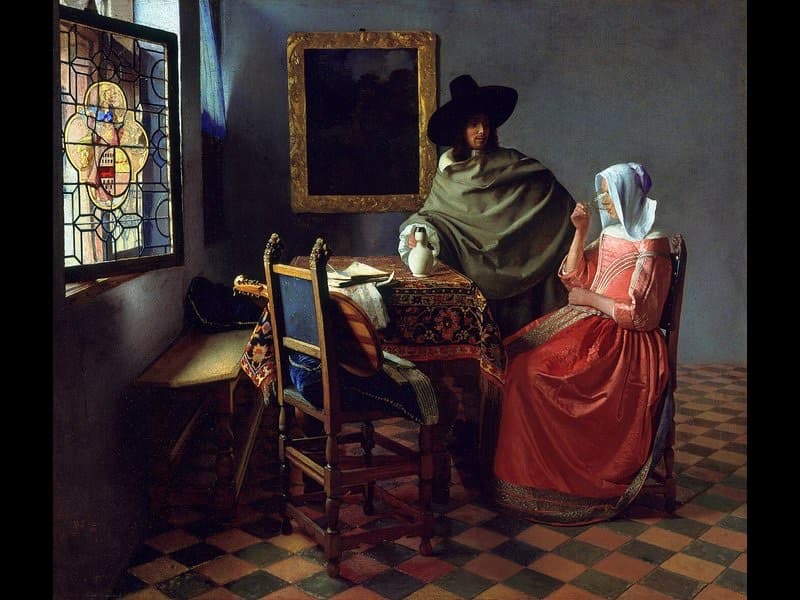
Girl with a Wine Glass
Johannes Vermeer, 1660
Moment of stillness and restraint in social interaction.
Wilhelm Commentary
Richard Wilhelm's classic translation and interpretation
The Judgment
True quiet means keeping still when the time has come to keep still, and going forward when the time has come to go forward. In this way rest and movement are in agreement with the demands of the time, and thus there is light in life. The hexagram signifies the end and the beginning of all movement. The back is named because in the back are located all the nerve fibers that mediate movement. If the movement of these spinal nerves is brought to a standstill, the ego, with its restlessness, disappears as it were. When a man has thus become calm, he may turn to the outside world. He no longer sees in it the struggle and tumult of individual beings, and therefore he has that true peace of mind which is needed for understanding the great laws of the universe and for acting in harmony with them. Whoever acts from these deep levels makes no mistakes.
The Image
The heart thinks constantly. This cannot be changed, but the movements of the heart–that is, a man's thoughts–should restrict themselves to the immediate situation. All thinking that goes beyond this only makes the heart sore.
First (Bottom) Line
Keeping the toes still means halting before one has even begun to move. The beginning is the time of few mistakes. At that time one is still in harmony with primal innocence. Not yet influenced by obscuring interests and desires, one sees things intuitively as they really are. A man who halts at the beginning, so long as he has not yet abandoned the truth, finds the right way. But persisting firmness is needed to keep one from drifting irresolutely.
Second Line
The leg cannot move independently; it depends on the movement of the body. If a leg is suddenly stopped while the whole body is in vigorous motion, the continuing body movement will make one fall. The same is true of a man who serves a master stronger than himself. He is swept along, and even though he may himself halt on the path of wrongdoing, he can no longer check the other in his powerful movement. Where the master presses forward, the servant, no matter how good his intentions, cannot save him.
Third Line
This refers to enforced quiet. The restless heart is to be subdued by forcible means. But fire when it is smothered changes into acrid smoke that suffocates as it spreads. Therefore, in exercises in meditation and concentration, one ought not to try to force results. Rather, calmness must develop naturally out of a state of inner composure. If one tries to induce calmness by means of artificial rigidity, meditation will lead to very unwholesome results.
Fourth Line
As has been pointed out above in the comment on the Judgment, keeping the back at rest means forgetting the ego. This is the highest stage of rest. Here this stage has not yet been reached: the individual in this instance, though able to keep the ego, with its thoughts and impulses, in a state of rest, is not yet quite liberated from its dominance. Nonetheless, keeping the heart at rest is an important function, leading in the end to the complete elimination of egotistic drives. Even though at this point one does not yet remain free from all the dangers of doubt and unrest, this frame of mind is not a mistake, as it leads ultimately to that other, higher level.
Fifth Line
A man in a dangerous situation, especially when he is not adequate to it, is inclined to be very free with talk and presumptuous jokes. But injudicious speech easily leads to situations that subsequently give much cause for regret. However, if a man is reserved in speech, his words take ever more definite form, and every occasion for regret vanishes.
Sixth (Top) Line
This marks the consummation of the effort to attain tranquillity. One is at rest, not merely in a small, circumscribed way in regard to matters of detail, but one has also a general resignation in regard to life as a whole, and this confers peace and good fortune in relation to every individual matter.