漸
Jiàn — Development
upper trigram
巽Wind (Penetrating)lower trigram
艮Mountain (Stillness)The Judgment
女歸吉。利貞。
Character-by-character gloss
Modern Interpretation
The maiden is given in marriage. Good fortune. Persistence furthers. A tree on a mountain develops slowly according to the law of its being and consequently stands firmly rooted. Development proceeds gradually, step by step. Within is tranquility guarding against precipitate actions; without is penetration making development and progress possible. The very gradualness of development makes persistence necessary—persistence alone prevents slow progress from dwindling to nothing.
The Image
山上有木,漸。君子以居賢德善俗。
Character-by-character gloss
Modern Interpretation
On the mountain, a tree. Abide in dignity and virtue to improve the mores. The tree on the mountain is visible from afar; its development influences the entire region. It does not shoot up like a swamp plant—growth proceeds gradually. Work on influencing people can only be gradual. No sudden influence or awakening has lasting effect. Progress must be quite gradual, and for such progress, personality must acquire influence and weight through careful and constant work on moral development.
「山上有木,漸。」山上的樹遠遠就能看見,它的發展影響整個地區的景觀。它不像沼澤裡的植物那樣猛長。象辭說君子「居賢德善俗」——通過自己的德行來改善風俗。影響人心只能是漸進的。任何突然的影響或覺醒都不會持久。這話說起來慢,但往往是真的。
The Six Lines
First (Bottom) Line
初六 鴻漸于干。小子厲有言。無咎。
Modern Interpretation
The wild goose gradually draws near the shore. The young son is in danger. There is talk. No blame. The shore is the first resting place. A lonely young person just starting out to make their way in life. Since no one comes to help, first steps are slow and hesitant, surrounded by danger. Naturally there is much criticism. But these very difficulties keep you from being too hasty, and progress is successful.
Second Line
六二 鴻漸于磐。飲食衎衎。吉。
Modern Interpretation
The wild goose gradually draws near the cliff. Eating and drinking in peace and concord. Good fortune. The cliff is a safe place on shore. Development has gone a step further. Initial insecurity is overcome, a safe position found, giving enough to live on. This first success brings joyousness. One goes to meet the future reassured. The wild goose calls to its comrades when it finds food—symbol of peace and concord in good fortune.
Third Line
九三 鴻漸于陸。夫征不復。婦孕不育。凶。利禦寇。
Modern Interpretation
The wild goose gradually draws near the plateau. The man goes forth and does not return. The woman carries a child but does not bring it forth. Misfortune. It furthers one to fight off robbers. The high plateau is dry and unsuitable. Gone too far, contrary to the law of development. If you plunge too rashly into a struggle by your own choice, misfortune results. But if you don't willfully provoke conflict and confine yourself to vigorously maintaining your position, all goes well.
Fourth Line
六四 鴻漸于木。或得其桷。无咎。
Modern Interpretation
The wild goose gradually draws near the tree. Perhaps it will find a flat branch. No blame. A tree is not a suitable place for a wild goose. But if clever, it will find a flat branch on which it can get a footing. Life often brings you into inappropriate situations where it's difficult to hold your own. Being sensible and yielding enables you to discover a safe place, though surrounded by danger.
Fifth Line
九五 鴻漸于陵。婦三歲不孕。終莫之勝。吉。
Modern Interpretation
The wild goose gradually draws near the summit. For three years the woman has no child. In the end nothing can hinder her. Good fortune. In a high position, one easily becomes isolated. You are misjudged by the very person on whom you depend. This is the work of deceitful persons who have wormed their way in. Relationships remain sterile; nothing is accomplished. But in further development, misunderstandings are cleared away, reconciliation achieved after all.
Sixth (Top) Line
上九 鴻漸于陸。其羽可用為儀。吉。
Modern Interpretation
The wild goose gradually draws near the cloud heights. Its feathers can be used for the sacred dance. Good fortune. Life comes to its end. Work stands completed. The path rises high toward heaven, like wild geese leaving the earth far behind, keeping strict formation. If their feathers fall, they can serve as ornaments in sacred temple dances. The life of one who has perfected themselves is a bright light for the people of earth, who look up to them as an example.
Yilin Verse
From the Forest of Changes (焦氏易林) — 漸 Jiàn (Gradual Progress)
別離分散,長子從軍,稚叔就賊,寡老獨居,莫為種瓜。
Parted and scattered in separation. The eldest son goes to war; the youngest follows the rebels. Widowed and old, dwelling alone; do not bother planting melons.
Full explanation
Wind over mountain returns to itself: Development meets Development, the goose landing where it took flight. Separation and dispersal mark the scene: the eldest son joins the army, the youngest brother falls in with bandits, the aged widow dwells alone, and no one remains to plant the melons. When Development turns upon itself, the gradual process reveals its shadow: slow departure becomes permanent dissolution. Each family member drifts further along a different trajectory until the household is empty. From Development to Development, the pattern intensifies rather than resolves. The wild goose that advances step by step here scatters the flock in every direction. Gradual separation, compounded over time, leaves the planter with no one to harvest.
Masterpiece
A work of art reflecting this hexagram's essence
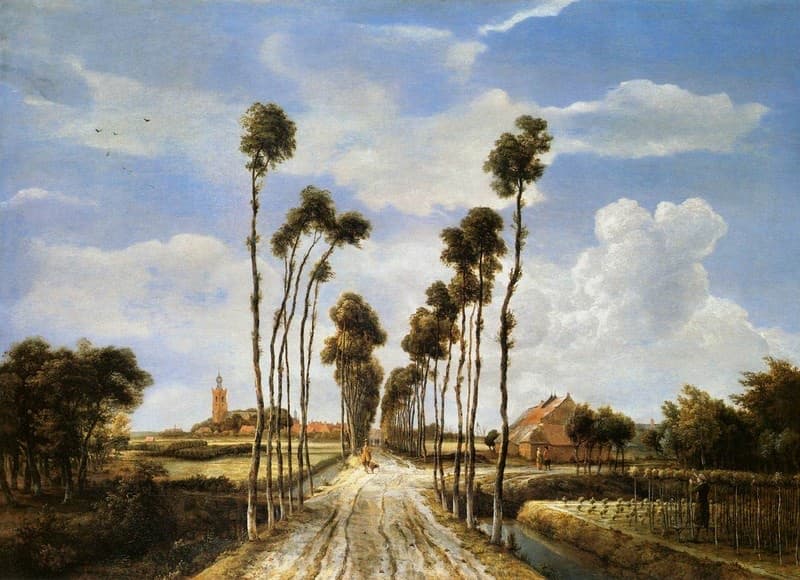
The Avenue at Middelharnis
Meindert Hobbema, 1689
Dutch Golden Age painter Hobbema depicts a tree-lined country road near Middelharnis with precise linear perspective. The tall, slender trees recede gradually into the distance, marking measured stages along the path. This visual progression through successive markers embodies Gradual Progress, step by step advancement along a clear route.
Wilhelm Commentary
Richard Wilhelm's classic translation and interpretation
The Judgment
The development of events that leads to a girl's following a man to his home proceeds slowly. The various formalities must be disposed of before the marriage takes place. This principle of gradual development can be applied to other situations as well; it is always applicable where it is a matter of correct relationships of co-operation, as for instance in the appointment of an official. The development must be allowed to take its proper course. Hasty action would not be wise. This is also true, finally, of any effort to exert influence on others, for here too the essential factor is a correct way of development through cultivation of one's own personality. No influence such as that exerted by agitators has a lasting effect. Within the personality too, development must follow the same course if lasting results are to be achieved. Gentleness that is adaptable, but at the same time penetrating, is the outer form that should proceed from inner calm. The very gradualness of the development makes it necessary to have perseverance, for perseverance alone prevents slow progress from dwindling to nothing.
The Image
The tree on the mountain is visible from afar, and its development influences the landscape of the entire region. It does not shoot up like a swamp plant; its growth proceeds gradually. Thus also the work of influencing people can be only gradual. No sudden influence or awakening is of lasting effect. Progress must be quite gradual, and in order to obtain such progress in public opinion and in the mores of the people, it is necessary for the personality to acquire influence and weight. This comes about through careful and constant work on one's own moral development.
First (Bottom) Line
All the individual lines in this hexagram symbolize the gradual flight of the wild goose. The wild goose is the symbol of conjugal fidelity, because it is believed that this bird never takes another mate after the death of the first. The initial line suggests the first resting place in the flight of water birds from the water to the heights. The shore is reached. The situation is that of a lonely young man who is just starting out to make his way in life. Since no one comes to help him, his first steps are slow and hesitant, and he is surrounded by danger. Naturally he is subjected to much criticism. But these very difficulties keep him from being too hasty, and his progress is successful.
Second Line
The cliff is a safe place on shore. The development has gone a step further. The initial insecurity has been overcome, and a safe position in life has been found, giving one enough to live on. This first success, opening up a path to activity, brings a certain joyousness of mood, and one goes to meet the future reassured. It is said of the wild goose that it calls to its comrades whenever it finds food; this is the symbol of peace and concord in good fortune. A man does not want to keep his good luck for himself only, but is ready to share it with others.
Third Line
The high plateau is dry and unsuitable for the wild goose. If it goes there, it has lost its way and gone too far. This is contrary to the law of development. It is the same in human life. If we do not let things develop quietly but plunge of our own choice too rashly into a struggle, misfortune results. A man jeopardizes his own life, and his family perishes thereby. However, this is not all necessary; it is only the result of transgressing the law of natural development. If one does not willfully provoke a conflict, but confines himself to vigorously maintaining his own position and to warding off unjustified attacks, all goes well.
Fourth Line
A tree is not a suitable place for a wild goose. But if it is clever, it will find a flat branch on which it can get a footing. A man's life too, in the course of its development, often brings him into inappropriate situations, in which he finds it difficult to hold his own without danger. Then it is important to be sensible and yielding. This enables him to discover a safe place in which life can go on, although he may be surrounded by danger.
Fifth Line
The summit is a high place. In a high position one easily becomes isolated. One is misjudged by the very person on whom one is dependent–the woman by her husband, the official by his superior. This is the work of deceitful persons who have wormed their way in. The result is that relationships remain sterile, and nothing is accomplished. But in the course of further development, such misunderstandings are cleared away, and reconciliation is achieved after all.
Sixth (Top) Line
Here life comes to its end. A man's work stands completed. The path rises high toward heaven, like the flight of wild geese when they have left the earth far behind. There they fly, keeping to the order of their flight in strict formation. And if their feathers fall, they can serve as ornaments in the sacred dance pantomimes performed in the temples. Thus the life of a man who has perfected himself is a bright light for the people of earth, who look up to him as an example.