既濟
Jì Jì — After Completion
upper trigram
坎Water (Danger)lower trigram
離Fire (Clinging)The Judgment
亨小。利貞。初吉。終亂。
Character-by-character gloss
Modern Interpretation
Success in small matters. Persistence furthers. At the beginning good fortune, at the end disorder. The transition from the old to the new time is already accomplished. In principle, everything stands systematized, and it is only in regard to details that success is still to be achieved. We must be careful to maintain the right attitude. Everything proceeds as if of its own accord, and this can all too easily tempt us to relax and let things take their course without troubling over details. Such indifference is the root of all evil. Symptoms of decay are bound to be the result. This is the rule indicating the usual course of history. But this rule is not an inescapable law. He who understands it can avoid its effects through unremitting perseverance and caution.
The Image
水在火上,既濟。君子以思患而豫防之。
Character-by-character gloss
Modern Interpretation
Water over fire. Take thought of misfortune and arm yourself against it in advance. When water in a kettle hangs over fire, the two elements stand in relation and generate energy. But the resulting tension demands caution. If the water boils over, the fire is extinguished and its energy lost. If the heat is too great, the water evaporates. These elements brought into relation are by nature hostile to each other. Only the most extreme caution can prevent damage. In life too there are junctures when all forces are in balance and everything seems in the best of order. In such times only the sage recognizes the moments that bode danger and knows how to banish it by means of timely precautions.
「水在火上,既濟。」水在鍋裡,掛在火上——兩個元素相互作用,產生能量。但這種張力需要謹慎。水滾過頭,火會被澆滅;火太旺,水會蒸發。這兩者本性相剋,只有極度的小心才能防止損害。人生也有這樣的時刻,一切力量平衡,看似完美。只有有智慧的人能認出潛藏的危險,並提前採取措施。
The Six Lines
First (Bottom) Line
初九 曳其輪。濡其尾。无咎。
Modern Interpretation
He brakes his wheels. He gets his tail in the water. No blame. In times following a great transition, everything is pressing forward in the direction of development and progress. But this pressing forward at the beginning is not good; it overshoots the mark and leads with certainty to loss and collapse. Therefore a person of strong character does not allow themselves to be infected by the general intoxication but checks their course in time. He may not remain altogether untouched by disastrous consequences, like a fox that at the last minute gets its tail wet, but will not suffer any real harm because behavior has been correct.
Second Line
六二 婦喪其茀。勿逐。七日得。
Modern Interpretation
The woman loses the curtain of her carriage. Do not run after it; on the seventh day you will get it. Especially in times 'after completion,' those who have come to power grow arrogant and conceited and no longer trouble themselves about fostering new talent. We are warned: do not seek it. Do not throw yourself away on the world, but wait tranquilly and develop your personal worth by your own efforts. Times change. That which is your own cannot be permanently lost. It comes to you of its own accord. You need only be able to wait.
Third Line
九三 高宗伐鬼方。三年克之。小人勿用。
Modern Interpretation
The Illustrious Ancestor disciplines the Devil's Country. After three years he conquers it. Inferior people must not be employed. After times of completion, when a new power has arisen and everything within the country has been set in order, a period of colonial expansion almost inevitably follows. Long-drawn-out struggles must be reckoned with. A correct colonial policy is especially important. The territory won at such bitter cost must not be regarded as an almshouse for people who have made themselves impossible at home.
Fourth Line
六四 繻有衣袽。終日戒。
Modern Interpretation
The finest clothes turn to rags. Be careful all day long. In a time of flowering culture, an occasional convulsion is bound to occur, uncovering hidden evil within society. Since the situation is favorable on the whole, such evils can easily be glossed over and concealed from the public. Then everything is forgotten and peace apparently reigns complacently. However, to the thoughtful person, such occurrences are grave omens that should not be neglected. This is the only way of averting evil consequences.
Fifth Line
九五 東鄰殺牛。不如西鄰之禴祭。實受其福。
Modern Interpretation
The neighbor in the east who slaughters an ox does not attain as much real happiness as the neighbor in the west with his small offering. In divine worship, the simple old forms are replaced by ever more elaborate ritual and ever greater outward display. But inner seriousness is lacking in this show of magnificence; human caprice takes the place of conscientious obedience to the divine will. Man sees what is before his eyes; God looks into the heart. Therefore a simple sacrifice offered with real piety holds a greater blessing than an impressive service without warmth.
Sixth (Top) Line
上六 濡其首。厲。
Modern Interpretation
He gets his head in the water. Danger. After crossing a stream, your head can get into the water only if you are so imprudent as to turn back. As long as you go forward and do not look back, you escape this danger. But there is a fascination in standing still and looking back on a peril overcome. Such vain self-admiration brings misfortune. It leads only to danger, and unless you finally resolve to go forward without pausing, you fall victim to this danger.
Yilin Verse
From the Forest of Changes (焦氏易林) — 既濟 Jì Jì (After Completion)
玄兔指掌,與足相恃。謹訊詰問,誣情自直。冤死誰告,口為身禍。
The black rabbit points with its paw, hand and foot accusing each other. Careful interrogation and questioning; false charges straighten themselves out. Who will tell the wrongly dead? The mouth brings disaster to the body.
Full explanation
Water sits above fire — After Completion returning to itself. The dark hare points with its paw, relying on its feet for support. Under rigorous interrogation, false accusations are straightened out on their own. Yet the unjustly dead have no one to appeal to, for the mouth that should speak becomes the body's undoing. The verse oscillates between justice and its failure: inquiry can expose falsehood, but sometimes truth arrives too late, after the innocent are already dead. The mouth — instrument of both testimony and self-incrimination — is the pivot. From After Completion to After Completion, the hexagram meets its own mirror. There is no transformation, only the completed order confronting its own internal contradictions: the system that can both vindicate and destroy.
Masterpiece
A work of art reflecting this hexagram's essence
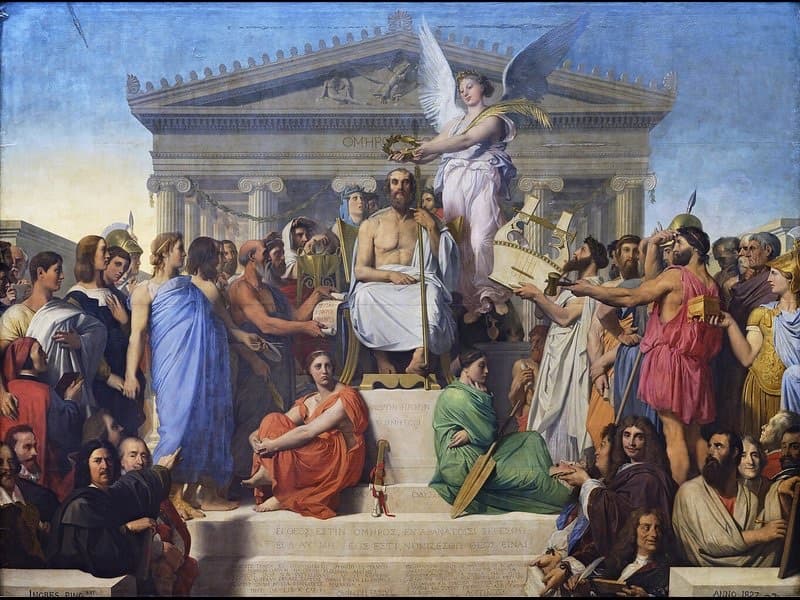
The Apotheosis of Homer
Jean-Auguste-Dominique Ingres, Unknown
Ingres crowned Homer on the steps of an Ionic temple, surrounded by symmetrically arranged great artists and thinkers. Commissioned for the Louvre, this academic history painting celebrates cultural order achieved. After Completion (Ji Ji) describes a moment when all elements are properly aligned—Ingres presents an idealized hierarchy of artistic achievement in balanced neoclassical composition.
Wilhelm Commentary
Richard Wilhelm's classic translation and interpretation
The Judgment
The transition from the old to the new time is already accomplished. In principle, everything stands systematized, and it is only in regard to details that success is still to be achieved. In respect to this, however, we must be careful to maintain the right attitude. Everything proceeds as if of its own accord, and this can all too easily tempt us to relax and let things take their course without troubling over details. Such indifference is the root of all evil. Symptoms of decay are bound to be the result. Here we have the rule indicating the usual course of history. But this rule is not an inescapable law. He who understands it is in position to avoid its effects by dint of unremitting perseverance and caution.
The Image
When water in a kettle hangs over fire, the two elements stand in relation and thus generate energy (cf. the production of steam). But the resulting tension demands caution. If the water boils over, the fire is extinguished an its energy is lost. If the heat is too great, the water evaporates into the air. These elements here brought into relation and thus generating energy are by nature hostile to each other. Only the most extreme caution can prevent damage. In life too there are junctures when all forces are in balance and work in harmony, so that everything seems to be in the best of order. In such times only the sage recognizes the moments that bode danger and knows how to banish it by means of timely precautions.
First (Bottom) Line
In times following a great transition, everything is pressing forward, striving in the direction of development and progress. But this pressing forward at the beginning is not good; it overshoots the mark and leads with certainty to loss and collapse. Therefore a man of strong character does not allow himself to be infected by the general intoxication but checks his course in time. He may indeed not remain altogether untouched by the disastrous consequences of the general pressure, but he is hit only from behind like a fox that, having crossed the water, at the last minute gets its tail wet. He will not suffer any real harm, because his behavior has been correct.
Second Line
When a woman drove out in her carriage, she had a curtain that hid her from the glances of the curious. It was regarded as a breach of propriety to drive on if this curtain was lost. Applied to public life, this means that a man who wants to achieve something is not receiving that confidence of the authorities which he needs, so to speak, for his personal protection. Especially in times "after completion" it may happen that those who have come to power grow arrogant and conceited and no longer trouble themselves about fostering new talent. This as a rule results in office seeking. If a man's superiors withhold their trust from him, he will seek ways and means of getting it and of drawing attention to himself. We are warned against such an unworthy procedure: "Do not seek it. " Do not throw yourself away on the world, but wait tranquilly and develop your personal worth by your own efforts. Times change. When the six stages of the hexagram have passed, the new era dawns. That which is a man's own cannot be permanently lost. It comes to him of its own accord. He need only be able to wait.
Third Line
"Illustrious Ancestor" is the dynastic title of the Emperor Wu Ting of the Yin dynasty. After putting his realm in order with a strong hand, he waged long colonial wars for the subjection of the Huns who occupied the northern borderland with constant threat of incursions. The situation described is as follows. After times of completion, when a new power has arisen and everything within the country has been set in order, a period of colonial expansion almost inevitably follows. Then as a rule long-drawn-out struggles must be reckoned with. For this reason, a correct colonial policy is especially important. The territory won at such bitter cost must not be regarded as an almshouse for people who in one way or another have made themselves impossible at home, but who are thought to be quite good enough for the colonies. Such a policy ruins at the outset any chance of success. This holds true in small as well as large matters, because it is not only rising states that carry on a colonial policy; the urge to expand, with its accompanying dangers, is part and parcel of every ambitious undertaking.
Fourth Line
In a time of flowering culture, an occasional convulsion is bound to occur, uncovering a hidden evil within society and at first causing a great sensation. But since the situation is favorable on the whole, such evils can easily be glossed over and concealed from the public. Then everything is forgotten and peace apparently reigns complacently once more. However, to the thoughtful man, such occurrences are grave omens that he does not neglect. This is the only way of averting evil consequences.
Fifth Line
Religious attitudes are likewise influenced by the spiritual atmosphere prevailing in times after completion. In divine worship the simple old forms are replaced by an ever more elaborate ritual and an ever greater outward display. But inner seriousness is lacking in this show of magnificence; human caprice takes the place of conscientious obedience to the divine will. However, while man sees what is before his eyes, God looks into the heart. Therefore a simple sacrifice offered with real piety holds a greater blessing than an impressive service without warmth.
Sixth (Top) Line
Here in conclusion another warning is added. After crossing a stream, a man's head can get into the water only if he is so imprudent as to turn back. As long as he goes forward and does not look back, he escapes this danger. But there is a fascination in standing still and looking back on a peril overcome. However, such vain self-admiration brings misfortune. It leads only to danger, and unless one finally resolves to go forward without pausing, one falls a victim to this danger.