鼎
Dǐng — The Caldron
upper trigram
離Fire (Clinging)lower trigram
巽Wind (Penetrating)The Judgment
元吉。亨。
Character-by-character gloss
Modern Interpretation
Supreme good fortune. Success. The well relates to the social foundation of life; the caldron refers to the cultural superstructure. Wood serves as nourishment for the flame, the spirit. All that is visible must grow beyond itself, extend into the realm of the invisible. The highest earthly values must be sacrificed to the divine. But the truly divine manifests in prophets and holy people. To venerate them is true veneration. Accept their revealed will in humility—this brings inner enlightenment and true understanding.
The Image
木上有火,鼎。君子以正位凝命。
Character-by-character gloss
Modern Interpretation
Fire over wood. Consolidate your fate by making your position correct. The fate of fire depends on wood; as long as there is wood below, the fire burns above. In human life, there is likewise a fate that lends power to your life. If you assign the right place to life and to fate, bringing the two into harmony, you put your fate on a firm footing.
「木上有火,鼎。」火的命運取決於木頭——有木頭在下面,火才能在上面燃燒。人的生命也是這樣,有某種東西在支撐著它。象辭說「正位凝命」——把位置擺對,命運才會穩固。這種對齊,好像是要一直調整的。
The Six Lines
First (Bottom) Line
初六 鼎顛趾。利出否。得妾以其子。无咎。
Modern Interpretation
A ting with legs upturned. Furthers removal of stagnating stuff. Taking a concubine for the sake of her son. No blame. Turning the ting upside down before use clears it of refuse. In highly developed civilization, every person of good will can succeed. No matter how lowly, provided you're ready to purify yourself, you are accepted. You attain a station where you can prove yourself fruitful.
Second Line
九二 鼎有實。我仇有疾。不我能即。吉。
Modern Interpretation
There is food in the ting. My comrades are envious, but they cannot harm me. Good fortune. In a period of advanced culture, achieving something significant is of the greatest importance. Concentrate on real undertakings, and you may experience envy and disfavor, but that is not dangerous. The more you limit yourself to actual achievements, the less harm the envious inflict.
Third Line
九三 鼎耳革。其行塞。雉膏不食。方雨虧悔。終吉。
Modern Interpretation
The handle of the ting is altered. One is impeded in their way of life. The fat of the pheasant is not eaten. Once rain falls, remorse is spent. Good fortune comes in the end. No one notices or recognizes you. Good qualities and gifts of mind go to waste. But if you possess something truly spiritual, the time will come when difficulties resolve and all goes well. Rain symbolizes release of tension.
Fourth Line
九四 鼎折足。覆公餗。其形渥。凶。
Modern Interpretation
The legs of the ting are broken. The prince's meal is spilled and his person is soiled. Misfortune. A difficult and responsible task to which you are not adequate. Moreover, you don't devote yourself to it with all your strength but go about with inferior people. Therefore the execution of work fails. Confucius says: 'Weak character coupled with honored place, meager knowledge with large plans, limited powers with heavy responsibility—this will seldom escape disaster.'
Fifth Line
六五 鼎黃耳金鉉。利貞。
Modern Interpretation
The ting has yellow handles, golden carrying rings. Persistence furthers. In a ruling position, a person who is approachable and modest in nature. This attitude helps find strong and able helpers who complement and aid the work. Having achieved this attitude requiring constant self-abnegation, it is important to hold to it and not be led astray.
Sixth (Top) Line
上九 鼎玉鉉。大吉。无不利。
Modern Interpretation
The ting has rings of jade. Great good fortune. Nothing that would not act to further. Jade combines hardness with soft luster. Counsel works greatly to the advantage of the one who is open to it. In imparting it, be mild and pure, like precious jade. The work finds favor and becomes pleasing to all.
Yilin Verse
From the Forest of Changes (焦氏易林) — 鼎 Dǐng (The Cauldron)
積德之至,君政且溫,伊呂股肱,國富民安。
Virtue accumulated to its fullest; the lord's governance is gentle and warm. Yi Yin and Lu Shang serve as the sovereign's arms and legs; the state is rich and the people at peace.
Full explanation
Fire over wind fills the cauldron — and the cauldron transforms into itself, the purest expression of its own nature. Accumulated virtue reaches its zenith; the ruler governs with warmth and wisdom. Yi Yin and Lu Shang serve as the sovereign's right arms, and the nation grows rich while the people rest secure. Yi Yin, the cook who became Shang's founding minister, and Lu Shang (Taigong), the fisherman who became Zhou's founding strategist, represent the ideal of sage-ministers discovered in humble circumstances and elevated through merit. From The Cauldron to The Cauldron, the identity transformation signifies perfection: the vessel fulfills its own nature completely. The cauldron that cooks also governs — fire over wind, refining the offering until nothing remains but nourishment itself.
Masterpiece
A work of art reflecting this hexagram's essence
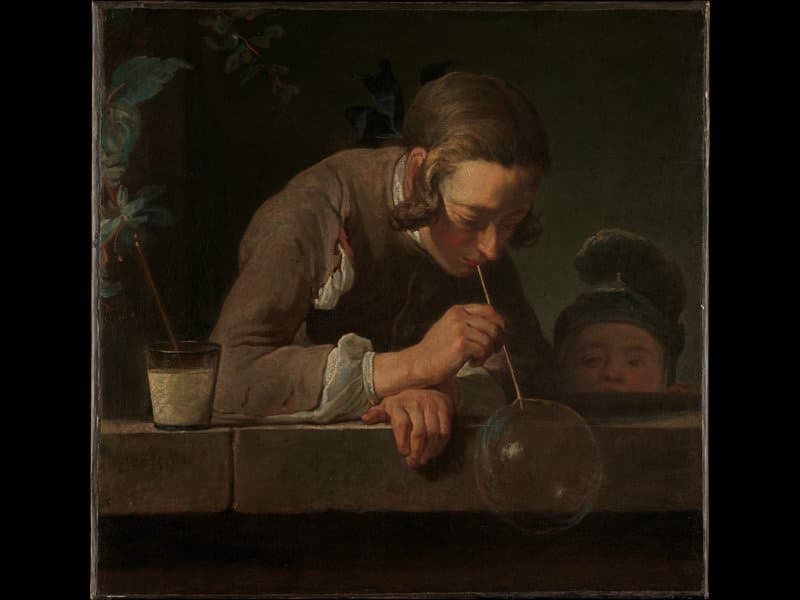
Soap Bubbles
Chardin, Unknown
Jean-Baptiste-Siméon Chardin's genre painting shows a young boy blowing soap bubbles, a traditional vanitas motif in Dutch and French art. The fragile, temporary bubble serves as a vessel or container that holds air momentarily before bursting, relating to The Caldron's function as a ritual vessel that transforms and nourishes through careful tending and proper form.
Wilhelm Commentary
Richard Wilhelm's classic translation and interpretation
The Judgment
While THE WELL relates to the social foundation of our life, and this foundation is likened to the water that serves to nourish growing wood, the present hexagram refers to the cultural superstructure of society. Here it is the wood that serves as nourishment for the flame, the spirit. All that is visible must grow beyond itself, extend into the realm of the invisible. Thereby it receives its true consecration and clarity and takes firm root in the cosmic order. Here we see civilization as it reaches its culmination in religion. The ting serves in offering sacrifice to God. The highest earthly values must be sacrificed to the divine. But the truly divine does not manifest itself apart from man. The supreme revelation of God appears in prophets and holy men. To venerate them is true veneration of God. The will of God, as revealed through them, should be accepted in humility; this brings inner enlightenment and true understanding of the world, and this leads to great good fortune and success.
The Image
The fate of fire depends on wood; as long as there is wood below, the fire burns above. It is the same in human life; there is in man likewise a fate that lends power to his life. And if he succeeds in assigning the right place to life and to fate, thus bringing the two into harmony, he puts his fate on a firm footing. These words contain hints about the fostering of life as handed on by oral tradition in the secret teachings of Chinese yoga.
First (Bottom) Line
If a ting is turned upside down before being used, no harm is done–on the contrary, this clears it of refuse. A concubine's position is lowly, but because she has a son she comes to be honored. These two metaphors express the idea that in a highly developed civilization, such as that indicated by this hexagram, every person of good will can in some way or other succeed. No matter how lowly he may be, provided he is ready to purify himself, he is accepted. He attains a station in which he can prove himself fruitful in accomplishment, and as a result he gains recognition.
Second Line
In a period of advanced culture, it is of the greatest importance that one should achieve something significant. If a man concentrates on such real undertakings, he may indeed experience envy and disfavor, but that is not dangerous. The more he limits himself to his actual achievements, the less harm the envious inflict on him.
Third Line
The handle is the means for lifting up the ting. If the handle is altered, the ting cannot be lifted up and used, and, sad to say, the delicious food in it, such as pheasant fat, cannot be eaten by anyone. This describes a man who, in a highly evolved civilization, finds himself in a place where no one notices or recognizes him. This is a severe block to his effectiveness. All of his good qualities and gifts of mind thus needlessly go to waste. But if he will only see to it that he is possessed of something truly spiritual, the time is bound to come, sooner or later, when the difficulties will be resolved and all will go well. The fall of rain symbolizes here, as in other instances, release of tension.
Fourth Line
A man has a difficult and responsible task to which he is not adequate. Moreover, he does not devote himself to it with all his strength but goes about with inferior people; therefore the execution of the work fails. In this way he also incurs personal opprobrium. Confucius says about this line: "Weak character coupled with honored place, meager knowledge with large plans, limited powers with heavy responsibility, will seldom escape disaster. ""Weak character coupled with honored place, meager knowledge with large plans, limited powers with heavy responsibility, will seldom escape disaster. "
Fifth Line
Here we have, in a ruling position, a man who is approachable and modest in nature. As a result of this attitude he succeeds in finding strong and able helpers who complement and aid him in his work. Having achieved this attitude, which requires constant self-abnegation, it is important for him to hold to it and not to let himself be led astray.
Sixth (Top) Line
In the preceding line the carrying rings are described as golden, to denote their strength; here they are said to be of jade. Jade is notable for its combination of hardness with soft luster. This counsel, in relation to the man who is open to it, works greatly to his advantage. Here the counsel is described in relation to the sage who imparts it. In imparting it, he will be mild and pure, like precious jade. Thus the work finds favor in the eyes of the Deity, who dispenses great good fortune, and becomes pleasing to men, wherefore all goes well.